

Brandmerry Blog Archives

How to Boost Your Confidence and Increase Brand Awareness
Visibility (aka showing up) is a non-negotiable as a business owner, but it's not always easy. Learn my top tips for improving your confidence so you can show up online.

How to Boost Your Confidence and Increase Brand Awareness
BY MICHELLE KNIGHT
As I wrap up creating 90 days of content both for Youtube and the Brandmerry Podcast, I started to think more about visibility and showing up online.
You can watch an entire vlog I created about the process here.
The thing with visibility and creating content is it’s not easy, and it took me months to build up the confidence to even show up online to promote my business.
But, this confidence is absolutely essential if you want to not only build an online community of warm leads, but also lead your audience through the buying process so they become a paying customer.
Today, I want to talk about getting visible, and how you build up the confidence to show up.
I've been doing this long enough and I work with a lot of new entrepreneurs, people who aren't super familiar with social media or don't feel comfortable with social media or afraid to use video or don't want to look stupid in a reel or don't want to send an email because it's not perfect.
There are so many things that are keeping us from showing up and growing our audience, but more importantly, nurturing our audience and making the sale, that we can move through.
However, I know you can move through those beliefs and I’m sharing five ways to do that with you today.
5 WAYS TO BOOST YOUR CONFIDENCE AND GET VISIBLE
I made a list of five things to share with you on how to boost your confidence and start getting visible online so you can make that money.
Make the money, make the impact, go out and get it, because visibility is a non-negotiable.
You’ve got to show up.
Number One: It's Bigger Than You
When it comes to visibility and showing up in marketing in general, you have to understand that it's bigger than you.
When I was first starting, I kept asking myself, "But why do people care? What if I sound like an idiot? What if this is not correct? What if nobody shows up?"
I kept saying all these different things like, "What if, what if, what if, what if?"
Then one time, when creating content, I sat down and thought to myself, What if this is not actually about me?
It was at this moment that my branding shifted, because for a long time I thought branding was 100% about me and what I did, and we know now that it's not. It is about your audience. It has to be about your audience.
You are in this to make money. You are in this to make an impact. If you're just talking about yourself all damn day, your audience isn't going to be able to resonate with you. There's going to be no connection.
Everything you share, even when you're sharing stories about yourself, you must ask yourself the following questions:
Who is this for?
What will my ideal customer get from this?
How is this going to support them?
Otherwise, you're just showing up to show up and talk about yourself and that won’t move your business forward.
So one of the first things that I started to ask myself was, "What is the bigger picture?" and that, I think really ties into your mission. In the first episode of the Brandmerry Podcast, I shared with you a mission-driven business.
You can go back and listen to that episode and get really clear on what the mission is behind your business. It's always bigger than you. It's the impact that you are ultimately going to make. So the first step is identifying the mission.
The second step is really switching your focus, switching your thinking when it comes to visibility. Remove you from the equation.
You are the vessel, right?
You are the one that is delivering the information, carrying out the mission.
That's it.
When we start to recognize that it's so much bigger than just us showing up, and it's about the message and the mission and the impact that we are going to make, that will give you the motivation to show up and increase your visibility.
That's number one, big picture.
Number Two: Have a Plan
Now, notice I didn't say be prepared because I think this whole idea of being prepared fluctuates and can be different for every single person.
For those of us, who are recovering perfectionists, working on it every damn day, you're never prepared. You're never prepared because of perfection. It's a vicious cycle, so it's not about being prepared and having all your ducks in a row.
You can never have everything perfectly lined up and perfectly ready to go. You need to record videos, and you're like, "Ooh, I need this perfect background, and I gotta paint my wall, and I gotta have wallpaper, and I’ve got to get the perfect outfit, and I have to have this perfect boom mic and this perfect ring."
No, you don't need to have any of those things, so it's not about being prepared because your ratio of what is prepared could be crazy compared to what is actually required.
But it is about having a plan. You’ve got to know how you're going to show up and when you're going to show up.
This is going to allow you to actually do the damn thing because you will keep postponing it over and over and over and over again if you don't plan for it. Something will always come up. It always does. There will always be an obstacle or an objection or something that you're like, "Oh, can't do it today. No, today's not the day. No, I'm not ready."
Create a plan.
When are you going to post your first blog post?
When are you going to create your first video?
Have you been thinking about reels?
Have you been saving reels to your phone and you just keep waiting and you're like, "Oh, I don't know"?
Put it on the damn calendar.
Create a plan of action. If you’re in your first year of business it feels like you’re throwing spaghetti at a wall. Shit, I'd argue your first, second, and third year, too! It kind of feels like that.
It's like we're just throwing stuff and seeing if it sticks, but even though that's like a really good analogy, there still has to be a plan in place.
What the hell are you throwing on the wall?
What are you wanting to stick?
You've got to know these things. Otherwise, you really are just mindlessly floating around the internet. So having a plan will actually support you in getting visible and being confident in showing up.
Knowing what you're going to talk about on a video before you hit live or record, will take the pressure off. It doesn't mean you have to have the perfect script, it doesn't mean you have to have the perfect microphone, but have a game plan and get it scheduled.
If you’re looking for my tips to create a plan for your content calendar, watch this video here.
Number Three: Choose Your Platformu
When it comes to visibility, showing up, and nurturing your audience, you want to choose one platform and one medium to start.
We know with niching down, especially the more specific you are, the more streamlined you are, same with your offers, the more specific you are, the less you have when you're starting out, the faster you will grow. Because your attention is not pulled in a million different directions.
When you're just starting out and you're really struggling to just get started and just get the confidence to go do something, don't stretch yourself so thin. Start with one area.
When I was first starting, Facebook was super comfortable for me because I spent all my time on Facebook back in the day. I'd never run a business there, I never had a business page, but I was comfortable with the platform. That's why I decided to start there.
I also love video so I decided to just create a lot of live videos as this was something new Facebook was offering at the time.
I did frequent challenges. I would do multiple videos a week sometimes, and that is what I focused on, and that is how I signed most of my clients.
Then, I started to get a little bit more confident and decided to venture to Instagram. I hated it at first, it felt like a lot of pressure, but I was also excited about it and knew I had the capacity to take it on. So, I practiced, I refined, and I figured out what worked for me. I got good at writing captions and so on and so forth.
You don't have to do it all at once. A visibility plan doesn't mean that you're showing up everywhere under the damn sun.
If you're really struggling to gain confidence, then pick a platform where you know your ideal customer is, pick a medium, and really focus on that. Now, as you start to expand, of course, there are ways that you can repurpose your content, which is still something that I do today. It's a huge staple inside of Brandmerry Academy.
With a repurposing plan, you can start to find your main core medium, and then kind of push your content out from there.
For me, it's still video, all these years later, so I really encourage you to simplify, strip it down, think about the main platform and the main medium that your audience is on. Practice. Get yourself out there. Do the work.
Find what works. Find what doesn't work. Really dedicate your time and energy to it, because you're going to get confident as you do it. That's the secret. You get confident the more you do it, so why not laser in and focus on one thing, get really confident on that, and then watch that snowball?
I used to tell my clients that it is literally like a snowball rolling down a hill, right? It starts really, really small, and then it starts to get bigger, and the momentum picks up, and that's essentially what visibility is.
You're going to start small, it's going to feel really, really slow, it's going to feel insignificant, and you're going to start to pick up momentum the more that you do it and the more that you focus on where your reach is going to expand.
Number Four: Identify the Value
This kind of circles back to number one, where we discussed the point of showing up. Why are you doing this in the first place?
This particular point is about each individual piece of content. So before I record a live video, I always sit down and identify what I want my audience to walk away with.
Before I record a podcast, I sit down and identify what I want my audience to walk away with.
Before I create a social media post, I'm like, "What the hell is in it for my audience?"
If you can identify the value before delivering the content, it's going to take the pressure off of you.
Your mindset starts to shift and you start to realize…
...This isn't 100% about me. It doesn't matter how I look. It doesn't matter exactly what I say. As long as I deliver the value piece, we’re golden.
So make sure that you're taking the time to identify that.
Now, I recommend that a lot of my clients do that in the content planning process, but you can absolutely just sit down right before you hit record or right before you write the post and connect back to the value and what you want to provide with that piece of content.
I'm telling you, it seems incredibly simple, but it's a game-changer.
Number Five: Practice
That leads us to number five, which I already kind of told you, but we can still hang out here and talk about it a little bit more...practice.
If you listen to any entrepreneur, public figure, athlete, they will tell you that they boost their confidence and skill set by continuing to do it over and over and over again.
I had an amazing client inside of Brandmerry Academy the other day and she asked, "How did you get so confident on camera? How are you able to just speak really fluidly?"
My response was that I’ve done so many videos. That was the medium I chose in the beginning and I wanted to do it as much as possible to become incredibly confident at it.
I remember when I recorded my first podcast episode, and my husband can probably attest to this, I re-recorded it over and over and over again because it just didn’t feel like enough.
Now, I've recorded a lot of episodes and I just sit down and record it. Mistakes and all, I'm here for it.
The confidence comes by doing, and I think that's the irony of the entire thing. People wait, and maybe you're waiting, to be confident to get started, but you're only going to get confident by getting started.
Think about it.
Your confidence will grow the more you do it, and that's why all these things build on each other.
CONCLUSION
I know there is something you’ve been waiting to do, or holding off on until you’re ready. YOU ARE READY NOW.
Go through this process and tips I’ve just outlined, because visibility is non-negotiable as a business owner, and it's so fun to connect with people as you grow your business.
Show up, share your value, and connect with your audience. That's the fun part for me about content creation.
Yes, I love new leads. I love when people discover me and my brand, and that's part of the equation, but more than anything I love when people are like, "Watched last week's video and loved it."
"Watched this week's video and it was amazing. Love listening to your podcasts."
That's why I'm doing it, and because we're business owners, you're also going to make more money. Let's not sugar-coat it.
We want to see you.
We want to hear your message.
One of the things that I said really early on, on a podcast just by accident, and it has stuck with me ever since, is “Someone, somewhere needs to hear your message!”
So just remember that. You're just speaking to someone, just one person, that's it. If one person gets your story, gets in touch with you, you did your job.
If you’re looking for more support with your marketing, I suggest you check out my free training. I’m teaching you how to master your marketing without social media and you can sign up here to access it.

- FREE GIFTS YOU'LL LOVE -



DISCOVER YOUR BRAND STORY IN UNDER 5 MINUTES
LEARN HOW TO WRITE AN ‘ABOUT ME’ PAGE THAT CONVERTS
MAP OUT 30 DAYS OF CONTENT IN UNDER AN HOUR
- READ THE LATEST POSTS -






MEET MICHELLE
Hey there, I'm Michelle Knight and I an online branding and marketing consultant for female entrepreneurs.
I believe in the power of storytelling and using that superpower to brand and market yourself online...oh and to set yourself free.
I'm obsessed with living a life of freedom, so much so, that my family and I now travel full-time while running my business from the road.
This blog serves as a home base for all things branding, marketing, content creation and more.

Online Business Tip: Is There a Secret?
Is there a secret to running an online business? While I don't believe it's a single strategy, template or checklist, I do believe there is a secret sauce. Find out on the blog.
BY MICHELLE KNIGHT

The context and inspiration for this blog came to me on my morning Peloton ride.
I then found myself scrolling on social media, which doesn’t happen very often, and came across an ad, marketing, after marketing, after marketing, that was talking about quick results in business.
Some of the language was 10K in 10 days. We're all familiar with that. And it got me really thinking about what I wanted to share with you on this topic. So that led us to the secret sauce in business.
Which, if you know me, you know there isn’t a very specific, copy and paste, universally used secret sauce that you might be looking for.
It doesn't exist. But, when I was riding on my Peloton yesterday, Cody Rigsby, my favorite instructor on the Peloton app kept saying, "Do the work, do the work, do the work."
And I started thinking maybe that's the secret sauce.
Maybe the secret sauce isn't some brand new strategy, or this template, or this platform, or this launch messaging.
Maybe the secret sauce is doing the work.
When you look at the entrepreneurs, and the business owners, and the brands that see results maybe quickly, maybe in three months, six months, maybe in a year, you can see that the thing that connects them is that they're willing to do the work.
They're willing to show up. They're consistently showing up and doing the work. They're committed to doing the work. They don't shy away from it.
So since this isn't a very, "Hey, apply this to your business and go make 10K in 10 days,” strategy, I wanted to break it down for you.
What does doing the work look like?
How do you do the work?
And what are some things that you need to keep in mind?
What is The Work?
What am I talking about when I say “the work?”
There are four key pieces that I believe require you to show up and dedicate time and energy to as a business owner.
Some of them, you do it once. You don't need to circle back to it very often. Maybe every year, every two years, depending on your business.
Some of them are ongoing.
FOUR PILLARS OF A SUSTAINABLE BUSINESS
PILLAR ONE: Clarity on Your Business Goals
How do you know what work to do and how to measure the impact of the work that you're doing if you have nothing to measure it against?
If you don't have goals, if you don't know why you're showing up every day and doing the workaround, what your end result is, then you're constantly going to feel like you're just busy.
And when I say do the work, I don't mean busy work. I don't mean piddle over here and change this color over here, and change this font over here. And let me update this page that nobody visits anyways over here.
I mean do the strategic work.
To figure out what that is, you have to first start with your goals. The first thing you need to identify is what you are moving towards. And that will allow you to reverse engineer and set those goals.
Recently, I released a YouTube video on planning six months in your business. In that video I break down how to look at the big picture and reverse engineer, to break it down into smaller more manageable steps; the same applies to all goals!
The first goal is to get clear and specific with your goals. And just like we learned in school, make them measurable. If they're not measurable, how are you going to know your progress? You're not going to know how things are working out for you and this measurable piece is going to play a role in the kind of work you ultimately do (more on that later).
PILLAR TWO: Brand Foundations
The second piece of doing the work is your brand foundations.
If you want to grow scalable and sustainable, meaning you're not losing your mind in the process, online business, you have to have a solid foundation. Newsflash, you have to have a solid foundation for everything in life. Anything that you want to keep growing or scaling, there has to be a solid foundation.
In an online business, that just happens to be your brand.
When we're building the brand foundations, we're focused on your niche. We're focused on your ideal customer, focused on your messaging, and focused on your offer. I believe that your offer is part of the branding process because when you have this early on you can create your marketing plan to match. And then, of course, that emotional branding component, which plays into the aesthetics.
Now here's the beautiful thing about this work. This is not work that you do every day, every week, every month. You take the time and dedication to do the work around your brand foundations, build that solid foundation and then determine how often you want to revisit it.
Is it once a year?
Are you going to be rebranding?
Do you need to go back to it and freshen it up? That's one of those things that's not constantly changing. And that's why it's important to dedicate the work to it right from the get-go.
I love to have my clients give themselves a deadline. In my course, You! Branded, we encourage clients to complete it in three weeks, so make that a frame for you to show up and do the work. Do the work, the worksheets. And then implement it in your own life. And then we get to move on, but it is essential.
If you want to learn more about You! Branded, head here.
PILLAR THREE: Set Up Systems
I keep hearing all these entrepreneurs talk about how incredibly stressful scaling is because they never had systems in place.
If you know me, you know that I'm all about systems. And I credit that to the fact that I've been able to have a small team for so many years. That I was able to do most things by myself for a long time when I couldn't necessarily invest in team members and be a woman, and a mother, and show up for myself.
It always came back to my systems, and these systems have continued to serve me as a business owner and continued to serve as we scale.
When it comes to setting up your systems, here are some things to consider.
Think about your client onboarding and the process that you go through to bring on a new client. What does this look like for your business?
I have a blog and video available if you need inspiration.
When you think about this, can you automate any of it?
Are you manually scheduling your clients?
Are you manually sending out invoices and contracts?
What does that look like?
Take some time to look at your business and see where you can streamline and automate things to improve your overall systems.
What about your workflow?
Do you know how you’re creating content every single week in your business?
Is it a copy, repeat, copy, repeat, copy, repeat type of system? To the point where you have it set up in a task management software. And when you mark it as complete, it kicks it to the next week.
What about your SOPs?
How do you do things in your business? When it's just you and you're just getting started, document what you're doing.
If someone's a new client, what's the process?
What do you do?
Do you send them an invoice first, a contract?
Do you email them?
Do they get tagged with anything?
Just start documenting that in a Google Doc or a Word doc, so when you hire team members, you just get to hand them that information.
I think so many entrepreneurs skip over the systems piece of it and find themselves feeling overwhelmed with the process. Everything can be streamlined, even if it can’t be automated.
And this pillar is ongoing. I'll be honest with you. They're going to be updated. You're going to create new systems as you expand and as you do new things.
But this is an area where you've got to sit down and do the work.
PILLAR FOUR: Marketing
And then we come to one of my favorite topics, the ongoing, happens every day in your business. Even if it's automated, it's still happening every single day, whether you are manually posting it or not.
And that's marketing.
That is getting people familiar, introducing them to your brand. Building trust with them. Telling them about your offers. Then continuing to show up and serve them even after they become a client, yes that is also part of the marketing strategy.
This area is ongoing, and this area requires your commitment, and your dedication, and your consistency.
Don't look for an easy out when it comes to your marketing. If someone comes to me and says, "I'm just looking for a way where I don't have to do any marketing. I don't want to market."
I'm like, "You're going to have an issue as a business owner. You're going to have a really hard time."
The first step is to create a clear marketing strategy.
How often are you creating content?
What platforms are you showing up on?
What is your weekly workflow?
How are you repurposing your content?
What are the core pillars and topics that you're talking about?
You can set those up, and you can say I'm going to dedicate 30 to 60 or 90 days to this strategy.
I recommend a minimum of 30. I try to push for 90 days now because I know sometimes, it just takes a little bit of momentum and testing. But give yourself a clear period of dedication and commitment.
The reason for this is the consistency will show you want needs to be improved upon. You need to do the work to know what to change. There is always work to be done with your marketing.
One of the biggest myths that I see entrepreneurs believing is that automation means they don’t have to do anything. I believed it for way too long.
We think that if we are creating a course or creating a funnel, we're automating something in our business that we make, and we get to walk away from it. And we never need to worry about it again. And that is so far from the truth.
Once your automation has been optimized, it will help with consistent revenue in your business, depending on what that automation is. But it doesn't mean that you don't have to check in on it. It doesn't mean that you don't have to look at the data. It doesn't mean that you don't have to make changes. You absolutely do.
It’s so important to choose a simplified marketing strategy, like the one we teach inside of Brandmerry Academy, and implement it for at least 30 days to know what should be improved upon.
HOW DO YOU DO THE WORK
So nothing is just done. It's always evolving. So how can you do the work more efficiently?
Let's talk about that. I've got five key pieces that I want you to walk away with today.
How do you actually do the work?
What are the things you need to keep in mind?
NUMBER ONE: Make Time For It
Schedule a very specific time to make your business a priority so that your business becomes a priority. On the flip side of that, schedule a very specific time to make your business a priority so it doesn't interfere with your other priorities.
I'm a big fan of scheduling every part of my business because it allows me freedom.
An example of this is what I just wrapped up doing. I prepared 90 days of content. It's something like 16 videos and 18 podcasts.
The reason I'm putting in the time and the energy and I am committed to doing this is because I'm going to be in Greece for three months. I want to work 10 hours or less every single week and still hit my monthly minimum cash goal.
So I am making time to do the work. I am scheduling early mornings on Saturday because that's what I want to do so I have all this extra free time. I'm scheduling every little thing in my calendar. I'm scheduling my workouts. I'm doing all of that.
So make time to do the work. Schedule it or you won't do it.
We'll keep pushing it off and saying, "I'll do it later. I'll do it later. I'll do it in two weeks, whatever." And then finally you're like, "Wow, okay. I haven't done any of that." So now I have to spend tons of time going back through that process.
NUMBER TWO: Set Clear Objectives
So this is kind of a piggyback of what I shared in the first part, which is all about clarity on your business goals.
How do you know what work to do if you don't know where you're going? It's all reverse engineering. That is the best strategy for a business owner.
Where are you headed? Now break it down step-by-step in how you're going to get there.
When you're talking about the step-by-step, set clear objectives for yourself. This will help you know how the work is playing out. So you might be doing something and you might be doing it consistently and you're like, "Man. I just don't know if this is working."
Look at the data.
Let the data drive your decisions.
What does the data say? And then make adjustments. But you don't know how to shift things, or change things, or know if that particular thing isn't working anymore unless you have clear objectives.
NUMBER THREE: Be Open to Evolution
Be open to things changing. All automations, as I mentioned before, will need adjustments and changes to keep optimizing. We have to be open to looking for those small shifts.
We can't be stuck in our ways as marketers. We have to be open to change, and new opportunities and switching things up.
Going back to the clear objectives, those will tell you when it's time to switch things up. It doesn't have to be a guessing game. Marketing is not a guessing game.
It's based on data.
NUMBER FOUR: Test
The fourth piece of doing the work is giving yourself plenty of time to test things. Stop saying, "I'm going to work for 48 hours and see how it goes." Going back, we don't have enough data. We can't decide off of just 48 hours of work.
So you have to give yourself time to test the work that you're doing.
Let’s say you want to test Reels. You know how fun and engaging they can be and you’re looking for more reach in your business.
Do one reel every day for 30 days. Now that's some testing. Especially for a platform that changes every five hours.
Let’s say you want to start blogging and see how it impacts your SEO ranking.
Make it a point to blog every single week, once a week for 60 days.
You've got to be willing to test. That is part of doing the work.
NUMBER FIVE: Evaluate
Finally, and I think what brings all of this together, is evaluation.
Put your marketing lens on, look at the data. Look at the time that you were testing, and evaluate what's happening with the work. Remember, this isn't about busywork. I'm not saying sit down and just work for eight hours.
We're talking about that commitment and that clarity on the work.
What specifically are you working towards?
How can you measure the progress that you're taking?
And then be open to evaluating and making those changes as well. If you are not open to evaluating, I really think that's how people get burnt out. Because it's like you just continue to walk into a wall over, and over, and over, and over again when there's a door and another avenue like right next to you.
We're just like, "I'm just doing the work. I'm just being busy. I'm just working today. I'm going to work every single day on my business." But we need to be intentional with the work that we're doing.
The only way that we can be intentional is through this process of having clear objectives, of being open to things changing and modifying based on the data, to give yourself time to test.
And of course evaluate, evaluate, evaluate. And see not only what's working based on the data, but also how does it feel?
DATA-DRIVEN DECISIONS IN MARKETING
We talked about measurable goals. Let those be an indicator for the work, and also what needs to be adjusted based on the work.
Let’s say your webinar is in one week and you want 100 people on the webinar.
How can you show up and do the work?
What haven't you tried?
What haven't you done?
Where could you give a little bit more?
These are the types of evaluations that we have to be making.
So when you're first starting as a beginner, what can help determine where to focus your energy is where and how do you enjoy showing up online?
What comes a little bit more naturally to you?
I'm not saying it's easy. You have to be uncomfortable a little bit, you don’t just want to take the easy route, but what would you enjoy the most.
For myself, this was video. Even early on, it worked with my schedule. I didn't have to write a bunch of stuff. I could just show up, deliver content, repurpose it. This worked for my business because my audience loves video and I love making it.
Where is your audience? Where are they spending their time and their energy the most?
Where do you enjoy showing up? What medium?
If you need permission to focus on one area, here it is!
That's one of the reasons that we decided to drip the content inside of Brandmerry Academy every 30 days, because I didn't want someone jumping into the academy and saying, "I'm going to do SEO, Pinterest, and this all in 30 days."
No. It's not going to work. It's going to be so hard.
When I first started, everyone was on Instagram, but Instagram intimidated the crap out of me. I did not want to edit photos. I was stressed about choosing the right photos.
What if the photo is not good enough? I was nervous about it all.
So I just went all-in on Facebook and Facebook groups. That's all that I did in the beginning. Not my favorite strategy and not what I recommend today. But five years ago, it definitely was. Video was just getting started on Facebook at the time and it made sense to focus on one area.
So that's all I did. And I would think about going on Instagram. And I would maybe dabble a little bit. And then I'd back off a little bit.
Then, when I felt solid in my Facebook strategy I looked for ways to repurpose my content on Instagram. Then Pinterest was of interest to me and I hired someone to take that on because I didn’t want to add more to my plate.
Remember work does not mean busy work.
CONCLUSION
Speaking of doing the work, I’ve done a lot for you!
I’ve compiled all my favorite lessons inside of this free eBook that I put together for you, where I am sharing the 15 lessons to propel your online business. It's really the ultimate guide of shit I wish someone would have told me.
I talk about a lot of the elements that I see holding entrepreneurs back from reaching the income level and the impact that they desire. And as you can probably imagine, I made the same mistakes.
So whether you're just thinking of starting your business or you're three or four years into it, I recommend that you head to brandmerry.com/lessons to download your free eBook.
Because even if you get one little golden nugget from this eBook, I know it is going to support you in achieving your goals in 2021. Head to brandmerry.com/lessons to download your free eBook today.
This is only available for a limited time.
- FREE GIFTS YOU'LL LOVE -
DISCOVER YOUR BRAND STORY IN UNDER 5 MINUTES
LEARN HOW TO WRITE AN ‘ABOUT ME’ PAGE THAT CONVERTS
MAP OUT 30 DAYS OF CONTENT IN UNDER AN HOUR
- READ THE LATEST POSTS -
MEET MICHELLE
Hey there, I'm Michelle Knight and I an online branding and marketing consultant for female entrepreneurs.
I believe in the power of storytelling and using that superpower to brand and market yourself online...oh and to set yourself free.
I'm obsessed with living a life of freedom, so much so, that my family and I now travel full-time while running my business from the road.
This blog serves as a home base for all things branding, marketing, content creation and more.

How to Create a 90-day Content Calendar for Your Blog
What if I told you that you could plan 90 days of content with ease in just a few days?! The content creation hacks I'm sharing with you in this video will help you find your content ideas, plan your content ideas and feel confident in the content creation process. Think of this as a mini-training on content creation strategy!

Is planning your content creation for 90 days really possible?
I know right now you might be thinking, "Absolutely not. It is a goal. It is an aspiration, but I'm barely doing 30 days."
So we are going to remove the overwhelm, remove the mystery, and talk about the system to have in place to plan out your content for 90 days.
This question comes up a lot from my free community all the way to my paying clients who are constantly like, "How the heck do you create content?"
It all starts with a plan.
This blog (and video if you want to watch it here) is perfect timing.
I got this idea in June of 2021 that I really wanted to test my willpower and see how powerful my planning really was and I wanted to batch create 90 days worth of content within a two-week period so that I could thoroughly enjoy myself in Greece. Not to mention wifi is very unreliable and I didn't want to deal with that. I learned a lot living in an RV.
Now, I'm not recommending that that's where you start. No way am I recommending that you just start planning and creating 90 days worth of content right out of the gate, but I want to share with you how I'm able to do it.
It's the exact same system that I've used to create weekly content, 30 days’ worth of content and now 90 days’ worth of content.
It all comes back to this plan and this system so you can use it to get your content out into the world.
90-Day Content Creation Plan
STEP ONE: Create Your Repurposing Plan
Step number one is to create your repurposing plan.
Now, if you didn't already know this about us over here at Brandmerry, we are big fans of repurposing. It has also floated around with my clients that I should change my name to Repurposing Queen because I'm so obsessed with it.
This need for repurposing came out of building my business while working a nine-to-five, being at home with my son, and then trying to be this whole entrepreneur thing. I realized I could not create fresh content every single day, but I did want to show up every single day.
So that really introduced me to the art of repurposing, something I talk about in-depth in this video right here, where I actually break down the entire planning process of your repurposing workflow. If you don't know what I'm talking about, this video is going to support you in building your plan.
So the base of your content system is your weekly workflow or repurposing plan.
What I mean by that is: What is your core piece of content? You need to know this in order to plan out 90 days worth of content.
For instance, for a really long time, my core piece of content was a live video that I did on Facebook and Instagram. I would go live every Monday, I would take that content, turn it into a blog post, I would push that out on Pinterest, I would share it in my Insta Stories, I would create an IGTV, and then I would create various posts throughout the week that talked about the same topic that I talked about on Monday.
That's the art of repurposing. Think of it like a web and all of these other platforms coming out of that.
As my business grew, I started creating pre-recorded content that we could do 30 days in advance. We would repurpose that, transcribe that into a blog post, put it out on Instagram, put it on Facebook, put it out on Pinterest, all the things to where we are today.
I've really mastered the art of repurposing so that I now have two core pieces of content. I have a weekly YouTube video and a podcast, both with completely different content ideas. So I have two new ideas every single week for 90 days. That's a lot. I get it. You do not have to start there.
I recommend just starting with one. When you really think about it, all you're planning for 90 days is one idea every week. Doesn't that make it a lot less overwhelming than thinking about it every seven days? I know it does for me.
The first thing you want to do is determine what your custom repurposing plan looks like. Again, watch this video because that's going to go through the entire process.
STEP TWO: Brainstorm Ideas
Step two is a brain dump of sorts. It's really a brainstorming session that happens every 90 days where you are just dumping ideas for content creation. We're not going to stop here, there's way more strategy involved, but you've got to get the juices flowing.
At this stage, what I recommend is having a very simple spreadsheet where you're just listing out all the different ideas that you can create for your core piece of content.
Now, you want to start to think about launches. Is there anything that you're going to be promoting within the next 90 days? Is there something new that you're going to be offering?
You want to think about any events that are coming up, whether that's within your own business or outside of your business. Think holidays, Black Friday, end-of-the-year sales, those different things.
You also want to start to think about some of the top questions your audience has really been asking you. If there's something you've noticed that people are asking you over and over and over again, it's probably time to deliver some information around that. So you want to use this as a brain dump.
This is also really helpful if you want to conduct some fresh market research, which I talked about in this video right here, where you can take some fresh market research that you've done and put that into your spreadsheet.
You're not thinking too analytical about this process, you're just getting the information out there, and you're letting the juices flow.
At this stage, I also recommend thinking of any content that you could use from live events that you've done. Maybe you did a podcast interview and you haven't shared that out with your community. Think of ways that you could repurpose content that you haven't repurposed. This is really going to help you so it doesn't feel like you're constantly creating fresh content.
In fact, for my podcast, The Brandmerry Podcast, I repurpose live videos that I do on Instagram. I release those recordings weeks later on my podcast and that really helps me because I don't have to just constantly be creating fresh content.

STEP THREE: Plan Your Content
Then the final step, if you haven't done this already, is to put that information on a spreadsheet with your dates and if you want to, you can absolutely start putting this in a task management software.
I personally like to organize my entire spreadsheet before I add it to the task manager because it just saves a lot of time back and forth. The task management software that we love to use is called ClickUp.
At this stage, we are focused on getting the information inside of the spreadsheet. It doesn’t have to be anything fancy, a simple spreadsheet will do.
**If you want to watch this entire process as a screen share, I recommend hopping off of the blog and over to my Youtube channel to watch this video explanation. You can watch this video here.
In the first column you want to have your release dates. So, I release a new Youtube video and blog every Monday. Then again, I release a podcast episode and blog every Thursday.

In the second column you can create a drop down menu with different status of the project. This is just for my end. I'm the main person who uses this spreadsheet. Once everything feels final to me, that's when I upload it or add the information to ClickUp.

At this stage we’re just organizing your spreadsheet with your content ideas you’ve finalized.
We've got the release date.
We have statuses drop down. I just have very, very simple things here: Research, ready for notes, recording, editing, workflow initiated, and posted.
"Workflow initiated" just means that we've input it into ClickUp and it's started its process.
At this stage, I’m also adding the title once it’s been finalized. This is the big piece of the puzzle.
This is the piece of the puzzle that people forget about. I recommend conducting your SEO research at this stage. A lot of people will teach you to wait until you’ve recorded or written your content. But, I recommend figuring it outright at the beginning.
This information is going to help you finalize titles, which is going to play a role in formatting your blog, it's going to play a role in your thumbnails, it's going to play a role in everything.
It'll allow you to finalize your title based on SEO and it's going to allow you to understand what keywords are going to help you, which will also help you in formatting your content as well.
There are two platforms that I prefer to use for SEO research.
The first is called Ubersuggest. I've talked about it multiple times on this blog. You can use a paid version of that, which is what I use, or you can do a few free searches every single day. So you'd have to be really strategic in that week when you're planning it out.
Ubersuggest is a fantastic platform that will allow you to type in the main content idea and then determine, "Hey, what is the search volume? Is it really difficult for me to rank for that?"
You'll see that I have two columns here for that: Search Volume and SEO Difficulty

I don't use these in my business for the podcast and the blog specifically because I've been doing this enough that I know, but a lot of my clients love to put in how much is the search volume and what's the SEO difficulty when they're in that initial stage of modifying their title.
This information can be found using the Ubersuggest tool I mentioned previously.
But you're going to want to do this research to find out if people are actually searching for this. You want to play with your title quite a bit.
For example, I have a podcast titled “Your Brand Values.” For podcast titles, I like to keep the title shorter, but you'll see after I did my SEO research, the title for my blog modified to, “What Are Brand Values and Why Are They Important in Personal Branding?”

Because by doing my SEO research, I was able to find that this was a great combo. "What are brand values?" was a top question that people are asking on Google. Then the keywords of "personal branding" are ones that I always want to rank for, so I added that and made a long-tail keyword.
You'll see how doing the SEO research is incredibly helpful. We know what the podcast titles are going to be. We also know what the blog title is going to be and then I also write my SEO description based on the keywords.
Then you can use this research to also write out your SEO Description.
For the brand values, one we did "Clear brand values are essential as an online brand in 2021 and beyond," and "over to the blog to learn more about what brand values are important and how to find yours." Your SEO description is just more enticing. If someone saw this title on Google, what could you say to them that would get them to click through on your blog?
This research is so important because if you're going to take all the time and the energy to create your content, you want to make sure that people are actually finding it.
Another tool is called Keywords Everywhere. I've talked about that platform before. That's another helpful tool. If you're doing your content on YouTube, the tool that I also love to use is called TubeBuddy.
For podcasting specifically, I won't do a ton of SEO research for the podcast title. That's for my warm audience. I will use Ubersuggest to finalize the blog title.
For YouTube, I will finalize the YouTube title based on the research that I find on TubeBuddy. TubeBuddy is just a tool that you can use that integrates with your YouTube search engine and will help you figure out what you're most likely to rank for based on search volume and competition.
For instance, this six-month planning step-by-step, I think originally my title was “How to Plan Six Months in Your Business”, but it was not giving me a great score, so I played around with it and ended up with “Six-Month Planning Step-by-Step Business Calendar.”
We don't know what we don't know. Let the data tell you what you should name your content. That's why it's important to brain dump all your stuff into a spreadsheet and then go through each of these and finalize the title.
So all in all your spreadsheet will contain the following columns:
Release date
Status (if you want to track this on your end)
Final title (Youtube, podcast, blog, etc) depending on your repurpose plan
SEO Title (if different)
SEO Description
Tags or keywords (tags are used on Youtube)
OPTIONAL: Search Volume and SEO Difficulty
This stage is going to take you a little bit of time in the beginning, but it is 100% worth it because you're putting the pieces in place to make sure that your content is actually discovered.
Again, at this stage, you want to finalize your spreadsheet, finalize your dates, finalize your titles, finalize your SEO, keywords, your descriptions, your titles for your blog, have it all done, because it will help you plan out how you actually create it.
Once you've finished the spreadsheet, then we can move into the next step.
STEP FOUR: Add To Your Task Management Tool
ClickUp is the task management software that we prefer to use. You could also use something like Asana, another very, very popular one with entrepreneurs.
With the weekly workflow, I obviously have a team, so I’m cosigning a lot of different stages of the workflow to my team. However, in the beginning, I too was doing this by myself and I have just found that organizing it in a weekly workflow is incredibly helpful for making sure that things are moving along.
As I've mentioned before, we are repeating our workflow every week. Nothing is changing. Whether you're creating new content every week based on your 90 days of planned content or you're batching it all together, what we're doing for each piece of content stays the same.
Inside of ClickUp, we've created some automation and some templates that we can use.
What I do is dump all of the final titles in the first column. So I'll just pull directly from my spreadsheet, put them all in here as a new task. Then I go through and I pull them either into YouTube or podcast, depending on what they are.
I would do this for each of the pieces of content that I'm going to create. Once I've done that, then I'll pull it to its corresponding piece. My automation will start pulling in the checklist that I have designed and it will also pull in all of our notes and different things like that.
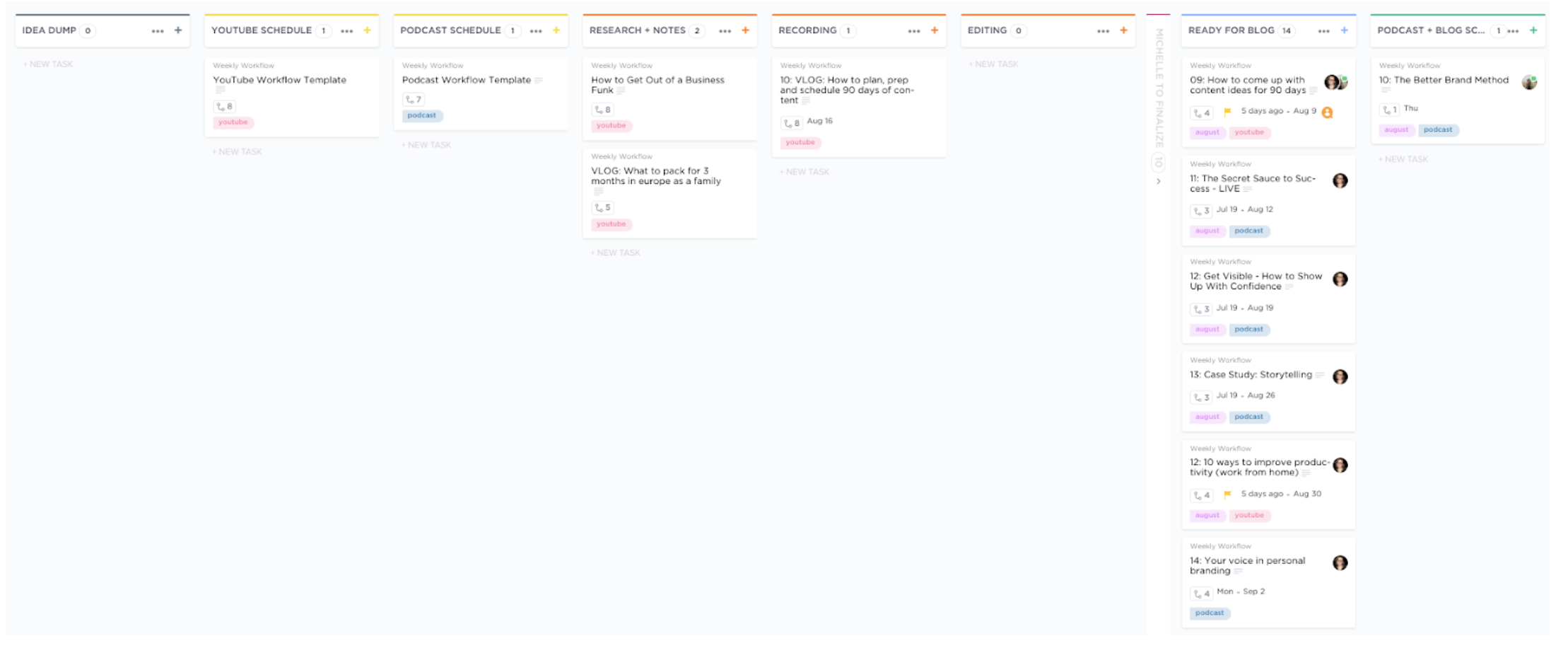
The statuses that we have are:
Idea Dump
Youtube Schedule (this is when the automation kicks in)
Podcast Schedule (this is when the automation kicks in)
Research and Notes
Recording
Editing
Ready for Blog
Youtube + Blog Scheduled
Podcast + Blog Scheduled
Complete
Each of the pieces of content I’m creating becomes a new task and moves through the statuses.
ORGANIZING MY CONTENT
I highly suggest watching this screen share video to see how each task is broken down into a specific workflow.
CONCLUSION
I just gotta tell you, being in it where I'm bulking 90 days worth of content, it is absolutely amazing and will save you so much time and energy.
When you have a system in place, it just makes it that much easier.
Now, the first time that you do this, the process might take a little bit longer. Maybe you're not five years into your business and know your ideal customer like the back of your hand.
Maybe you're just starting out. You're going to get in a rhythm. It's going to start saving you time. But I promise you, if you get into the habit of planning this out 90 days at a time, it's actually going to save you time and energy. If you're trying to come up with topic ideas every single week, you're going to find that you're wasting time.
Do all of your research at once, add it all into a spreadsheet, add it to your task management, and then the final piece of the puzzle is actually scheduling a time when you're going to create the content.
Now, we're focused on planning content right now. I'm not recommending that you sit down and record all your videos in one week. That might be a faraway dream for you, but at least get it on your calendar.
Tell yourself and your Google calendar when you're going to record those podcasts. When are you going to record those videos? When are you going to write those blogs?
When I first started, I did this every Monday. So I knew what I was talking about for 90 days.
Then every Monday I would sit down and I would say either write a blog or I would record my video or I would go live, whatever my core content was at the time, and then I would transcribe and get it on the blog and all of those different things.
I just refined that practice week after week. Then I moved into batch recording for 30 days. Then I moved into 90 days. That became a lot easier when I had a team and we used platforms like rev.com to transcribe. I dive into so much more about repurposing in this video.
I mean, I know I've told you like six times to watch it, but if you haven't, you got to watch it. All this will make sense when you do.
In next week’s video, I’m releasing my first vlog where I document the process of creating all of the content I had planned.
Make sure you head over to the Brandmerry Youtube channel and subscribe so you don’t miss it.
And remember this is just one piece of a solid marketing strategy. So if you’re ready to elevate your marketing strategy and really master the art of online marketing, then check out my free training.
P.S. Planning and creating your content doesn't have to be a constant struggle. There is a better way to research, plan, and create your content as an entrepreneur and it's all inside the Content Planning Blueprint!
The Content Planning Blueprint is perfect for online business owners who know the power of content creation but are tired of spending all of their time coming up with ideas, organizing their content, and wondering what will attract their dream clients.
In just a few hours, you'll have 90 days of content planned, a repeatable workflow to save you hours on creating and distributing your content every week, and content topics that will keep performing for your brand for years to come! Get your blueprint now >>
- FREE GIFTS YOU'LL LOVE -
DISCOVER YOUR BRAND STORY IN UNDER 5 MINUTES
LEARN HOW TO WRITE AN ‘ABOUT ME’ PAGE THAT CONVERTS
MAP OUT 30 DAYS OF CONTENT IN UNDER AN HOUR
- READ THE LATEST POSTS -
MEET MICHELLE
Hey there, I'm Michelle Knight and I an online branding and marketing consultant for female entrepreneurs.
I believe in the power of storytelling and using that superpower to brand and market yourself online...oh and to set yourself free.
I'm obsessed with living a life of freedom, so much so, that my family and I now travel full-time while running my business from the road.
This blog serves as a home base for all things branding, marketing, content creation and more.

What is Branding and How To Build A Personal Brand
Sometimes branding can feel like a mystery, but it's such a crucial step in building an online business. On the blog, I'm sharing what branding is and how to build a better personal brand online.
What is Branding and How To Build A Personal Brand
BY MICHELLE KNIGHT

If you didn’t already know, at Brandmerry, we focus on two key elements for building a business, both branding and marketing. And today I want to share with you a snippet from my free on-demand training called the Build a Better Brand Method.
Inside of this free video training, I share with you the signature framework that I have used to support hundreds of entrepreneurs in building a scalable brand that just feels really f*cking good.
It feels like them.
It's a strong personal brand.
They get to show up and do their thing online in a way that feels amazing.
This free on-demand training is available for you to watch if you go to betterbrandmethod.com, but I thought it would be really fun to give you a little teaser.
I'm going to share with you what personal branding is.
I'm also going to break down my signature branding framework. This is the six-part framework that I teach inside of my program You Branded. Inside of the training, you are getting the entire framework step-by-step, plus what happens at each level and how each level builds to the next.
After you dive into this blog (or listen to the audio above), I encourage you to go to betterbrandmethod.com to sign up for this on-demand training because in addition to what you're hearing today, you are also going to get some amazing content on the training around storytelling, writing your brand messages, doing ideal client work and more.
WHAT IS A BRAND
I want you to start thinking about the brand as the ultimate experience that you are creating for your potential customers.
It's made up of the feeling and the connection that someone has about the experience that you've given them online.
It's made up of the stories, the emotional connection, and different experiences as a whole.
If they watch a video from you, if they see an Instagram post from you, if you have a business, then personal branding allows you to create a deeper, personal connection with your audience that will build trust.
It ultimately goes deeper than just a product or service. Yet, so many people make the mistake of branding around a product or service when they start.
I don't want you to do that because things are going to change within your business over time and you don’t want to have to shift your branding as a result.
Your product or service is not a brand.
A brand needs to be about the business as a whole, the company as a whole, you as a whole showing up as your true self because as we'll learn, purchase decisions are made based on human connection.
They're not made because of that product that you're selling, because I bet you, someone else has the exact same thing.
We all know it's true.
We know what our industry looks like.
But you can stand out and you can become profitable when you focus on building your personal brand.
Think about your brand as the beating heart of your business.
Without it, you won't have anything.
In fact, Richard Branson said, “The way a company brands itself is everything. It will ultimately decide whether or not your business survives.”
So, remember it's essential.

WHY YOUR PERSONAL BRAND IS IMPORTANT
So why is your personal brand important?
We've talked a little bit about it, but let's break down some of the key pieces.
REASON #1 TO CREATE A PERSONAL BRAND FOR YOUR BUSINESS
Your ideal customer is shopping around, right? We all know that. Let's not pretend it's not happening.
It is part of the client buying process.
So why would they choose your product or service over someone else that offers the same thing?
Your brand.
There was a study done by Harvard University that found that we make purchase decisions based on an emotional connection that we feel. So, although we think it is because we list out how many modules are in something, or how many videos they get, or how many calls, someone's made a decision by that point.
That logistical information might help them to commit today, but they've already decided based on a connection.
That's why creating a personal brand is so essential. It allows you to share more story, it allows you to build connections, and they ultimately will move through the buying process faster.
REASON #2 TO CREATE A PERSONAL BRAND FOR YOUR BUSINESS
Branding also impacts every single element of your business.
You cannot have a website without a solid brand.
You cannot show up on social media without a solid brand. You won't know what to say.
You won't know what aesthetics to choose.
You won't know what you're ultimately leading people to.
You can't have a solid marketing strategy without a solid brand, because so much of your marketing strategy relies on your ideal customer and your messaging.
You can't advertise without a solid brand because you won’t know who to target or how best to communicate with them.
Your copy will suck if you don't have a solid brand because your messaging will be less than mediocre and you will not stand out and will not convert. Your content creation will fall flat.
In fact, many entrepreneurs who have had their business for a while come to me because they're having trouble staying consistent with their content.
When we fill the holes in their brand, suddenly it all works and makes sense again. Your brand impacts every element of your business.
WHY DO YOU NEED BRAND STORYTELLING?
So what role does storytelling play in branding?
I've talked about storytelling a lot on the Brandmerry Blog.
When you integrate story into your content, it is 22 times more likely to be remembered. This includes copy on your homepage, email, advertisement copy, social media, all of it.
That is because storytelling has major effects on the brain. Inside of your audience’s brain, there's dopamine firing, there's neuro coupling happening.
I think just this stat in and of itself as an entrepreneur always spoke to me because if I'm going to take the time and the energy to create content, which we all are because it's important when you're building an online business, I want to make sure that people actually remember it.
In addition to the power of storytelling, 86% of consumers say that authenticity is a key factor when deciding what brands they like and support.
Now, this comes down to being your true self online and building a brand around that rather than something you think people might want.
81% of consumers said that they need to be able to trust a brand in order to buy from them.
This again is where storytelling and personal branding comes into play. Storytelling is such a great way to build connections so that people feel like they know you and they can trust you. And as we mentioned before, it's oftentimes the reason someone will make a decision between two very similar products.
If you Google photographers near you, you're going to have a lot of options.
Why are your ideal customers ultimately going to choose one over the other?
It's going to come down to trust and an emotional connection.
And to close out my statistical rant, 64% of consumers around the world said that they would buy from a brand or boycott it solely because of its position on a social or political issue.
Your story, your values, and your mission are the foundation of your brand and will help you communicate these things with your audience, stand your ground, and speak up on the things that your audience cares about most.
BRANDMERRY 6-PART BRAND FRAMEWORK (STEP-BY-STEP)
All right. Let's dive into this six-part framework, that we call the Build a Better Brand Method.

Phase One: Story
At this stage, the emphasis is on identifying your strengths, your transitions, things that you've gone through in your life, different paths that you've taken, and experiences to ultimately define your niche and create your profitable brand story.
This is when you're really getting in touch with who you are as a person and the different things that you want to provide, the mission, and your values so that you can ultimately carve out your little pocket inside of your industry.
Remember, a lot of us are offering the same exact thing.
I'm not oblivious to the fact that there are other people offering branding work and supporting people with their branding but I found based on my story and my experiences, my little pocket, and then from that am able to create a really profitable brand story.
WHY IS THIS IMPORTANT?
Profitability comes from your specific niche and by using your story from the get-go to define your expertise and your strengths, you'll easily incorporate it into your brand as a whole. Many people make the mistake of saying this is my niche, because they're like this is the product that I want to sell, and then that's their niche.
You can niche down based on your credentials, your expertise, your experiences to give you a leg up in your industry. It's one of the things that I did when I was starting out as well.
So this is the first stage. You need to understand and get super clear on your story before you can move on to the next piece and at the end of this phase, you're ultimately going to know your specific niche and how you're really going to use your superpowers to stand out in your industry.
Phase TWO: Your Customer
That leads us to the second phase. Phase two is all about your customer.
Once you've identified who you are, your strengths, your story, and those experiences that you want to share, now we move into who you're talking to.
Who do you ultimately want to attract to your brand?
Now at this stage, the emphasis is on identifying deeper layers of your ideal customer. This is ultimately who your brand will be supporting and doing the research to better understand who they really are is essential.
Too many people skip this step. You might be one of them. I was. I did it. I skipped the step in the beginning and guess what? I didn't make any money.
So when you get back down to the customer market research, you are able to really know your ideal customer, which is going to play a role in everything that you are going to create moving forward. And yes, it's going to take a little bit of time, but I promise it's going to be worth it in the end.
In fact, the knowledge that comes from deep ideal client market research will impact your overall messaging, your overall copywriting, the words that you are going to use on your website and social media and your overall marketing strategy.
Because how do you know where to show up and market if you don't know who you're trying to attract?
The second phase is going deeper into really understanding who your customers are. I'll give you a little hint on this one. It's not just the demographics that everybody stresses about.
What is their age?
Are they married?
Do they have kids?
No. We're going deeper than that. We're thinking about what their struggles are.
What are their weaknesses?
What are their strengths?
What keeps them up at night?
What do they ultimately want?
Why do they want it?
What's standing in their way?
Those are just some examples of the questions that we need to be asking ourselves when it comes to phase two of the branding framework.
Phase Three: Your Messaging
Phase three is your messaging. How do you communicate and tie those pieces together to bring in and attract your ideal customer?
At this stage, the emphasis is on consistency. It's one of my favorite words.
Crafting messages that really represent your brand as a whole, not just the individual offer.
You will notice, I haven't talked about a single product or offer yet. Because we're talking about the brand as a whole, we're talking about the experience. How are you ultimately supporting your ideal customer to go from where they are to where they want to be?
This is important because a consistent presentation of a brand has seen to increase revenue by 33%. Look, we can all get every little bit that we can, right?
The messaging consistency will make sure that your overall brand message never gets confusing and is super clear to your ideal customer, meaning that the brand as a whole solves the problem and then the individual products or services go into the logistics of how you do that.
Phase three is focused on communicating your strengths, your expertise, the experience that you're providing with what you know about your ideal customer, what they want, what's standing in their way, all of those things and crafting it into messaging for your brand as a whole.
Phase Four: The Offer
That leads us to four, which is crafting your signature offer.
Now at this stage, the emphasis is on building your core offer and signature framework. I know it's really tempting to start off with a million offers out of the gate. If you're just starting off or you're having trouble selling what you currently have, strip it back, become known for something, build a reputation around something, get results around something, and then add more offers down the line.
So inside of You! Branded, I specifically tell my clients, we are focused on one thing right now. Let's get good at that one thing and then scale.
At this stage, you want to determine the pillars, the phases of your offer, much like the one that you're seeing right now. And that will allow you to monetize more consistently. This is really important because part of the branding process is figuring out what you're going to monetize.
But many people either do it too early and then they've got nothing to back it up, or they figure out their brand and then they create their offer and then their brand and the offer aren't connected.
It only makes sense to craft a signature offer that can scale with your brand over time. Don't do it backwards or you're going to find yourself very confused with communicating your offer and your brand and all the different things.
Phase Five: Your Voice
We cannot create a personal brand without talking about your voice, the voice of the brand, the voice of the company, how you're going to show up.
So at this stage, the emphasis is on defining the authentic voice of the brand, of the characteristics to make sure that your true personality is coming through online. Many of you are most likely starting out as solopreneurs, meaning it's you with a business idea and a plan in place and you're going forward with it.
Showing up and sharing your story and building that trust is going to be incredibly helpful. That's how I started as well.
Even though my company Brandmerry isn't my name Michelle Knight, I'm still able to build a personal brand because again, we're focused on personal connection. I know that someone is ultimately going to decide to work with me or maybe purchase my services because they have felt a connection to me over somebody else that may offer the same thing.
This is the stage where you want to identify your brand values as we talked about in the beginning. How you want to be perceived and your mission.
Then you'll be able to use those to communicate with your audience, not just through your copy in your messaging, but also with your aesthetics. This is important because authenticity matters.
81% of survey consumers said that they need to be able to trust a brand in order to buy from them. That's a pretty big number.
Defining your authenticity from the start will allow you to show up 100% as yourself online and maintain and build deeper trust with your audience.
Phase Six: Connection
And that leads us to phase six, which is all about connection. Now in this stage, the emphasis is on building an emotional connection with your audience. Studies show that we make purchase decisions based on an emotional connection. So you want to determine this while branding so that it flows not only through your copy, not only through your aesthetics, the visuals, the photos, the colors, the fonts but also in your marketing efforts as well.
This is a very, very, very important part of the process.
Many branding mentors, coaches, educators, course creators do not teach the importance of emotional branding. This is something that I have become known for in my industry. And as we know, purchase decisions are based on an emotional connection so it is important.
It's not enough to have a great product. It's not going to lead to consistent revenue. Your audience needs to feel something from you.
There are a lot of different ways to do that. Through understanding color psychology, to choosing the right fonts for your brand, to choosing photos that build better brand affinity. These are all pieces that when someone lands on your website, boom, they know what you're about and they know how they feel in that moment.
So again, this is important because choosing colors, choosing fonts, choosing photos, and choosing elements can feel really overwhelming. In fact, many of you are probably sitting in that right now where you'll pick out a bunch of colors and then two days later, you're like, “Oh, actually I want this color instead.” And you're spinning your wheels for a really long time.
But all of those pieces are rooted in emotion and when you start with the emotional piece first, then you can choose your branding aesthetics.
Conclusion
So this is the six-part framework that I teach my clients called the Build a Better Brand Method.
Think of it as building a new building. In order to add stories and increase the height of the building, you need to take the time to construct a solid foundation. If you don't, the building will not stand.
The same is true for your business. If you do not have a solid foundation, you're going to notice you can't go very high. Things start to crumble. Things start to slip. Things won’t fit and you’ll always feel like something is missing.
So now you know. This is the brand roadmap in this exact order. Now, you should be able to look at this and identify what you’re missing or where you need to start.
You know I'm all about the action so make sure you sign up for the Build a Better Brand Method.
This might have been a small sample of that free training, but there’s more in-depth information on storytelling, ideal customer and messaging within the class.
This is a free on-demand training teaching you how to completely elevate your brand and business. You can learn more at betterbrandmethod.com.
- FREE GIFTS YOU'LL LOVE -
DISCOVER YOUR BRAND STORY IN UNDER 5 MINUTES
LEARN HOW TO WRITE AN ‘ABOUT ME’ PAGE THAT CONVERTS
MAP OUT 30 DAYS OF CONTENT IN UNDER AN HOUR
- READ THE LATEST POSTS -
MEET MICHELLE
Hey there, I'm Michelle Knight and I an online branding and marketing consultant for female entrepreneurs.
I believe in the power of storytelling and using that superpower to brand and market yourself online...oh and to set yourself free.
I'm obsessed with living a life of freedom, so much so, that my family and I now travel full-time while running my business from the road.
This blog serves as a home base for all things branding, marketing, content creation and more.

Market Research: How to Perform Better Research for Your Brand
No matter what you decide to do in your business you have to know who your ideal customer is. Yet, market research can be incredibly overwhelming. The good news, it doesn't have to be. On the blog, I'm sharing how to conduct market research in 2021 and beyond.

Prefer to watch this blog content instead of reading it? Head here to watch it on the Brandmerry channel.
I'm going to make a pretty big claim right now and say that ideal customer work can make or break the success of your business. And there are a lot of different reasons for that. I'm going to cover those in today's blog and I'm also going to share with you how to conduct better market research.
We no longer needed to get on the phone with individual people every 90 days. We don't always have the time and the capacity for that. Now I'm not saying that that's not a good strategy, but there are other more effective ways to do ideal customer research that is actually going to help you in the long run with your marketing.
There are two things that we do really well over here at Brandmerry and that is helping you build a personal brand around you and your story and teaching you how to market very effectively, to have incoming leads for brand awareness, and ultimately converting them to paying clients. More income, more impact. That is our goal.
And both of those categories rely on ideal customer research.
I know you've heard about the ideal customer avatar. You might even be at a place where you're like I'm so sick of this work. I get it. And I hope that at the end of this blog, you're feeling revamped, re-energized, and you have a new strategy to get the feedback and the information that you need to totally elevate your branding and your marketing.
So why is ideal customer work so important?
Well, at the end of the day, you have a business. You're selling to someone and you better know who the heck they are or they're not going to buy from you. As I've mentioned, ideal customer work plays a role in both branding and marketing.
So from a branding side, we want to focus on ideal customer work to really understand who your customer is at their core. Understanding what their big problems are, their struggles, their goals, their aspirations is incredible information.
You can even use ideal customer work to find out what social media platforms they're hanging out on, where they get most of their information and other people that they look to for advice in your industry.
The branding work and ideal customer work can help you set a very strong foundation for your brand and your business moving forward.
Once you know who your ideal customer is, it's much easier to craft your offer to serve them at the highest level.
You can craft better messaging, which has got to play a role in your website copy and your marketing. You're also able to better understand emotional branding, which I talk about in this video right here, where I share a little bit more on how we make our audience feel and the connection that we create.
In addition to that, one of the things that play a huge role in branding is the art of storytelling. And in order to tell great stories as a business owner, you've got to know who you're telling those stories to. It's not enough to just share stories to share stories. We want to share stories that are going to motivate our audience to take action, aka buy our product or our service.
So from a branding perspective, ideal customer research is so important because it's going to set the foundation for everything that you're going to create in your business.
From a marketing perspective, it's all about content.
When you're thinking of content, you want to make sure that you're thinking of content that not only attracts new people to your community but also moves them through the client buying journey.
I talk about that entire journey, that entire process in this video right here.
It's really important that you understand that your content is there to not only let people know who you are, build that brand awareness, pull them in and attract them, but ultimately connect with them, leading to the sale.
It's so important to understand who you're talking to and ultimately who your business is for.
KEY ELEMENTS TO UNDERSTAND ABOUT YOUR IDEAL CUSTOMER
I want to share with you some updated strategies for doing your ideal customer work. But before I do that, let's talk about some of the key elements that you need to understand about your ideal customer.
TIP #1: IDENTIFY DEMOGRAPHICS
I recommend that you start broad and then narrow it down a bit as you go.
So this stage is all about the demographic. These are the things that you know about the person that you ultimately want to work with or who your product and service are ultimately for. Depending on where you're at in your business, you might have more information about this individual or you might have nothing.
At this stage you want to think about the individual people who AREN’T the right fit for your brand, ultimately starting to narrow it down.
One of the ways to do this is to focus on things like demographics.
What do we know about this person?
Is this person just graduating from college?
Is this person a working mother?
Who is this person?
And I'm not recommending that you have to focus on men or women or mothers or not mothers, but those are some of the things to start considering.
What do you know about the individual that you want to work with? The offer that you're ultimately creating, who is it really designed for?
This information is going to help you narrow it down from everyone, which is not an ideal customer, to getting a little bit more specific.
TIP #2: ANSWER THE TOP QUESTIONS
Then the next thing you want to do is answer a few top questions.
What is the problem they are facing now?
Every single business has to solve a problem. This is actually part of the niching down process.
If you don't solve a problem, you're going to have a really hard time selling anything. And just so we're clear every product, every service can solve a problem. It's your job to figure out what that problem is and narrow it down really specific to your ideal customer.
So let's say that my target market is new moms and I sell a program that teaches you how to tidy up your house. The problem is that new moms don't have a lot of time in their schedules. They're tired of a messy house. It's overwhelming. It's weighing on their shoulders, not speaking from experience at all. And they want to understand better strategies to keep it maintained if you will. Keep their sanity.
So the problem is that they want to be able to tidy up their home in a limited amount of time. And they don't understand exactly how to do that.
Every single thing comes down to a problem.
What is the problem that your ideal customer is facing?
What are their struggles with that problem?
How are they feeling about that problem? Where are they now?
This is incredibly helpful with marketing because it allows you to connect with your ideal customer and allows them to feel seen, heard and understood.
Where do they want to be?
So they've got these current struggles, they've got these pain points, they have this problem. What do they ultimately want?
If they resolve this problem, what does life look like for them? Do they suddenly get to make their eggs in 10 seconds and stop cursing every morning at their pan that keeps sticking?
You want to understand what the core problem is, where they are now, and what those pain points and struggles are.
How would they describe that to you and where do they ultimately want to be?
What are the specific obstacles in their way?
Why haven't they solved the problem yet? Why haven't they done it on their own or with another product or service? What are some of the things that they're specifically looking for that they haven't found?
Another thing that you can start to explore is the objections.
I find that these are incredibly helpful for service-based entrepreneurs. If someone hasn't solved their problem just yet, they probably have some obstacles standing in their way.
What are some mindset pieces that they have? Maybe they think they don't have enough time to do the work. Maybe they think that they don't have the energy or the capacity to take on something else.
What are those objections? These are incredibly helpful when it comes to selling your product or your service. If you can understand these obstacles and the objections your ideal customer is going through, then you can use that in your marketing.
So these are just some questions that you can start to organize the research that I'm about to give you my favorite tools for, into these little categories.
This is going to help you with your branding and your marketing overall.
MARKET RESEARCH STRATEGIES
So let's now talk about some of my favorite ways to do market research.
Number one is a free tool that not enough people know about that is incredibly powerful. When you think about your own life and your own customer journey with different products and services, where do you turn when you need something? Google.
We all go to Google. It is a database of information.
And the free tool that we love to use is called Answer The Public.
Answer the Public
What Answer The Public does is it takes the information from Google and it categorizes it into questions and into sub-categories. So you can go on to Answer The Public and type in an ideal customer that you know you want to work with.
You can type in a core problem.
You can type in your industry.
So you can start as broad as you want. And then it will divide it up into a bunch of different webs.
Let's say I type in brand photography. I am a photographer and I want to sell brand photography and I want to better understand my ideal customer and what they're looking for when it comes to brand photography.
I can type in brand photography and then it's going to show me all of the top questions and searches related to brand photography.

With each of those, you can actually click and it'll open up another tab and show you the Google searches. It'll show you the most popular blog posts, the most popular websites. And you can start to do a little bit of research. You can get as granular with it as you want, but what this is really offering you is information on what your audience is asking.
This can go back to what they are struggling with?
How are they phrasing their problem?
What outcomes do they ultimately want?
Answer The Public is an incredible, helpful tool and it's free with a few searches every single month. So you can definitely use it to your advantage.
YouTube
YouTube is a search engine platform meaning that people are turning to the platform to look for solutions to their problems.
You can use YouTube's basic function by typing in brand photography. We'll just run with this topic, brand photography, and see what YouTube is suggesting auto-populates.

This can be incredibly helpful for finding some of the top searches within your industry.
Further than that, you can start to explore some of the top videos and look at the comments section, see what people are asking and if it's a really popular video and you're seeing that it has tons and tons of views, that's probably a top struggle that your ideal customer is dealing with.
So not only looking at the topic for the video that has a bunch of views and saying, “Wow, okay, this must be something that my ideal customer is struggling with if everyone's watching this,” but also exploring the comment section.
This can be incredibly valuable for grabbing specific language that your audience is using.
Pinterest
To piggyback off of YouTube, another search engine platform that we like coming in at number three is Pinterest.
Oh, I just love Pinterest so much. As a marketer, it's a freaking goldmine.
Pinterest uses a very, very similar feature because it's a search engine where it will auto-populate with the most popular searches.
So if you're going in for brand photography, you type brand photography in the search bar, Pinterest will help you out and tell you the top searches for brand photography.
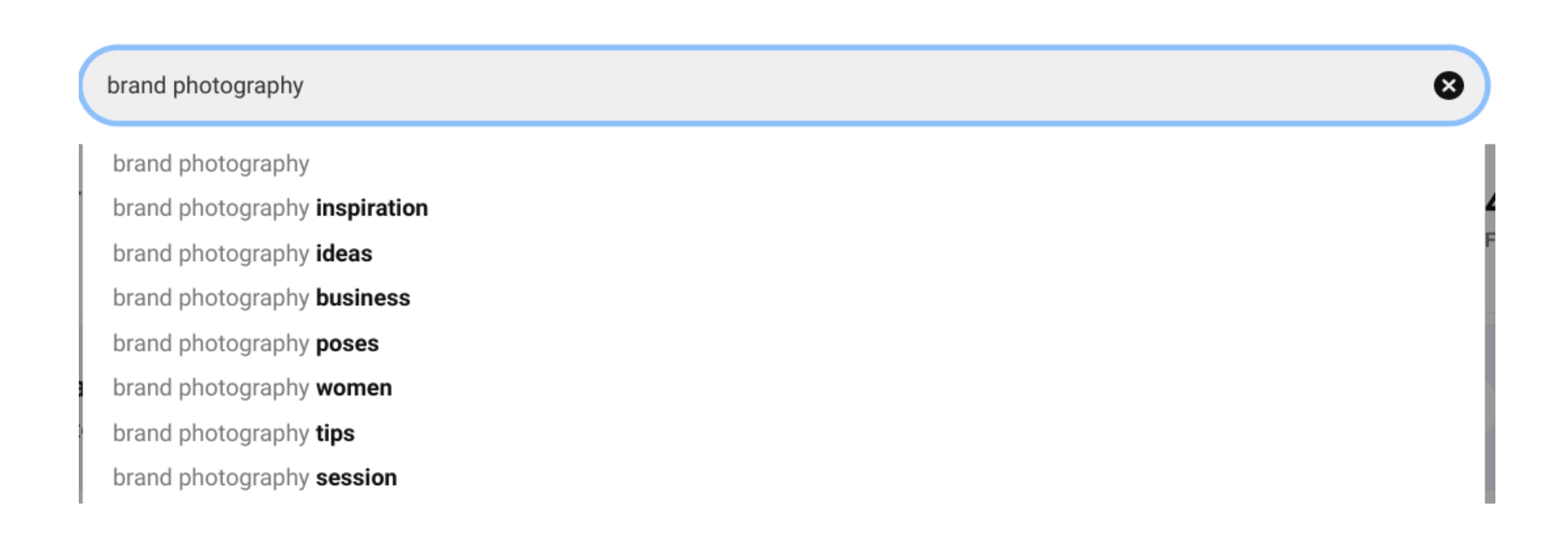
It'll just kind of fill in those keywords. Again, another incredibly helpful way for you to start to get content ideas and information from your audience.
Amazon
The next one uses another popular platform that we're all familiar with and that is Amazon.
Look, no matter how you feel about Amazon, it is where people are buying their books. So one of the things that I started doing really early on in my business was starting to explore book reviews.
Finding books that were related to my industry. Now I totally understand this might not work for everyone. With all of these, take the ones that will best serve you and your industry and run with them. You don't have to use all of them, but this is a really helpful one especially if your industry typically has very specific topics and books related to what you do.
So let's say I am focused on marketing. I can go to Amazon, type in marketing, and choose the book option from the dropdown.
This is going to show me all the top marketing books. I'm going to look for the ones that have the most reviews because that's where the information lies.
I can then go to that book, I can read a little bit about it.
What was the general idea of the book, scroll down and start reading the reviews. Now the positive reviews are nice, but what you really want to focus on are the negative reviews.
What did people say?
Did they say it was too simple?
Did they say that it didn't answer this question?
Did they not like it because of X, Y and Z?
This is going to give you more information about what your audience is looking for and a possible gap that you can fill in your content creation.
Community Forums
The next one is all about community forums. Now I'll be honest with you, I don't use this one very often, but I've had a lot of clients who find success and use them for themselves.
The community forums, Reddit is a great example of this, where you can go type in a specific topic, whether it's a specific problem that you've identified for your ideal customer, your industry as a whole, or something that you specifically do.
Personal branding would be a great example for my business. Type that in and see what people are talking about. See what types of questions individuals are asking. This is a really helpful tool for getting very specific language for your ideal customer.
In addition to that, and one of the platforms that I'm a little bit more familiar with and comfortable with is Facebook groups.
Now, I am not suggesting that you go into every Facebook group and you just start asking random questions. Exhausting, outdated. We don't need to do that anymore.
Facebook has a search function, so you don't have to do all of the outward postings and choosing a cute pic for attention. We just get to go into the Facebook group that we know is full of our ideal customers, go to the search bar, and start typing in very specific keywords related to the things that you offer, your industry, your problems and see what questions come up.
Whether that's a single post or actually in the comments. I have found gold mines in Facebook groups before.
In fact, and I'm going to be sharing with you, how I map out 90 days worth of content, that video is actually coming out next week. One of my favorite places to find content ideas are Facebook groups.
Survey Your Audience
The last one I'm going to share with you is really helpful if you already have an audience. Now, you don't have to have a huge audience. You don't have to have thousands of email subscribers or fans on Instagram or whatever you use to classify an audience for your business. Although I recommend that that's your email list. You can have 10, 15, 100 people. It doesn't matter.
This tool is really helpful for getting really specific information from people who've already said yes to your brand. And those are surveys.
Every 90 days-ish, I will put together a survey for my audience and ask very specific questions like:
What are you struggling with right now?
What is the number one problem that you're facing?
What are you looking to do within the next 90 days?
What would you love from me?
If I could create one piece of content that would help you, what would that piece of content be?
And that's incredibly helpful for getting specific feedback from your audience, making open-ended questions so you can get very specific language and then using that to create your content moving forward.
Conclusion
So no matter which one of these options you choose, I hope that you see that there is so much information waiting for you on the internet.
The biggest thing I want you to remember is that we’re focused on getting specific language from our ideal customer.
It's not enough to assume what our audience is saying. We really want to use the words that they are using to describe their current struggles, to describe their problem, to describe where they ultimately want to be.
That is going to help you with your marketing.
It's going to help you with your messaging.
It's going to help you with your consistent income as a business owner.
- FREE GIFTS YOU'LL LOVE -
DISCOVER YOUR BRAND STORY IN UNDER 5 MINUTES
LEARN HOW TO WRITE AN ‘ABOUT ME’ PAGE THAT CONVERTS
MAP OUT 30 DAYS OF CONTENT IN UNDER AN HOUR
- READ THE LATEST POSTS -
MEET MICHELLE
Hey there, I'm Michelle Knight and I an online branding and marketing consultant for female entrepreneurs.
I believe in the power of storytelling and using that superpower to brand and market yourself online...oh and to set yourself free.
I'm obsessed with living a life of freedom, so much so, that my family and I now travel full-time while running my business from the road.
This blog serves as a home base for all things branding, marketing, content creation and more.