

Brandmerry Blog Archives

Marketing Strategy Example for Solopreneurs
Mapping out your marketing strategy can feel like a lot when you’re a one-person show, but I’ve learned over the years that a weekly workflow, mixed with the power of repurposing can transform the way you show up, build your leads and make sales. Read the blog for all the details.
BY MICHELLE KNIGHT

When I first started my business I felt overwhelmed with the idea of constantly creating content, notice I didn’t say consistent here because for a long time I thought consistent meant constant.
This is actually not true, consistency is what works best for YOU!
Once, I realized I could map out how I wanted to show up, where and how often I began to bulk my content creation days. Every Monday, I would have a few hours, kid-free, to write my blogs, social media posts and emails for the week.
This was crucial in making sure I could get my content out into the world, increase brand awareness and attract quality leads.
But, as any business grows so do the creative juices and I began to think of new ways to reach my audience. Many of these included live videos, pre-recorded videos, podcasts, Pinterest strategies and more. That’s when I became mildly obsessed with streamlining my marketing.
Over the past five years, I’ve become a master at not only my own marketing strategies but also supporting entrepreneurs in doing the same for their business. It’s the core principle inside of signature membership Brandmerry Academy!
Today, I’m giving you a look inside of my marketing strategy so you can steal it for yourself.
Let’s get started!
MARKETING STRATEGY TEMPLATE: 4 KEY PIECES
Before we get into the exact strategy you can steal from me, it’s important to take a birds-eye view of marketing as a whole.
There are four very important key pieces to a strong marketing strategy.
MARKETING PIECE #1: STRATEGY
The first piece in a strong marketing strategy is the strategy and systems.
This is getting a strong foundation in place so that you can show up and market your business consistently.
And having the pieces in place that are going to not only bring in new leads but also convert those leads into email subscribers and paying clients.
This stage includes a strong website, core messaging, email marketing platform and onboarding, plus a weekly workflow which we’ll talk about in a bit.
MARKETING PIECE #2: AWARENESS
In the Awareness phase, you're making sure that you're touching on all of those stages of the buying process, and that people are constantly learning about you and your brand.
This is typically where all those cold subscribers are coming in, people who find your blog on Google, see a pin that you created on Pinterest, or a video on YouTube.
They're coming in not knowing you previously, and becoming aware of your brand and how you ultimately support your clients.
MARKETING PIECE #3: ATTRACTION
Attraction is where someone who is now aware of you moves into being attracted to your brand, your mission and your work. This is where the magnetic energy starts to build.
They're ultimately at that phase where they want to learn more.
This is where having a lead generation piece in place is so important because the people who are ready for more can buy or join your email list where they move a little bit further through the customer-buying process.
MARKETING PIECE #4: CONNECTION
And then the final phase is what I like to call Connection.
This is where you are ultimately connecting and building trust through your marketing efforts and leading people to the sale.
Think about it as an upside-down triangle, where you've got cold leads coming in the top through awareness, moving into the second phase, warming up a little bit, into the bottom phase where they feel that connection and they are ready to purchase.
All of that is part of your marketing strategy. Making sure that you have the systems and the solid strategy in place so that all of those pieces work very effortlessly together.
Now, it's time to steal my strategy.
Just like I promised you, I'm going to share with you the seven-piece marketing strategy that I use in my business.
MY 7-STEP MARKETING STRATEGY
MARKETING STEP #1: CREATE YOUR WORKFLOW
One of the core parts of the Systems Phase is creating your workflow. One of the things that get entrepreneurs so freaking hung up is the idea of consistently showing up, but there is a way to fix this, and that is making sure that your system and your workflow are established.
Now, I teach this workflow inside of Brandmerry Academy in great detail, but for a limited time, I also have a freebie for you if you want to just dip your toes in the water a little bit.
You can go to brandmerry.com/repurpose, where I teach you how to master the art of repurposing and create a workflow for your content that you can repeat week after week after week. You’ll get your hands on my Content Creation Repurposing Guide!
This is the same workflow that you have heard me talk about numerous times in my videos and blogs, where I take a video and post it on multiple platforms, like Facebook, Instagram, and YouTube.
I transcribe that and turn it into a blog.
I share that blog on Pinterest.
I share that blog in my email.
I share that blog on social media.
My goal is to make sure that I am extending the life of my content.
You want to create this workflow very early on so you understand where and how often you are going to be showing up with your marketing efforts. That is going to allow you to create a workflow that you can just plug the various content topics into and repeat week after week.
So, number one, create your workflow.
Again, something we talk about and cover in great detail inside of the Academy, but you can also get your hands on a small portion of that at brandmerry.com/repurpose if you just want to dip your toe in the water.
MARKETING STEP #2: LEAD MAGNET
Number two is making sure that you have your lead magnet set up.
This is part of that Systems Phase again because as you start to build that brand awareness and attract more people to your brand and your business, you want a way for them to stay in contact with you.
It is not enough to say, "Hey, just follow me here. I hope you actually see my stuff." We want to make sure that we have a way to email our community members. This is where you're able to talk about your products and your offers more effortlessly because these people want to hear from you.
So, the second thing that you want to do when setting up your marketing strategy is to make sure that you have a lead magnet established.
This includes making sure that you have that free gift whether that's a PDF, a video, audio, quiz, or something similar. You’ll want to create your landing page or opt-in page as a way to capture their information.
My favorite platforms for this are Leadpages for opt-in pages and Convertkit as my email platform. I like this combination, but many of my clients will just simply use Convertkit, as they do have the ability for both opt-in pages and general email marketing.
After they’ve opted into your free gift, you’ll need a way to send them the gift via email, and put them into a nurture sequence, where they get to learn more about you, your mission, your brand, and how you are going to support them. You can also offer up your product or your service in that email sequence if you have something readily available.
You don't have to wait for the perfect offer, you can always focus on nurturing them and building deeper trust and go back to add your offer later.
Having your lead magnet established early on is so important because as your marketing picks up, and it can take off very quickly, you want a way to capture those quality leads.
MARKETING STEP #3: WEBSITE
Now, one of the things that I teach over here at Brandmerry, specifically inside of Brandmerry Academy, is the power of a website. I know a lot of people will sit there and tell you that your website isn't important, but here's the thing: your website is a home base for your expertise.
When you use the strategies that we teach at Brandmerry like SEO, where you don't have to show up and post every single day on Instagram, or utilizing search engines like Pinterest, where you can extend the life of your blog post and make sure that you're driving traffic to your blog for two, three, four, five, six years down the line, then your website is important.
Now, if you want to show up every single day on Instagram and post all the time and just try to convert those people into sales, and that feels like a good strategy for you, go for it.
But, I've seen a lot of entrepreneurs who follow that strategy and struggle a bunch, where they're like, "Well, I have all these subscribers but nobody's buying from me." That is why we teach the strategies that we teach for evergreen content over here at Brandmerry because in our minds it’s much more effective.
So, with these evergreen strategies, it's important to have your website established.
I’m not asking you to hire a designer or spend months building the “perfect” website, in fact, it’s quite the opposite. It can be very simple to start, and you can continue to add on to it as you go.
What I recommend to start is a very simple homepage, where you have your lead magnet, where you tell people a little bit about who you are and who you serve, and you can link to your product.
Having an additional page that shares your product or your service with a link to purchase, book a call or submit an application.
Followed by additional pages for your ‘About Me’ and your blog.
You can have your website set up in no time, because as we know, it's not about perfection, it's about putting it out there. And you can continue to add to it and build.
This is one of the things that we teach inside of the Academy. There’s an entire brand new course all about creating your website, where I walk you through step by step by step what pages to have and what to include on them.
Remember, think of your website as a home base where you're going to be setting your evergreen traffic so that you don't have to show up on social media every single day, multiple times a day.
MARKETING STEP #4: BLOGGING
Please, start your blog from the get-go. This is going to be powerful for you because it's allowing you to create strong content on your website so people can learn a little bit more about you, a way for you to showcase your expertise and authority and create content that lives on.
You can then utilize SEO so you can show up in Google and other SEO platforms.
And, a little hint, if you have your workflow set up, you're creating long-form blog content, which you can then cherry-pick pieces out of and put on social media, or email your list, or create a small reel about.
So, because you're creating a piece of long-form content right out of the gate, you're actually giving yourself smaller chunks of content that then you can put out on various platforms. Having a blog, in the beginning, is powerful.
Now, if you're not someone who likes to write, don't think of blogging as just writing an entire post every single week. There are a lot of different ways that you can create blog content. One of them is writing the blog, but the second one is how I create my blog posts - starting with a video.
I create a video because I happen to enjoy video content more, transcribe that and turn it into a blog.
Another option is starting with a podcast or audio recording. You can transcribe that and put it onto the blog.
I'm not saying that you can't also start with video or start with podcasting, but because we're going for a simple strategy, bare-bones, you need a blog, and you want to start it right away.
If you're like, "I can do video and blog," then let's do it. That's why the workflow that we designed in the first part is important. You can get yourself into a system and you can use awesome marketing tools to streamline your energy.
One more thing about the blog is that it's important to have that text for repurposing.
Remember, you can use that long-form content to create multiple pieces of content to show up on social media. You could take an entire blog post, pull out individual sentences, and have an entire month's worth of content for Twitter.
There's a lot of really strategic ways to extend the life of your content, so start with the long-form and then can thank me later.
MARKETING STEP #5: PINTEREST
Pinterest is a search engine optimized platform, meaning that people come to the platform to find very specific pieces of information and the platform uses the keywords from your content to categorize the content. This means if someone is looking for travel tips and you have a post on travel tips, you’ll show up as a resource for them.
I talk a lot about SEO because I love it so much. Feel free to dive into last week’s post if you need a deeper dive.
This SEO strategy is why Pinterest is a more powerful platform than some of the social media platforms like Instagram or Facebook because people aren't specifically going there to solve their problem and seek out solutions.
Pinterest users tend to be further along in the buying process, as opposed to Instagram or Facebook. They're ready, they know their problem, they're seeking out solutions and they're ready to purchase. Where on the other platforms, you're just throwing content out there and hoping that it hits the right person.
So, integrating Pinterest is powerful.
Now, I'm not going to do an entire video on Pinterest. It is a whole strategy in and of itself. But if you're serious about marketing and you're ready to use this platform, which I highly recommend, we teach it inside of Brandmerry Academy.
It is an entire monthly marketing mini-course, learning how to use Pinterest effectively in your business. We're talking thousands and thousands of monthly traffic, anywhere from a thousand to what we see over here at Brandmerry upwards of 25,000 website viewers a month. Pinterest is a powerful tool to support you in doing just that.
You've got the blog because you followed Step 4, now, integrate Pinterest so you can create that consistent traffic to your blog.
While I’m not sharing the entire strategy here, there is one little piece of information that I will give you. When you create your blog content, create anywhere between five and six Pinterest pin-sized variations of your title.
Let's say, you tilted your blog “Three Ways to Improve your Content Creation”.
Go to Canva, choose the Pinterest template, make five individual pages, design them all just a little bit different. Change out your brand colors. Put a photo back there. Maybe change the text a little bit. And then, put different variations of your title on those images.
One could be “Three Tips to Improve your Content Creation.”
One could be “Want to Improve your Content Creation? Read my Three Tips here.”
Another one could be “The Number One Tip You Need to Know About Utilizing Tools to Improve your Content Creation.”
You can change them up.
You can change colors, font, photos, etc, but have at least five different variations.
Then schedule those to release over the first week or two when your blog gets out into the public. You can continue to share them on different boards, etc. This is going to allow you to create fresh content on Pinterest, which is important when it comes to utilizing Pinterest.
Again, check out Brandmerry Academy for the complete training.
MARKETING STEP #6: VIDEO
Now, number six is where you get to incorporate video. This is where social media does come into play just a little bit, but we're focused on using video rather than just static content, which will allow you to reach more people because these platforms love video.
Now, you don't necessarily have to do videos on Instagram or Facebook.
You could use YouTube as well, but hey, if you're creating the video, why not put it out there on a bunch of different platforms so you make sure that you get in front of your ideal customer?
Video could look like Mondays with Michelle, which is an entire video that I record that I put on Facebook and Instagram every single week. Video could look like using Instagram stories, because those work incredibly well for moving people through the buying process, building trust, and leading them to the sale. It could also be live videos on a platform of your choosing.
Let's not forget our friends' Instagram Reels or TikTok, these short-form videos that are highly educating and highly entertaining do well, and these platforms love to push these types of videos out.
So, no matter what you're doing in your business, no matter what feels good for you, figure out a way to incorporate video at this stage so that you can start to build that know, like, and trust factor with your audience.
MARKETING STEP #7: KEEP IN TOUCH WITH YOUR AUDIENCE
And then finally, number seven is to figure out and design your weekly touch base with your growing audience.
Now, if you remember back to number two where we talked about your lead magnet, it's important that if you're growing this email list that you are emailing them, and not just when you want to sell something.
Email them and let them know what's happening regularly.
We tend to, as marketers think that everyone sees our content the first time that we put it out there, but that's just not true. You want to make sure that you're getting in front of your audience and that we're hitting them wherever they are.
Our audience is busy, they’ve got a lot going on and they've got a lot of information coming their way. So if someone has said, "Yes, I want to hear from you," on your email list, do yourself a solid and email them.
This could be focusing on emailing your list every single week when you release your new blog.
It could be making sure that you share your new video every single week via email.
If you've got a podcast episode, sharing that every week.
Remember, you're creating new content every week so you can just email your audience about that. And then, if it feels good to, you can always take it a step further and include additional story or additional resources to email and stay in contact with your audience multiple times a week.
But, the bare minimum is once a week. That's what we believe over here. Highly, highly recommended to keep a strong and healthy email list.
CONCLUSION
Those are the seven pieces of a solid marketing strategy. You want to have these core pieces in place and then every day focus on taking three important actions: Growing your email list, nurturing your existing email list, and working on making a sale.
Watch this video on Youtube where I dive into a deeper strategy about these 3 daily marketing moves.
That is the seven-part marketing strategy that I want you to steal which will allow you to show up daily to attract new customers with ease.
Roll these out phase by phase. You want to have one, two, and three, ready to go for your systems.
Then your blog and start to integrate Pinterest.
Remember, you don't have to do it all at once. Think about it in phases as it will make it much more manageable.
And, again, if you want support with every single part of this process plus more, because there's a lot when it comes to marketing your business, we believe in simplifying it inside of the Academy.
Head to brandmerry.com/academy to get signed up before doors close.

P.S. Have you tuned in to The Beautiful Climb podcast? I release new episodes every other Friday on topics around productivity, motherhood, habits, goals and going after the life of your dreams! Check out past episodes and be sure to subscribe at thebeautifulclimb.com
- FREE GIFTS YOU'LL LOVE -



DISCOVER YOUR BRAND STORY IN UNDER 5 MINUTES
LEARN HOW TO WRITE AN ‘ABOUT ME’ PAGE THAT CONVERTS
MAP OUT 30 DAYS OF CONTENT IN UNDER AN HOUR
- READ THE LATEST POSTS -






MEET MICHELLE
Hey there, I'm Michelle Knight and I an online branding and marketing consultant for female entrepreneurs.
I believe in the power of storytelling and using that superpower to brand and market yourself online...oh and to set yourself free.
I'm obsessed with living a life of freedom, so much so, that my family and I now travel full-time while running my business from the road.
This blog serves as a home base for all things branding, marketing, content creation and more.

The Truth About SEO - Does it Really Matter?
Is SEO really important as an online entrepreneur? Should you spend your time researching and implementing when you could be doing something else? If you've ever wondered what all the hype is about SEO don't miss this post.

The Truth About SEO - Does it Really Matter?
BY MICHELLE KNIGHT

I stumbled into SEO, Search Engine Optimization, when I first started blogging. I was implementing tiny bits of information I would find online and crossed my fingers that it might work.
Honestly, I knew nothing at the time but did know that small changes could yield big results. Within months I discovered I was on page one of Google - that’s when I knew it was working.
I continued to put more emphasis on my strategy heading into 2019, learn as much as I could about SEO and over time I discovered that the majority of my leads were coming from Google and Pinterest.
Today, thanks to effective SEO strategies I experience thousands of website visitors every month.
Here’s a sneak peek at what happened from 2019 to 2020.

VS.

But, let’s not just talk about SEO, let's strip away all the mystery that we see in online marketing and have a real conversation about why every single business, no matter what you sell, should have a solid SEO strategy inside of your marketing.
What SEO Means
Let's first just break down into everyday terms what SEO is.
It's essentially search engine optimization, which you probably already know, but what is that exactly?
It means that when you are on search engine platforms like Google or even platforms that you might not think about, like Pinterest and YouTube, you can go to those platforms, type in questions, keywords, or a single word, and the algorithm will pull all of the resources that match those terms.
As a marketer, if you want to show up for people who are searching for those things, you want to make sure that you're paying attention to the SEO in your content.
This tool is giving the algorithm the information that you are sharing on your page so that you show up in your ideal client’s search results.
And yes, ranking on page one is kind of a big deal, most people don't scroll past page two or three, but even showing up on those early pages, page one, two or three can be super beneficial for your business.
Obviously, we're all shooting for page one and we're going to talk about how you can do just that for your industry.
The Consumer Buying Process and SEO
A few blogs ago, I introduced the consumer buying process and I presented the different phases that a customer goes through before they purchase.
Stage One: Problem or Need Recognition
Stage Two: Information Search
Stage Three: Evaluation of Alternatives
Stage Four: Purchase Decision
Stage Five: Post-Purchase Evaluation
We also broke it down as it relates to content creation. So, make sure you go back and watch that video. That's going to specifically tell you about each of those individual pieces so you have a better understanding of the client buying journey.
What I want you to focus on when we're talking about these five phases is that people are finding your content at different points in their journey.
Not everyone is going to be coming to you and discovering your brand with a credit card in hand, and not everyone is going to be coming to your brand wondering, "What am I supposed to be doing with my life?"
There are a wide variety of different stages that a consumer might be sitting in at any given time and that's why SEO can be incredibly powerful.
It allows you to create multiple resources, as well as the SEO on your site as a whole, to make sure that you are showing up for people at multiple stages of the buying process.
SEO MARKETING: 3 SEO ACTION STEPS
SEO TIP #1: SITE-WIDE SEO
The first thing you want to do is make sure that you have your site-wide SEO set up.
As I mentioned before in the consumer buying process there will be people looking for your services and industry specifically at stage four or five. Now, this is where your website homepage comes into play because when you set your site-wide SEO, and you rank on Google for specific keywords, the traffic is going to go to your homepage.
So, you want to make sure that your homepage is set up and ready to rock and roll. Last week I shared my 4-part framework for increasing conversions on your homepage, you can check that out here.
A lot of people miss this piece of the puzzle, they start to rank, and then they realize, "Oh, crap, everyone's just landing on my homepage which isn't optimized to collect leads or direct people to my offers, or send them to resources like my blog." We don’t want that so make sure you have an optimized homepage to start.
Ok, back to site-wide SEO.
I use Squarespace in my business so there's an actual section in Squarespace for site-wide SEO. Kajabi is another tool that I use and they have a section for site-wide SEO as well. No matter what platform you're using, there is going to be a section to set up the SEO for your website as a whole, typically found in the settings section.
Now when you’re choosing what to include in this section, I want you to think about those final stages of the buying process. The stage where someone already understands their problem, already understands their solution, they've looked around, and now they want to purchase.
That's what I want you to focus on when it comes to choosing keywords for site-wide SEO - think about your industry or product. For instance, “chemical-free skincare” or “business coach” or “wedding photographer Australia”.
In my case, if someone is looking for a branding coach and they're ready to invest in a branding coach, they might Google “branding coach,” and my website is going to pop up.
If someone is looking for a personal branding consultant, they might type in “personal branding consultant” and my website will pop up.
It's much easier to convert those individuals because they are ready to invest and by having this SEO in place you can create a consistent stream of clients.
You’ll use these keywords to format your Site Title and Site Description, which is another place to include some of those keywords but typically is written more conversationally and enticingly.
In addition, you can give it another boost but also include those keywords on your home page individually as well.
I'm not going to go into that entire strategy today. That's something I teach inside of Brandmerry Academy, but if you’re choosing to do it yourself then you want to keep in mind that research is everything.
It's a mistake that many entrepreneurs make. They might say, "Okay, fantastic, this is my title. I'm a unicorn princess coach," and that's what they put for their site title.
No one's Googling that, right? And this is where I often say that your titles shouldn't be fluffy, they should be rooted in data and research. So, using some of the tools that I mentioned in a previous post on my favorite marketing tools, Ubersuggest or Keywords Everywhere are great tools that you can use to see how much traffic a particular keyword gets.
Now ranking for an industry doesn't mean that you need to have like 10,000 or 30,000 searches every single month, it could be as simple as 150 to 500 because those people are further along in the buying process so they are looking for a very, very specific solution to their problem.
TO RECAP:
Do your research to discover what people are researching at stage four of the buying process
Implement a Site-Wide Title and Description
Add those keywords to your homepage in your copy
Optimize your homepage for conversions
SEO TIP #2: BLOGGING AND PINTEREST
Number two is supporting what you're saying you're known for, i.e. Site-Wide SEO, with additional resources on your website through blogging.
Blogging does a few different, incredible things for ranking your website.
Number one, blogging is an awesome resource. So, if someone wants to get to know you, you want to support them in moving through the buying process, blogging is a great way to showcase your expertise.
In addition to that, many people who are at stage one of the buying process are just looking to understand their problem, looking for solutions to their problem, or just trying to get some information about what they are experiencing.
That's where blogging could be incredibly helpful. And if you use SEO on your blog strategically, then your blogs will show up in Google Search. For instance, my ideal customer at Stage One might be searching for content creation strategies and one of my blogs will show up.
It is, I would say, much easier to rank for your site as a whole, which is why that's number one than it is to rank individual blog posts. But the more that you get into SEO and the more that you practice utilizing keywords in your headers and optimizing your title, then it is more likely that your blogs will rank on Google.
In addition to supporting your ideal customer on their journey, Google also loves content that supports what you ultimately say you are doing. So, if I say I'm a branding coach and I have a lot of blogs on branding, Google likes that a lot, and they're going to use that to help me show up on their search engine.
It also helps with other search engine platforms as well.
Think about Pinterest! Remember, Pinterest is an SEO platform and a great place to feature your blog content to get in front of your ideal customer.
Putting your blog content on your website, sharing it on Pinterest and making sure it's optimized there as well can help drive consistent traffic to your platform.
Many of those individuals on Pinterest are at the beginning stages of the buying process where they're just looking for solutions, and your blog can show up for them. So, making sure that you're creating supporting content within your niche, within your industry on your blog, and that's a consistent part of your marketing strategy.
SEO TIP #3: SEO RESEARCH
It's one thing to blog, it's another thing to do your dang research.
So, one of the best pieces of advice that I could give to you when it comes to content as a whole is to do your research and make sure that you're optimizing your content on Pinterest, on your blog, and YouTube for SEO.
What does that mean? That means that you might have a fantastic idea in your head of something that you want to share and I want you to research that topic to make sure that you're choosing the best title and the best keywords so people find it.
On the flip side of that, you might not know what you want to talk about at all and you can use these tools like Ubersuggest and Keywords Everywhere to search for specific topics that you know are relevant for your ideal customer and get a plethora of topic ideas and content that you can share that you already know is going to do well on search engines.
When planning your content give yourself some extra time to do your SEO research.
There are so many resources out there that will give you the answers, you don't have to just wonder, "How many people are searching for this?"
The data is there.
If you take an extra step when you're mapping out your content for 30 days, 60 days, 90 days, like I like to do over here at Brandmerry, you're making sure that the titles, the URL that you're creating, and the keywords on your content are going to show up for people.
CONCLUSION
Remember, so many people create their website and then it just sits there because they're not getting traffic.
SEO is the answer to getting consistent traffic, leads and conversions. And utilizing search engine platforms like Pinterest, Youtube and Google will allow you to continue to scale your business with ease.
I hope that this was helpful for you in understanding what SEO is and why it's important. Make sure you go back and read those previous posts specifically on the client buying journey and optimizing your homepage.
And if you’re ready to learn how to market your business with ease, without relying on social media and implement the strategies we talked about today with SEO, Pinterest, blogging, video marketing and more, then check out Brandmerry Academy and how the membership can support you in scaling your business.
P.S. Have you tuned in to The Beautiful Climb podcast? I release new episodes every other Friday on topics around productivity, motherhood, habits, goals and going after the life of your dreams! Check out past episodes and be sure to subscribe at thebeautifulclimb.com
- FREE GIFTS YOU'LL LOVE -
DISCOVER YOUR BRAND STORY IN UNDER 5 MINUTES
LEARN HOW TO WRITE AN ‘ABOUT ME’ PAGE THAT CONVERTS
MAP OUT 30 DAYS OF CONTENT IN UNDER AN HOUR
- READ THE LATEST POSTS -
MEET MICHELLE
Hey there, I'm Michelle Knight and I an online branding and marketing consultant for female entrepreneurs.
I believe in the power of storytelling and using that superpower to brand and market yourself online...oh and to set yourself free.
I'm obsessed with living a life of freedom, so much so, that my family and I now travel full-time while running my business from the road.
This blog serves as a home base for all things branding, marketing, content creation and more.

Digital Marketing Guide for Entrepreneurs
BY MICHELLE KNIGHT
This guide was designed to give you everything you need to know about digital marketing as an entrepreneur.
Inside the guide you’ll find:
Why digital marketing is essential
3 ways to improve your online marketing
3 marketing mistakes to avoid
3 ways to improve content marketing
Tips for growing your email list
How to not rely on social media
How to improve your email list
Why you need a website
Tips for improving your SEO
Why you need Pinterest marketing
How to increase your website conversions
Let's dive into what relationship marketing is and why it's essential 👇
WHAT IS RELATIONSHIP MARKETING?
Relationship Marketing, also referred to as H2H (Human-to-Human marketing) is focused on one thing, building a relationship between the brand and the consumer.
It is the new age of marketing if you can call it new. It’s no longer acceptable to rely on traditional marketing setups like B2C (Business-to-Consumer) or B2B (Business-to-Business) and has moved to a Human-to-Human marketing approach.
Relationship marketing builds on the idea that every transaction comes down to a human buying something from another human, when you think of marketing and specifically selling in this way it shifts the way you go about sharing your products and services to a more emotional and empathetic approach focused on connection.
Added bonus not only does this increase conversion rates, but it also increases client retention!
In relationship marketing your strategy becomes 100% about building trust.
It’s about the emotional connection your audience has to your brand, it puts an emphasis on Brand Affinity and as the brand and marketer, it puts more emphasis on storytelling.
This switch is much more effective than the “traditional” way of advertising and marketing your products and services, which can sometimes feel disconnected and inauthentic to your audience.
86 percent of consumers say that authenticity is a key factor when deciding what brands they like and support (Stackla, 2019)
WHY RELATIONSHIP MARKETING IS IMPORTANT AS AN ONLINE BRAND
As we’ve already covered a million times, relationship marketing is about relationships, so with that in mind, there is a two-fold approach.
Can you guess what it is? You probably guessed it...relationship marketing comes down to you and the consumer or potential client.
Let’s first talk about you (aka the brand). No matter if you work for a company, or more likely have an entrepreneurial business (possibly a personal brand) there is a human(s) running the show.
The idea is that the human(s) become the face, voice and connection between the audience and the products. It’s important to focus on creating content that showcases the values of the brand, connects emotionally to the consumer, and shares great stories.
It becomes more about quality over quantity, tieing every single piece of content back to the question, “How does this build a relationship and trust with my audience?”
The other side of the equation is your audience. Remember, you’re talking to a real human on the other end of your emails, social media posts and videos. This can be so easy to forget as we’re living in an age of automation.
However, you can’t automate human connection!
Think about how you as a consumer hope to engage with a brand, actually take it a step further, how do you like to interact with a friend? My guess is if the only communication you had with them was an automated/ canned response you’d peace out!
We often overlook the fact that our potential customers are real people, with real lives, looking for real connections.
At the end of the day, humans want to be seen, heard, and understood, and as a brand, you have the ability to do just that through your marketing efforts.
From a marketing standpoint when you can focus on building a solid relationship through your marketing efforts you’ll build trust with your audience much quicker than if you're ignoring the struggles and desires of your audience.
Relationships build trust and trust is what leads to sales.
81 percent of consumers said that they need to be able to trust the brand in order to buy from them (Edelman, 2019)
Let's talk about 3 ways to improve your overall online marketing 👇
1. Become a Better Storyteller
If you’ve read my blogs before then this tip shouldn’t come as a surprise to you, it’s literally how I’ve built the half-a-million-dollar business I have today.
Learning how to tell better stories is going to improve your marketing across the board, whether it's on your website, in your freebie funnel, live video, social media, blog, Pinterest, I can keep talking and going on and on about every single aspect, but you get the idea.
And there are a couple of the core reasons storytelling works so well in marketing.
Your content is 22 times more likely to be remembered If you incorporate storytelling.
I know you spend time creating content, right? It is probably the most time-consuming part of running your business and it's an important part of running your business. So don't you want to make sure that when you take this time, and you put the content out into the world, that people actually remember what you said? Don’t you want to know it’s making an impact? That it’s not just consumed and forgotten in 48 hours?
Incorporating storytelling allows you to do that.
In addition, storytelling does some cool stuff in our brains
When we read or hear a story dopamine is released in our brains. This release makes us feel an emotional connection to the story instantly. If it’s a great story it might even allow us to connect with the storyteller. This emotional connection is important because it’s why people decide to buy.
It has been proven that logistics aren’t enough on their own. When we share the price, the savings, the number of modules, etc...it isn’t going to get someone to commit. The emotional connection, what’s happening on the subconscious level, is the reason someone makes a purchase decision.
And, finally, if you’re not already convinced, one of the fundamental pieces of storytelling that I love to teach is that your story is actually not about you as the marketer, it's about your ideal customer.
One of the ways to become a better storyteller is to remember that every single story that you share needs to be about your audience and connect to your audience in some way and invite them in. When we do this with our storytelling, we continue to neural coupling.
Neural coupling is the firing of mirror neurons that create coherence between a speaker's brain and the brain of his or her audience members. And inviting your audience into the story is actually quite easy. Look for ways to ask questions like, “Have you ever felt this way?”
“Does that sound familiar?”
“Have you had this experience?”
Just those simple one-liner questions can Invite your audience into your story.
These are just three reasons why integrating storytelling into every aspect of your marketing is so important, because it will actually allow you to build trust quicker, leading to the sale.
2. Take Care of Your Client’s on Their Journey
Yes, I mean every single step of the way. Your client journey doesn’t just start when they purchase a product from you, it starts the second they learn about you and your brand.
The client journey isn’t talked about enough and as a result, people market the crap out of their business and they do an amazing job, but after the sale, the client is just not satisfied. It’s because they didn’t spend the same level of care on their client as they did selling.
So, I want you to think about a couple of things.
When someone opts into your freebie, what happens? What do they get? What do they hear about?
When someone gets an email from you or sees on social media that you have an offer and they go to your sales page, what does that process look like?
When someone buys from you, what does that process look like?
You want to really break down each of these different processes every step of the way.
I'll give you an example of the onboarding process for my program Brandmerry Academy.
When someone is ready to join The Academy, during a launch, they go to the sales page, they choose their offer, then they go to the checkout page.
On the checkout page, I have a video of me walking them through the process. After they enter their payment information, they are immediately taken to a confirmation page that says, “You did it! You're in!” and it includes another video from me sharing the next steps.
Under the video, I tell them exactly what they need to do, which includes checking their email for their login and looking for another email from me with all the details they need. Then, while they wait for the emails, I’m directing them to the New Member Survey.
After the survey, they check the email and have everything they need to get started. They have a link to the Facebook Group. They can log-in to the membership site. They have a walkthrough video of the membership site so they can get started. They have a New Member Roadmap.
There is no guessing as to what they need to do and as a result, my clients feel 100% supported from the second they choose to buy.
Do you see how powerful this is? I made it a point to maintain trust the entire way through the process.
A few questions to start asking yourself to clean up your process:
How can I make this a memorable and easy experience for people from the second they hear about my business?
What happens when someone lands on a sales page? Do my buttons work?
When someone wants to schedule a call, what is that process?
When someone buys a product what is the step-by-step process?
3. Consistently Show Up and Deliver Value
If you want to make it in marketing, people need to know who you are.
Consistently showing up for your audience, is just another way to build trust with them. And no, consistency does not mean posting every single day, that’s so old school, what consistency means is finding a rhythm that works for you and sticking to it.
Building trust and credibility with your audience so they know you’re showing up during the week. When you focus on consistency you are less likely to get lost in the mix of information.
This is one of the reasons I love email marketing and I make it a goal to send at least one email a week. Email marketing allows you to get directly to your audience without having to compete for space on social media. And when you’re showing up on the same day every week, they know to look for you!
When we’re talking about consistently showing up, no matter what platform you choose to share your content, you need to have core systems in place to make your life easier. Consistency is a really big struggle for so many entrepreneurs and that’s because they don’t have clear systems in place to create content weekly.
James Clear, the author of Atomic Habits, states, “You do not rise to the level of your goals, you fall to the level of your systems.”
This line spoke to my soul because it's not just about hitting your goals, it's about having the systems in place so that you can get back on the horse when you inevitably fall off. It’s going to happen so having these systems allow you to pick back up and get right back into it.
If you don't have these workflows and these systems and you don't know how to create consistent content, you don't know how to write content quickly, and you don't know how to come up with content ideas, and you don't have these systems that you can essentially rinse and repeat you will struggle.
It’s one of the reasons I created The Consistency Guide for entrepreneurs. I’m finally solving the problem so many entrepreneurs have by addressing the mindset and systems of it all. You can learn more about The Consistency Guide here.
3 marketing mistakes to avoid 👇
Marketing Mistake #1: Relying on Social Media
The very first marketing mistake is that you are most likely relying only on social media to grow and market your business. As the online mentoring and course industry expands more and more coaches are utilizing social media platforms and unfortunately the message is getting out there that all we need to do is show up on social media to grow a profitable business.
I don’t know about you, but I quickly noticed it’s not quite that easy, right?
While, this strategy might have worked wonders for them and it probably still does cause they have like 100,000 followers or 25,000 followers, for those of you that are just starting out and in the trenches of that first and second year maybe you've realized that you've hit a ceiling and that you can't create more content.
Showing up on social media daily to engage and create content takes a lot of time. When you go about using this strategy only, you’ll start to create less and less content because it starts to get harder to keep it consistent. Then over time you notice you’re going weeks without anything.
I got to a point in my business where I had reached six figures, and although I felt accomplished I also didn’t know how I was going to keep growing. I realized I couldn’t make more than this a year, if I was going to keep getting clients and then still show up on social media every single day.
The reality is by relying on this strategy I was limiting myself and you’re most likely doing the same. It’s not scalable to rely on social media to grow your community and profits.
The other piece is that you don’t own social media. If you're relying on Instagram to promote your business and Instagram doesn't work, how do you promote your business?
If you're relying on Facebook or even your Facebook group to show up and promote your business and for some reason that's not working in the middle of a launch or a sale, what happens?
That’s why it’s so important to have these other avenues in place to consistently build your audience.
**If you’re curious about my favorite strategy which is SEO (Search Engine Optimization) be sure to check out this post here.
You should not be relying on social media to constantly attract new leads and grow your business. Social media is where we go to be social, to build relationships, to nurture the community that's already there.
Marketing Mistake #2: Not Generating Leads
This mistake makes me hurt a little inside, when I see an entrepreneur who has no efficient way to collect leads from prospects on their website, watching a live video or following them on social media.
This is all about list building. The idea is that if someone is taking the time to consume your content, you want to give them a way to join your “inner circle” i.e. your email list.
To kick it off, I highly recommend Convertkit to grow your email list because it has all the tools you need including landing pages, segmenting, forms for your website, tags, funnels and more. You can try it for free with my link here.
The beautiful thing about capturing your ideal customers information is that they are committing to your business. It’s essentially their first investment in you and your brand. Even though you're not getting an exchange of money, somebody is saying, “Okay, I trust you. I like what you're about and want to hear more from you. I want to welcome you into my inbox!”
I don't know about you, but my inbox is a sacred space. This is a big deal!
So to generate consistent leads to your business you want to have advanced marketing strategies in place like, SEO, podcasting, YouTube, blogging and Pinterest where you’re putting out a piece of content and every single day people are finding it and saying yes to joining your list.
Now, here is the kicker!
There needs to be an exchange that happens where you give them a free gift in exchange for their email address. This is the very beginning of the lead generation process.
If you’re new to list building, here is the overview below. If you want to learn more about list building, check out this blog here.
So you start with a free gift. If you’re a service-based business this can be a PDF, video training, audio training, a quiz...there are a ton of different options here.
If you sell a product, this might be a coupon code or a discount on their first item, but it could also be something really cool like a quiz. If I were selling a skincare product, I might create a free quiz that tells people their skin type and recommends the best products. In order to get the results and tips, they would have to give their email address.
That’s the free gift, something of value in exchange for their email address. Then you show up for them regularly in their inbox, providing value and time to time asking for the sale.
3 TIPS TO IMPROVE YOUR FREEBIE (FREE OFFER)
Your freebie needs to be something your audience knows they need. If they are not aware of it, then it’s going to be really hard to market.
It needs to provide value to your audience. If after they consume the content, they walk away with something to implement, having learned something new or being inspired it’s valuable.
Your free gift needs to be a clear pillar of your brand. For instance, a skincare quiz sounds super cool, but I wouldn’t do that as a free gift because it doesn’t directly connect to my brand message or paid services.
Marketing Mistake #3: You’re Blaming the Algorithm
I call this the blame game.
My marketing isn't working because of the algorithm…
My marketing isn’t working because my industry is saturated…
My marketing isn’t working because my ideal client isn’t on [insert platform]...
That is not why your marketing isn’t working, but it's really easy to fall into this rut. It's really easy to fall into this thinking and then stay there.
I can teach you all the strategies in the world, but if you're stuck in a mindset that no one cares or no one sees it or it doesn't matter, then you won't get results.
And that's the truth.
I’ve had those moments in my own business, especially in the beginning. If I was promoting a challenge and there were 5 people who signed up, and in my mind, it was nobody cared.
EXCEPT for 5 people!
5 people who signed up, who had never heard of me before, who had never bought from me before, who were giving me an opportunity to show up for them.
That’s 5 potential clients.
It’s all in your mindset.
Such a big part of showing up is creating content! If you don't think people will find it, if you don't think people will find value in it, then what are the odds that you’re going to consistently show up?
Your mindset will take over and you’ll feel there is no point...no one sees it
...the algorithm is out to get me.
No, the algorithm is out to challenge you...accept that challenge and become better.
If your marketing isn’t working change your mindset, accept responsibility and find solutions.
We cannot play small games when it comes to building our online brand and our business and this belief will keep you playing small. In order to be successful, we need to think big picture and big picture responsibility, taking responsibility for things, not working and finding solutions.
3 ways to improve content creation 👇
1. Use a Content Calendar
If you are not currently using a content calendar then you’re flying by the seat of your pants and that is most likely contributing to the need to “search” for answers, rather than trusting your own writing instincts.
You can download my free Content Calendar if you haven’t already.
This will teach you a technique (not a template) I use with my clients to identify YOUR authentic Brand Containers as a way to come up with a stream of content. Then you can better plan for your content over the next month and pull from your own life experiences and needs of your clients in the process.
In addition, can you tell I’m super passionate about this, you’ll get into the habit or pre-writing your content which allow you to find your own voice.
2. Pull Ideas For Content From Your Followers
Want to know the secret to content that converts? Pay attention to what your audience is asking for. Yes, it gets to be that easy, yet so many entrepreneurs are missing this step.
Maybe it’s because they don’t have an audience yet?
Maybe it’s because their audience, although small, is made up of family and friends?
Maybe they don’t know how to ask?
Whatever the reason may be, I want you to remember you have the internet at your fingertips. Literally, anything you need to know is available to you if you take the time to look (and taking the time to brainstorm and research content ideas is huge)!
Use hashtags, groups, forums, connections, heck a simple Google Search to find what your ideal client is looking for and create content that addresses that need in a way that showcases your personality and brand voice.
3. Play up Emotional Branding in Your Content
Not sure what I mean by emotional branding? Be sure to check out this post here.
At its core, emotional branding is understanding the pains and pleasures of your audience and creating strong copy and content that:
Addresses the pain and/or pleasure
Uses strong emotionally charged language to connect to that pain and/or pleasure
Offers a solution
Even in the beginning when you’re testing your copy and your writing style or brainstorming content ideas, you can start incorporating emotionally charged words and phrases into your copy.
This will allow you to connect on a deeper level with your audience and start building an audience of true fans.
I believe that your true voice deserves to be heard and your brand to be seen.
I know that you have everything you need already inside of you to stand out on social media, you might need a little help in tapping into it, but don’t mask it with a generic template.
The goal is to find a system that allows your most authentic qualities to shine through.
Your language.
Your personality.
Your voice.
Your unique characteristics.
Your style.
When you use a template, that probably about 1,000+ other people are using you lose these pieces. Maybe not at first, but over time.
And as Dr. Seuss once said, and about a hundred other movies including What a Girl Wants 🙌🏻, “Why blend in when you were born to stand out?”
If you’re serious about doing the work and creating a brand that stands out on social media, produces high-value content for your audience and building a thriving community that leads to a revenue-generating business, then be sure to sign up for my free training on The Build a Better Brand Method here.
Growing your email list is important 👇
What if I told you that you could spend $1 and make $38...what would be your reaction?
Yeah me too! Well, the good news is that specific number is on average what email marketing generates. Yes, for every $1 spent you have the potential to make $38 in return. That’s a 3,800% ROI.
I don’t know about you, but sign me up.
Email marketing has been a love of mine for years now, ever since I realized that in order to make money in my business I needed people to sell too.
And, while I love showing up on social media to build trust and community there has always been something about relying on an outside platform that makes me nervous.
We’ve all had the days where Facebook or Instagram isn’t working, imagine if your entire business relied on your audience on social media...no thank you.
Over the years, I’ve used a very simple strategy to grow my online community via my email list using a lead magnet and email funnel.
Today, I’m breaking it down for you step by step and addressing some of the top mistakes I see entrepreneurs making when they are trying to grow their profitable list.
WHY EMAIL MARKETING IS IMPORTANT
When we’re asking for someone to follow us on social media we’re not asking a lot.
Think about the number of people you currently follow, do you really have a deep interest in each and every one of them? Probably not.
That’s because it’s super easy to just hit the follow or like button.
However, email marketing requires a small level of commitment. In order to be added to someone’s list, you’ve got to provide your email address.
Well, that my friends is basically gold. You’re asking someone to trust you enough to send them periodic emails. Ultimately, this low-level commitment is the first step in becoming a paying client.
Your new subscriber is saying, “Yes, this is valuable to me. I'd love to learn more from you!” or something similar to that.
Email marketing is not only an amazing way to build an online community but to also pull in targeted leads to your paying offers.
6 MUST-HAVES TO GROW YOUR EMAIL LIST
#1 FREE GIFT OR LEAD MAGNET
#2 OPT-IN OR LANDING PAGE
#3 THANK YOU PAGE
#4 WELCOME EMAIL (DELIVER THE LEAD MAGNET)
#5 WELCOME SEQUENCE
#6 TRAFFIC
Because relying on social media isn't the best strategy 👇
The goal of marketing your business should be to build your email list/ inner circle.
There I said it. Why is this your main goal? Because when you have a community you have people to sell too - Community = Profits.
Yet, so many entrepreneurs don’t put enough attention to doing this daily. The reason for this is because of social media. Social media is an amazing business strategy, but in terms of marketing your business, it’s not the best strategy.
If you’re relying on social media to build your email list and make sales for your business and are feeling overwhelmed and inconsistent you’re not alone, but there is another way.
Here are three reasons we shouldn’t rely on social media to build our business and what to do instead.
#1 SOCIAL MEDIA IS MEANT TO BE SOCIAL
The reason the purpose of social media is important is that it was designed to be social. The purpose of these platforms is to keep people on them and engaged for long periods of time, so they’re not ideal for sending people to your website or landing page for your free gift.
While platforms like Facebook and LinkedIn make it easier than Instagram to post external links, the platforms have released statements saying that they favor content that keeps users on the platform.
So while social media might be a great way to engage with your audience on social, it won’t give you the same conversions as other strategies when it comes to building your email list.
#2 YOU DON’T OWN SOCIAL MEDIA
You know this right? Well, if you don’t realize that building your following and community on social media is risky let’s remember the times when Instagram and Facebook went down.
There have been many times in my business when I wanted to go live on Facebook and I couldn’t. Or Instagram was down for everyone making it impossible to post.
Now, while this might be an inconvenience for me it doesn’t really matter because I lead my social media followers to my email list.
Imagine if the only place you can contact your community is social media and this happens during a launch or promotion? Not good!
And, while you don’t own your email platform either, you can download the name and email address for subscribers making it easy to move somewhere else.
#3 SOCIAL MEDIA IS NOT A SEARCH ENGINE
There’s a reason platforms like Google, Pinterest and Youtube work so well at attracting new subscribers and eyes on your brand; they are searchable.
What do I mean? We’ll if you type something into these platforms, often a question, you’ll get resources and solutions to your problem; social media was not designed in the same way.
Sure, you have hashtags and a search feature, but they aren’t optimized for search results and you’re not always getting the most accurate or prominent at the top.
If you’re running a business one of your daily goals should be to attract new people to your brand and business and that isn’t efficiently done if you’re relying on social media.
SO, WHERE DOES SOCIAL MEDIA FIT IN
Let’s talk about the 3 Tiers of Marketing - Know, Like and Trust.
Tier 1: Is the Brand Awareness stage, this is where people get to know you.
Often, this is done by creating content that you put out into the world and using tools like Pinterest, Google or Youtube so people can actually discover your content.
Tier 2: This is the Attraction stage and where you lead your new fans to your email list. You’re attracting them with a lead magnet or free gift in exchange for their email results.
Tier 3: This is where you focus on building trust with your new community members. This is where social media plays a vital role. You want to use social media to nurture your audience, educate them and share more behind the brand and your story. This is when social media makes the most sense.
However, as we’ve mentioned so many people are relying on social media at Tier 1 and are missing out on consistent leads and sales.
CONCLUSION
Social media is great, it’s one of my favorite ways to show up for my audience, but if you’re relying on social media to attract new subscribers and grow your list of potential leads it’s going to be a slow climb.
Using resources like Google, Pinterest, Youtube and more can not only speed up the process but optimize your time and energy in a much better way.
Check out this recent post I did on driving traffic to your website for some additional ideas.
So, now let's improve your email list! 👇
If you don't have a community, if you don't have an email list, if you don't have people who are going to ultimately buy from you, you have nothing.
We get right into building our businesses and our brands and we get focused on what we’re going to offer and what’s on the website, when we need to be focusing on our community growth.
That's why one of the core foundations, I teach inside of all of my programs, is ideal client work.
Without knowing who you're speaking to and without putting the energy and attention into building and attracting those ideal customers, you're going to have a hard time selling.
And with this emphasis on community building it’s important to share 5 Ninja Skills to improve your list building efforts.
If you want to watch the video, rather than read, scroll down!
Email List Building Tip #1
Your Lead Magnet
The first tips, and something you need with all of your email list and community growth, is the lead magnet!
This is what starts it all.
Remember, like 12 years ago, when you would land on a blog or a website and it would say, “Join our newsletter?” And it was like, "Okay, cool. I like your newsletter. This seems fun."
I still see this from time to time and it makes me cringe because the person on the receiving end of that is not attracting their ideal customer. They're not specific enough and saying, "Are you interested in these things? You're the right fit for our program. Please opt into my email list."
When we just have that very general newsletter approach to it, then we often find ourselves with an email list or a community that is not full of our ideal customer. And we don't want that.
So a lead magnet is what sets the tone for everyone joining your email list or joining your community.
What you want to think about is a core lead magnet for your brand as a whole. One of the core lead magnets I have for my business is my Brand Roadmap. I teach you the steps of my personal brand roadmap so you know those and you understand the three mistakes of branding.
This free gift works into all of my programs and all of my offers.
So when you're thinking about growing your community, please focus on growing the right community.
I'd rather you have an email list of 100 people that were 100 ideal customers than an email list of 2,000 people that may or may not actually be interested in what you offer.
Your lead magnet is what allows you to create a clean and targeted email list and community. This is the ninja skill that everyone misses, I think.
There's not enough strategic thought process that goes into a lead magnet and what I'm going to encourage you to do is think about your offer and reverse engineer.
Think about what you want them to actually do, purchase from you.
Then think about what lead magnet you can use to bring in the right person for that offer.
You'll find that you are bringing in the right people and you're repelling the wrong ones. And that's exactly what we want to do with all of our branding, with all of our messaging, with all of our marketing, with all of our freebies.
Email List Building Tip #2
Make Your Lead Magnet Evergreen
The second thing I want you to keep in mind when it comes to list building ninja skills is that you want this to be evergreen.
Evergreen content basically means that someone can grab it at any time. There's no time limit on it. It's not a live workshop or challenge happening on a specific date.
While these types of list builders are great and they're great to coincide with a big launch or a promotion or just a big push to build your email list, you always want to have an evergreen lead magnet in the background.
I’ve already shared with you that my evergreen lead magnet is my personal brand roadmap where you give me your name and your email address, and I give you the personal brand roadmap.
I've created a lot of lead magnets in my business long before I actually knew how to strategically create a lead magnet.
I would create them all the time - so I'm telling you this because I understand that you want to create a new lead magnet every week or you want to create a new one every month.
The best thing you can do is create a core lead magnet that someone can opt in at any time that's leading them to your core offer.
Then create these other fun periodic, live lead magnets to boost your list. It can be easy to get 200 people to sign up for a challenge in two weeks because it's exciting and timely. But what happens when that challenge is over?
Make it evergreen!!
Email List Building Tip #3
Passive and Active Promotion
Make sure that once you have your lead magnet created, you have your opt-in, you're promoting it both actively and passively.
So one of the easiest things to get set up, and something that I think every entrepreneur should do as soon as they have their lead magnet, is the passive side.
The passive side is the opt-in on your home page, sidebar of your blog, footer of your blog, social media links on your Instagram, in your TikTok, on your YouTube bio.
These different approaches are passive. You get to set it and then it's cool. You get to set it and then you kind of just get to leave it there.
Then you have the active piece of it. Now, sometimes people will go right into active and forget passive, or what typically happens is they go passive and they forget active.
Active is actively promoting your freebie, your lead magnet. Some of the ways to do that are obviously social media. I don't want you to put all your eggs in a social media basket, but I know that's the first thing that comes to mind and I encourage you to be creative with it if you're going the social media route.
Think about incorporating it on your feed, but also think about creating some templates for Insta Stories and saving it as a highlight.
Think about creating a Reel that leads to your evergreen opt-in. So people can see that video at any time and then go to the landing page and grab it.
You can do live video and share your lead magnet as an opt-in.
If you're blogging, create blogs that directly lead people to the lead magnet.
If I'm promoting my lead magnet, which is my free training to Build a Better Brand, then I might have a blog that's all about branding yourself in 2021. And I'm teaching them things that they need to do and telling them to grab the freebie as an extension of that.
So make sure that you have this combination of the passive pieces that are always there, always in play, and then the active pieces.
Email List Building Tip #4
Make It Timely and Seasonal
Think about ways that you can reframe that lead magnet based on things that are happening during that time of the year.
For instance, we always have the personal brand roadmap available, but one of the things we do is create new pin graphics on Pinterest that say, “Ready to build your brand in 2021?” or “Branding in the new year”
It’s timely so more people are searching for it which will give us a boost for sign-ups.
You don't have to change the lead magnet, at all, you’re just modifying how you promote it and making it exciting, timely, and seasonal.
It’s all about reframing your messaging around your core lead magnet, rather than creating a new one every season to keep it interesting for your audience.
Adjusting the messaging or graphics can make a big difference, especially if you’re running advertisements that work so well when they are based on what’s happening in the world.
For example, during Summer 2020 I repositioned my ad copy for the Personal Brand Roadmap to meet the messaging and needs we were seeing online.
I created ad copy that read, "Hey, I know this is on top of your mind. I know you're wanting to scale your business and grow your business quickly because of everything that's going on. Here's a brand roadmap for you."
It worked really well because it reframed the messaging and we saw an increase in sign-ups and a lower cost per ad.
When you make it timely, it feels like fresh content and they absolutely love it.
Email List Building Tip #5
Consistent Traffic to Your Website
In my program Brandmerry Academy, we focus on consistent traffic and consistently creating traffic to your website and to your lead magnet, so that you can consistently grow your email list, and you always have people coming in the top of the funnel, funneling down into a paid offer or a service.
Traditionally what we are always taught, when we're starting our business, is social media. Just show up on social media every day or post in Facebook groups every single day, to grow your community.
That doesn't work for me. I don't know if it works for you, but I've got a lot of different things going on in my life. I don't want to be thinking about posting in groups every day. I don't want to think about posting on social media.
What happens if you take a vacation? What happens if you step away for a week and stop promoting? Does your email list stop growing? Yes, it does. Unless you have these consistent streams to create traffic to your website, to your lead magnet.
Two of our favorites over here at Brandmerry are Pinterest and SEO.
So many entrepreneurs have websites that are just sitting there. I know y'all took a lot of time to build your website because I did too. If you have this website, or a landing page and a lead magnet for your freebie, you want to make sure you're consistently driving traffic to that.
Pinterest is an amazing tool to be able to do that.
Your content lives super long on this platform. We have pins from 2017 that still get consistent traffic, and as a result, because of all the traffic, Google loves them so those same blogs get traffic from Google.
The beautiful thing and what I love so much about Pinterest is it's so visual and so you get to play with creating all these different pin graphics.
You don't have to write a whole new post every time. You just get to play with the graphics and the messaging and the photos, leading them to the blog that you've already written or the landing page for your lead magnet. It’s way less effort than posting daily on social media.
Then, my other favorite method is making sure your website is optimized for SEO. When people are searching for your industry and services, they turn to Google. Then they find you, land on your website and opt into your lead magnet. It’s one of my favorite ways to make sure you’re getting consistent traffic to your website!
So start thinking about ways that you can create that consistent stream of sign-ups. Things like Reels are great because they can go viral. They can show up all the time. YouTube is a fantastic option. SEO, as we've talked about with blogging. Pinterest with blogging, are some of my favorites. Obviously, Facebook and Pinterest ads are great as well, but from an organic, not having to pay anything angle, Pinterest and SEO all the way!
You don't have to pay a dime to get started on those platforms unless you need to learn how to do it and then you can join the academy and learn how to do it there.
CONCLUSION
Let’s recap!
It’s important to make sure that you have a strong lead magnet. This is what starts the whole entire thing. You want to make sure that your lead magnet is specific to your ideal customer, bringing in the right person to your email list and keeps in mind your end goal. What are you ultimately going to sell them or promote?
Make sure that the lead magnet that you create is evergreen, meaning that they can sign up at any time and then sprinkle in fun, timely live pieces like challenges or limited-time offers.
Adjust your messaging and positioning for the same lead magnet to make it fresh!
And then finally, number five, make sure that you have a strategy to consistently get traffic to your website and into your lead magnet. Two of my favorites are Pinterest and SEO.
If you’re ready to build your email list without relying on social media, check out Brandmerry Academy! You’ll learn all the ins and outs of SEO, Pinterest, video marketing, advertising and more so you can grow your list consistently without the stress of posting daily.
Learn more at brandmerryacademy.com.
Let's talk about why you need a website 👇
So you have a website, but little to no traffic. The struggle is real, and something so many entrepreneurs, including myself have experienced.
It took me monthly to build my website and an additional year before I realized that my website meant nothing if I wasn’t getting people to actually view it. Now, just a few years later, I’m getting thousands of organic website visitors every month using the strategies I’m sharing today.
So if you have a website, one you probably spent a lot of time and maybe even money on, and no one seems to see it, today’s blog on 3 Ways to Drive Traffic to Your Website is for you.
WHY YOU NEED A WEBSITE
There are a lot of online educators and course creators saying that you don’t need a website and I disagree. If you’re running an online business you NEED a website, for one main reason...people are searching for your services online and if you don’t have a website, well they won’t find you.
In addition to showing up in search results, websites serve as a valuable resource for your business.
CENTRAL LOCATION: People want to find what they need and having a central location with the information for your business and services is a great way to do that. Someone doesn’t want to search through your Instagram profile or your Facebook page to learn more about you, they want a one-stop-shop, this is where your website comes into play.
FIND WHAT THEY WANT RIGHT NOW: In addition to having your information in one central location, people also want what they want right away. So if someone is looking for a particular service or resource you want to give it to them, that’s where your website and a collection of resources come in.
A PLACE TO REFER PEOPLE: I don’t know about you, but I love having a place to send people that I know is going to support them at the highest level. This is my website. My website is a resource for anyone interested in learning more about my brand, business and services. Having the information available and in one space makes it easier for me in growing my business.
METHOD #1
HOW TO DRIVE TRAFFIC TO YOUR WEBSITE FOR FREE
One of the most effective and simple ways to drive traffic to your website for free is by using our friend Google.
Think about it, when you have a question or a problem you turn to Google. So every single day your ideal customer is doing the same, looking for your product or service and a solution to their problem that you solve.
If you’re not taking the time to set up Site-Wide SEO (not specifically talking about blogs here) you’re missing out on free traffic.
Today, we’re getting hundreds of organic traffic from Google thanks to landing on page one for multiple keywords.
The best part about Site-Wide SEO is it’s something you can set up for your business on the backend, or hire someone to do it for you, and you don’t need to touch it every single week like you do content.
Today, I blog every week which helps rank for multiple keywords, but in the beginning, I only had optimized my main page SEO and still landed on page one.
If you want to learn more about SEO (Search Engine Optimization) check out this blog.
METHOD #2
MY FAVORITE WAY TO DRIVE CONSISTENT TRAFFIC TO MY WEBSITE
I’m in love and I don’t care who knows it. If you’re not already aware of how Pinterest can improve your online marketing, you’re in for a treat!
Pinterest is how I’m consistently driving traffic to the content on my website.
While the main purpose of my Site-Wide SEO was to rank my home page for specific keywords my audience is searching for, think Personal Branding Consultant, Branding Coach, etc...I’m using Pinterest to drive traffic to my blog.
Pinterest, like Google, is a search engine, so while many people think Pinterest is a social media platform like Facebook and Instagram they are wrong. Pinterest was designed to get people off the platform, not to stick around and socialize.
Because of this, it’s great for every online business, as it’s experienced experimental growth over the past few years.
The key to Pinterest is content, which I create in the form of my blog posts. Every blog post gets pushed out to Pinterest and using our Pinterest Strategy from inside Brandmerry Academy (http://brandmerryacademy.com) we’re consistently driving traffic to my website (even blogs from 2017 still get consistent traffic today).
So you can see why Pinterest is such a valuable tool in driving traffic to your website and the best part, it’s free (although there is an option to promote pins on Pinterest as well).
**Did I mention Pinterest also helps you rank on Google? Well, it does! When Google sees that you’re getting traffic to your content they love it and it tells them it’s valuable so they’re more likely to move it up.
METHOD #3
HOW TO DRIVE TARGETED TRAFFIC TO YOUR WEBSITE
You’ve probably already guessed I’m going to talk about blogging, but we’re going to get a little bit more specific here. It’s not enough to just blog random topics and to just post content without doing a little research.
In fact, taking just a few minutes to map out your blog content ahead of time and think strategically about what content you want your ideal customer to have their hands on will help with website traffic drastically.
So Method #3 is Do The Research. One of the best ways to improve traffic to your website is to create quality content your audience is searching for. This is why I love Ubersuggest and use it in my own business.
Ubersuggest allows you to do thorough keyword research, as well as see what people in your industry are creating content around.
Taking this time before you start writing your content will help. I suggest mapping out 90-days worth of blog topics with keyword research and repeat every 90 days.
SEO, Pinterest and blogging doesn’t have to be overwhelming, we show you how to do it step-by-step inside Brandmerry Academy.
Let's improve your SEO 👇
Why is SEO important for online business owners?
I don't know if any of you were like me where you spent all of this love and time and energy creating your website just to find out that people wouldn't actually stumble upon it.
In my case, five people were finding my website every single month. Can you relate?
This is why SEO is so important for every type of business. We have these awesome websites, but no one is landing on them. And with 3.5 billion Google searches a day, it seems silly that so many entrepreneurs are missing out on free traffic, quality leads and sales.
In my own story, when I began to get more strategic with my SEO (some of the strategies I’m sharing with you below) we started to see not only an increase in traffic every month, but also an increase in conversions to my higher-level programs.
New clients that were investing between $5,000 - $10,000 were coming from Google. This was happening because women were specifically looking for a branding coach or business coach (i.e. ready to invest) and finding my website on page one (often in spot one) and booking a call...some booking directly on the website!
And that trend has just continued and continued to where every single day I'm getting messages from people who say, I found you on Google.
The reason for that is because I didn't try to go viral for my blog. I put my focus and emphasis on ranking for my industry.
Oftentimes we think about SEO as it pertains to blogging, but we forget that we can also optimize our site for our industry to bring in quality leads ready to invest.
We want to optimize our blog posts, our title, our bullets, our headers, our images, all of those things play a role.
3 Ways to Improve Your SEO This Week
1. Research your main keywords
You need to understand what you want to rank for before you start optimizing your site.
Conduct research on the product or service you provide so you understand the industry as a whole and what people are searching for. I like to use tools like Keywords Everywhere and Ubersuggest to do a thorough keyword search.
You can also do some industry research through Google. Look for other brands in your industry and see what keywords they are using in their site title and site description. Pair that, with Ubersuggest to see how people are actually doing and you’ll have a great keyword bank to get started.
2. Optimize the Backend of Your Website for SEO
This is what we talked about in Phase One, but now it’s time to do it! After you have your keywords chosen you want to go into the backend of your website and update your Site Title and Site Description.
This should take you no more than 30 minutes and will make a big impact.
3. Optimize Your Homepage for SEO
You’ll repeat the same thing you did in Step 2, and update your Page Title and Page Description for your home page. Also, do a double check of the headers on your page, making sure they are efficient and include your keywords.
BONUS: Go through your images on the home page and add in Alt Text. Make sure the file name for the image includes your keywords and the caption includes a thorough description as well.
Start with these 3 steps and start improving your SEO immediately.
When I started ranking on page one, I was only focused on these 3 steps and then I started integrating more and more blogging, content and backlinks.
Pinterest is every entrepreneur's dream 👇
As I've mentioned before I love experimenting with advertising in business, but Pinterest, I believe is an entrepreneur dream.
REASON #1: Pinterest is a search engine platform, meaning people go to the platform with specific goals in mind. They are searching for something specific and through keyword targeting you’re able to show up in their search.
This is a far difference from Facebook where you’re just throwing stuff on someone’s feed and “hoping” they click!
REASON #2: Pinterest ads are much easier to set up. One of the hardest things, in my opinion is writing copy, headlines and making graphics for ads. There are so many options and testing takes a lot of trial and error.
With Pinterest, it’s mostly visual (or course titles and descriptions help with SEO, but let’s be honest here). Your focus can be on creating graphics that catch the eye of your target audience.
**more on strategy and my top tips below**
REASON #3: Pinterest ads keep going. This might be one of my favorite benefits of Pinterest advertisement. Because of the nature of the platform, even after you turn your ad spend off your traffic keeps increasing. The reason for this is as you were promoting your pin, it was being shared and saved. On Facebook you turn your ad off and it’s done.
This longevity makes Pinterest one of the best tools for sustainability in business! One of the strategies we love to use is promoting a few pins every month to give them the boost they need and then switching them off.
Now you have the views, let's improve your website conversions 👇
Website Conversion Tip #1
GRAB THEIR ATTENTION IMMEDIATELY
The average person will make a decision if your website is right for them in 15 seconds. Yes, that is the average time someone will spend on your website, so grabbing their attention and the first impression is crucial.
I look at this like the subject line of an email you want your audience to open or the photo on Instagram that you want your audience to see so they read your post.
This same approach applies to your website. My secret sauce for this is Emotional Branding.
I’ve been teaching the idea of Emotional Branding for years and it’s one of the most powerful pieces you can have in your branding, but more importantly in any situation where you want your audience to stop what they're doing and take action, or in this case explore your website.
Let’s assume for a moment we are talking about your homepage, since this is where most people from Google will land. The easiest way to see how your website is performing is to explore it yourself.
Head to your website, as a viewer, and write down that you see. What do the images say to you, what is the first language you see, are you excited, stressed, happy, comforted, etc when you first get there? You can also ask two or three of your friends or family to tell you what they see and feel when landing on your site as well.
When you get this information ask yourself, “Is this on-brand for me? Is this correct based on the limited time they spent on my website?”
You’ll start to notice that the more emotionally-charged your images and words are the more likely people will be to stick around.
Pictures of people work really well in this scenario, strong language or a mission at the top and pointing out the problem your audience is facing are great ways to get started.
Website Conversion Tip #2
CLEARLY STATE THE PURPOSE OF YOUR BRAND
Speaking of the first 15 seconds and the top of your website, the second thing you want to clearly state is the purpose of your brand. This will drastically help you improve website conversions because it gives people the opportunity to say, “Yes, this person is for me or no, I’m not feeling it!”
Despite what people say you actually want the wrong people for your brand to peace out. Why would you want someone who isn’t in alignment with your brand, not your ideal client and likely never going to buy from you hanging out? You don’t.
Having this clear brand statement at the top allows you to state what you do, who you serve, what problem they are facing and how your service or product helps them solve that problem.
For instance, my website says, “As a personal branding consultant, I teach female entrepreneurs who struggle with building a revenue-generating business, how to brand and market their mission and message online to make more money and impact.”
Right away you know what I do, who I serve, what they struggle with and what I help them accomplish. This is important because as a branding consultant I don’t do the physical branding work for you. So when people land on my website I want to make that clear that I’m not a designer. If they know right away there isn’t confusion or false expectations on how I can support them.
Website Conversion Tip #3
HAVE A CLEAR CALL TO ACTION
If someone is on your website, what do you want them to do? It’s a really important question that we don’t often think about.
Typically there are two options:
Option 1 - Buy your product or service
Option 2 - Join your email list (the inner circle)
This last option is important because if you don’t have this call to action you might miss out on a potential sale.
Let’s say I visit your website and I love it but I’m not in the market for your services. Of course, that doesn’t mean I’ll never be in need of your services, but if I have no way to stay in contact with you or learn more about you the odds of me remembering you are slim.
This is why we should always, I repeat always, have an email opt-in. You can learn more about building an email list here.
I prefer to have one core lead magnet that someone can receive in exchange for their email address. When you have one clear call to action it’s easier for people to say yes or no. For instance, my Personal Brand Roadmap is my only call to action on my home page and since making that change we’ve seen an increase in lead magnet conversions of over 60%.
The same is important for your blog as well, always have a lead magnet available on every single one of your blog posts so if someone finds you on Pinterest they can join your inner circle.
Website Conversion Tip #4
TELL A GREAT STORY
This is my specialty and the core foundation of my business. Storytelling is so important, but so many people reserve it for social media and email marketing and completely miss the mark on their website.
Up until this point we’ve talked a lot about your homepage, but there is another important page on your website that gets the majority of your traffic and that’s your ‘About Me’ page.
Your ‘About Me’ page is typically the second most viewed page on your website and rightfully so, people want to know what you’re about, they want to know your story. This is essential because what they are ultimately saying is, “Can I trust this person?”
Your ‘About Me’ page should, in fact, be about you. I know there is a lot of misinformation about what to include on this page and people often say it should only be about your audience, but I disagree.
If I’m going to your ‘About Me’ page then I want to learn about you. If you don’t tell me about you then I’m going to lose interest. So your page should include a clear brand story, as well as more information about you, what led you to where you are today, why you do what you do and who you serve.
By following this framework you’re more likely to convert readers and visitors into community members and paying clients. I know from experience that people have signed up for my programs because of what they read on my ‘About Me’ page.
For your page to perform and increase conversions you have to know your story. This is one of the core pillars of my program You! Branded, in fact, it’s the first module.
You! Branded helps women identify the different chapters of their book, aka ‘About Me’ page. It’s about introducing people to you, sharing your journey and building authority and trust and finally bringing it home to share how you can support them.
There is a fine art in writing your story while also keeping your audience engaged and inviting them in. I’ve got an entire blog on writing your ‘About Me’ page which you can check out here.
Website Conversion Tip #5
SEND A COHESIVE MESSAGE
And finally, let’s talk about a cohesive message for your website. This is where your branding work really gets to shine, and no I don’t mean your logo.
What I mean by your branding work is how consistent are your images, your brand emotions and your overall messaging? Break this consistency and you’ll break the trust of your website viewer.
If I land on your homepage and discover you are a Relationship Coach for women healing from a toxic relationship and I’m intrigued. So then, I hop over to your blog and your blogs are about building your email list, there is a disconnect and now I’m confused and the trust is broken.
You want to make sure that everything you’re sharing on your website follows the theme of your brand and speaks to a very specific person. One of the pieces to a strong brand is messaging and I believe in building core brand messages for your brand as a whole so you can share those messages everywhere, including your website and always be on-brand.
If your message on your homepage is different from your message on your About Me and your blog it’s going to be hard for me to understand what exactly you do and how you can help me.
An example would be that you don’t do any core messaging work and you start building your website. You sit down and write your homepage. Then the next day you write your story. Then an individual sales page. If you piece these together they don’t flow and feel like three separate standalone pages.
The reason we want things to flow is that we don’t just want to keep people engaged for 15 seconds as we talked about in tip one, but we also want to keep them on your website for an extended period of time.
Those visitors are more likely to convert.
If you’re looking for more support with your digital marketing strategy, we’re guiding you through the entire process inside The Brandmerry Academy.
Brandmerry Academy is a year-long membership community that gives you monthly marketing mini-courses, group coaching and advanced strategies to increase your leads and profits without spending all your time or relying on social media.
Learn more about Brandmerry Academy at brandmerryacademy.com
P.S. Have you tuned in to The Beautiful Climb podcast? I release new episodes every other Friday on topics around productivity, motherhood, habits, goals and going after the life of your dreams! Check out past episodes and be sure to subscribe at thebeautifulclimb.com
- FREE GIFTS YOU'LL LOVE -
DISCOVER YOUR BRAND STORY IN UNDER 5 MINUTES
LEARN HOW TO WRITE AN ‘ABOUT ME’ PAGE THAT CONVERTS
MAP OUT 30 DAYS OF CONTENT IN UNDER AN HOUR
- READ THE LATEST POSTS -
MEET MICHELLE
Hey there, I'm Michelle Knight and I an online branding and marketing consultant for female entrepreneurs.
I believe in the power of storytelling and using that superpower to brand and market yourself online...oh and to set yourself free.
I'm obsessed with living a life of freedom, so much so, that my family and I now travel full-time while running my business from the road.
This blog serves as a home base for all things branding, marketing, content creation and more.

How to Layout a Website Homepage in 4 Easy Steps
Your website homepage serves as the landing point for most Google traffic, hence why it’s important to make sure it’s optimized to increase conversions. Read the blog to learn my 4-part framework for increasing conversions on your website.
How to Layout a Website Homepage in 4 Easy Steps
BY MICHELLE KNIGHT
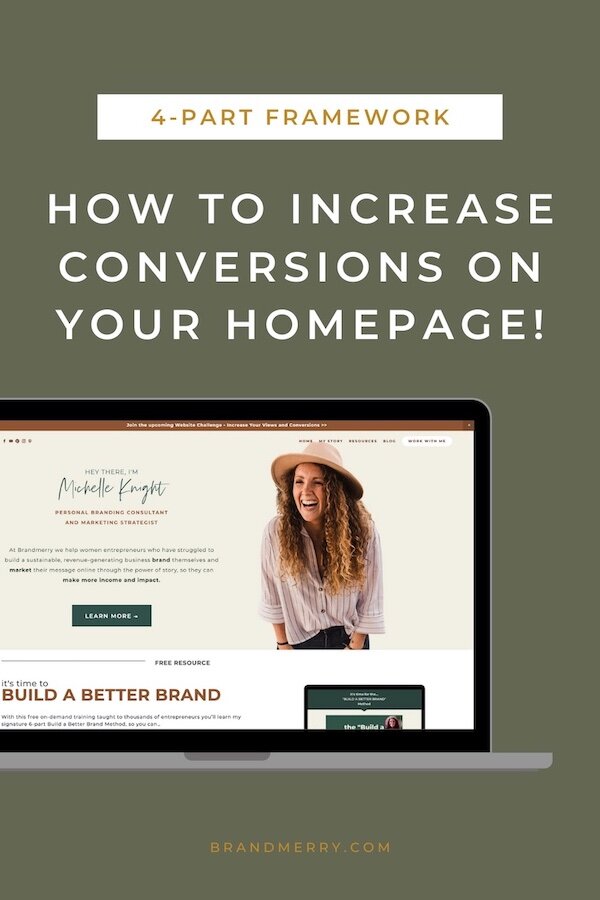
You’ll typically find yourself in one of two boats when it comes to having a website as an entrepreneur.
In one boat, you spend a lot of time, a lot of money, and a lot of energy on creating your website. Whether you've done it yourself, or you hired a team, bought a course, bought a template, or bought add-ons, you’ve spent the time, money and energy to have a website for your brand.
With boat number two, you are waiting to create your website, and it just keeps getting put on the back burner because it's incredibly overwhelming.
And no judgment, I spent, eight months creating my website, only to scrap the entire thing and start over because I didn't know what I was doing. Turns out your brand plays a really big role in your website, something I didn’t realize 5 years ago. It’s one of the reasons I teach the importance of having a solid brand foundation BEFORE you build your website.
If you need a little more love in the branding department, make sure you watch my free on-demand class where I’ll teach you my signature Build a Better Brand Method. Watch it here.
For our purposes right now, let's just assume that you've done the branding work because it is necessary. Don't think that you can jump in with this 4-part framework I'm about to give you, without knowing your brand and your message and your mission and your ideal customer, because it's just not going to work.
That's my disclaimer. It's out of the way.
Now let's talk about the 4-part framework.
WEBSITE HOMEPAGE TEMPLATE: 4-PART FRAMEWORK
Now, one of the things that I learned when I started implementing more SEO, search engine optimization, into my business is that my homepage was getting a lot of traffic.
One of the things that I teach inside of Brandmerry Academy is getting your homepage to rank in search engines for your industry because the quality leads you get are just perfection!
Things like site-wide SEO, your site title, your site description and more all help you rank on Google and all of that traffic is going to lead to your homepage. Sometimes we think about SEO only working for blogs, but one of the easiest things that you can do when you're starting your business is focus on the SEO traffic for your industry and ranking for your industry.
As I mentioned in last week’s blog, people who are in the fifth stage of the buying process are ready to buy and they're coming to your homepage where they will decide if you’re the right brand for them.
So that homepage better be working for you.
I realized pretty quickly my homepage was not working for me and I needed to switch it up a bit. I implemented what I now call my 4-part HOME framework, you see what I did there? HOME is the acronym that we're going to dissect for the homepage.
I discovered this by accident and fine-tuned it. And I've been teaching it ever since. So let's dissect the HOME 4-part framework for your homepage.
Homepage Framework Step 1: HOOK
H is for hook.
Listen, if someone's coming to your website, they are probably going to peace out in like eight seconds if you don't hook them. That's why this is one of the most important things that you can add to your website.
This is typically right at the top before anyone has to scroll down or take any action. And it tells the person who is viewing your page, exactly who you are, who you serve, and why you are going to support them in solving their problem, or how you support them in solving their problem.
Remember, as marketers and business owners, we're solving problems. That's what we do.
That's why people invest in our products and our services.
They have a problem
They're aware of the problem.
They're seeking a solution and ta-da, they're finding you as a solution, or your product, or your service to their problem.
Your goal with your brand is to attract or repel. You want to make sure that your hook is hooking in the right people and sending away anybody that isn't the right fit for you.
So, to recap your Hook should outlines:
Who you are
Who you serve
How you help them go from struggle to desire (the goal they ultimately want)
This is something I teach inside of Brandmerry Academy. One of the first bonuses you get is all about writing your signature Brand Bios and one of those is your Hook.
Homepage Framework Step 2: OPPORTUNITY
Then we move down the page a little bit to O.
O is for opportunity.
You want to give anyone that has now been hooked an opportunity to learn more and to join your email list.
This is where I love to include your freebie opt-in.
Now inside of my program Brandmerry Academy, one of the first things that we focus on is creating some sort of freebie, or lead magnet, so that as you increase traffic to your website, people are taking advantage of your lead magnet and joining your email list.
Your email list is gold. This is how you stay in contact with your brand. This is how you share important promos and updates.
People who land on your website, then disappear, are hard to stay in contact with if they aren't on your email list.
The best thing to do is include a button to a landing page or a form embedded so they can sign up for your free gift and join your email list.

Homepage Framework Step 3: MEMORABLE
Then that moves us down the page a little bit more to M.
And M is for memorable.
Listen, I teach storytelling and how we can apply it to our branding and marketing. It's kind of my thing. And one of the things that I love about storytelling is the fact that integrating story into your content, into your copy, makes it 22 times more memorable than if you didn't have any.
So, this is the point at which you become memorable to your ideal customer.
To do this, you also share a small ‘about me’ section and your mission. I call this the Bio Blurb and it’s something we teach inside Brandmerry Academy.
The goal here is to give your ideal customer more insight into who you are, your mission, the work that you do, and allow them to read more on your full ‘About Me’ page.
This is a great opportunity where you can connect through empathy and build authority, which leads us to the final stage.

Homepage Framework Step 4: EXPERTISE
That leads us to the fourth part of the homepage, which is E for expertise. This is where you want to continue to elevate your authority.
Remember, people are seeking us out to solve problems through our products, through our services, and they want to know that we can guide them and we can support them.
So after you've hooked them, you've given them an opportunity to get a valuable free resource, you’ve shared your story, let’s just amplify that expertise, shall we?
This is where you can share really popular blog posts that provide education for your audience, and can ultimately help them make small little micro-changes with their problem.
You can show your expertise by highlighting features that you've been on. If you've been featured in Forbes, or you've been featured in Business Insider, or relevant podcasts for your industry those logos can be beneficial. But, it doesn't have to be those big players that we always think about. Sometimes those niche-down outlets, media outlets, podcasts, things like that, can mean even more to our ideal customer.
If you have a podcast, you can share podcast episodes so they can explore additional resources from you.
You can also share testimonials. If you've had clients who have seen tremendous results, you can feature those on your homepage.
E is all about elevating your expertise and authority!
CONCLUSION
This is it.
These are the four things that I want you to have on your homepage. No more.
Don't overwhelm people with a million different options. Keep it simple.
Ultimately, when people land on your homepage, we either want to attract them or repel them.
Once we've attracted the right people, the ideal customer, because nobody else matters, then we want to give them an opportunity to join our email list, to learn more, or to buy almost instantly.
And creating a homepage like this is going to support you, in sending people in the different directions that you ultimately want them to go, while keeping it simple and not overwhelming.
Overwhelming your audience from the first thing that they see is a surefire way to lose them.
If you are ready to dive in to increase those website views and ultimately those conversions, this is exactly what we teach inside of Brandmerry Academy. Learn more at Brandmerry.com/academy.
P.S. Have you tuned in to The Beautiful Climb podcast? I release new episodes every other Friday on topics around productivity, motherhood, habits, goals and going after the life of your dreams! Check out past episodes and be sure to subscribe at thebeautifulclimb.com
- FREE GIFTS YOU'LL LOVE -
DISCOVER YOUR BRAND STORY IN UNDER 5 MINUTES
LEARN HOW TO WRITE AN ‘ABOUT ME’ PAGE THAT CONVERTS
MAP OUT 30 DAYS OF CONTENT IN UNDER AN HOUR
- READ THE LATEST POSTS -
MEET MICHELLE
Hey there, I'm Michelle Knight and I an online branding and marketing consultant for female entrepreneurs.
I believe in the power of storytelling and using that superpower to brand and market yourself online...oh and to set yourself free.
I'm obsessed with living a life of freedom, so much so, that my family and I now travel full-time while running my business from the road.
This blog serves as a home base for all things branding, marketing, content creation and more.

The Stages of the Consumer Buying Process and Why Marketing Matters
Have you ever heard about the consumer buying process before? For many of my clients, the answer is no, however with this knowledge you can better understand the different levels and stages of marketing. Dive into the blog to learn what they are and how marketing plays a role at every stage.

I'm jazzed and determined and lit up to talk to you today about the consumer buying process.
If you are a marketer, if you sell anything online, I don't care what it is, if someone pays you for something, you need to be aware of the consumer buying process.
When I discovered the stages of the consumer buying process, as we will talk about in this post, I quickly recognized how I, as a marketer, could make sure I was attracting leads at every stage.
But, before I get too far ahead of myself let’s start with the basics.
What is the Consumer Buying Decision Process?
Let's start by talking about John Dewey, the philosopher behind the consumer buying decision process stages.
John Dewey created this five-part system, which includes:
Stage One: Problem or Need Recognition
>> This when the customer is aware of their problem.
Stage Two: Information Search
>> When the customer is in the process of finding information to solve that problem. That's when we go to Google and other fun areas to find information to solve our problem.
Stage Three: Evaluation of Alternatives
>> The customer has found the solution to their problem, they figured out there's a way to solve it, now they're weighing which way am I going to go? This is when they’re product shopping or brand shopping, trying to figure out the best one to solve our problem.
Stage Four: Purchase Decision
>> They've decided on the brand, on the company, and on the product that they are going to purchase.
Stage Five: Post-Purchase Evaluation
>> This is when they're sitting there and going, "Did I make the right decision? I don't know. Can't wait for my product to come."
A major part of the final stage is closely related to how you onboard or welcome your new clients and customers. In a recent blog I shared my 8-step client onboarding process, so be sure to check that out after you read this post.
The Consumer Buying Process Begins When…
...the consumer has identified their problem.
Every consumer will go through the process at a different pace. Some will spend a lot of time in Stage Two, while others will be ready to make a purchase decision in a matter of days or even hours.
As marketers, this process, and where consumers begin, is important because you want to make sure that your content is reaching people at every stage of the process.
Creating content that is valuable and accessible to people at each stage can drastically improve your marketing efforts and conversions.
Ok, now time for a curveball because, in true Michelle fashion, I am going to share an alternative 5-stage buying process that is designed to specifically support you with your content creation.
5 STAGES OF THE CONSUMER BUYING PROCESS FOR CONTENT CREATORS
So we’re still focused on five stages, but you're going to notice there's a bit of a difference when it comes to designing a process for content creation.
STAGE 1: NOT AWARE
So, unlike the traditional stage one, I believe there is a group of individuals who experience symptoms or daily “red flags” that haven’t identified the true problem enough to seek out a solution. These are my Stage One-ers.
Maybe they've recognized that something might be up.
They are feeling a little off, maybe they're like, "Oh, I think I want to leave my job. I'm not sure. I think I might want to get healthy. Something's wrong. I don't know why."
The reason that it's important to think of this stage is that many people who are coming to discover your brand are at a place where they don't know the specific problem they are experiencing - maybe they can’t even identify or communicate what is happening clearly.
But through your content, through your education, through your marketing, you can help them become aware of the specific problem.
You can educate them on that, moving them quickly through the decision-making process.
STAGE TWO: PROBLEM AWARE
Stage two is when they are officially aware of the problem. So you'll notice that I add a little bit of extra in there from John Dewey's philosophy, as it applies to content creation. This is the stage, like his #1, when they are aware of the problem.
They know that they've got a problem, they've identified what it is, can describe it and find themselves starting to relate more closely to others with similar struggles, problems and pain.
This stage is all about connecting with them and their pain points with your marketing and content creation.
STAGE THREE: FINDING A SOLUTION
During stage three, your ideal customer is now aware of the problem and is now looking for solutions.
We find many ideal customers at this stage are looking for How-to and educational content, looking for quick solutions to their problem, but they're not necessarily aware that there's a product or a service that can solve that just yet.
Once they move into the third stage, they are aware of that solution. So they're starting to say, "Okay, I know how to solve this problem and now, I want to figure out the best avenue for me," which leads us to stage four.
STAGE FOUR: PRODUCT AND SERVICE AWARE
You'll notice in stage three, is when you're getting a lot of Google search results and your ideal customer is searching for brands and businesses to help them solve their problem.
Then stage four is when they're aware of the very specific offers and solutions to their problems. Their search has narrowed and they're starting to dive deeper into specific brands, yours hopefully because you delivered such awesome content 😉
At this stage, you’ll hear many entrepreneurs talk about moving from cold to warm (i.e. into brand awareness).
That's when people tend to move from being a cold audience to a warm audience.
They're starting to consume more of your content and getting to know you and this is when the know, like and trust factor is elevating.
STAGE FIVE: PURCHASE DECISION
Then finally, in the final stage, they are ready to purchase. Now, this is when they have taken out their credit card, they've decided to go with your brand and they are ready to make a purchase online or in person.
You'll notice there are a lot of similarities between what I'm sharing with you and what John Dewey originally shared about this client process, but there are some differences as well and I love to and encourage you to focus on the ones that I shared with you as it applies to content creation.
Why is that important? Because we have to understand that sometimes people are coming and discovering our brand, not fully aware of how to solve their problem.
They simply have a problem and now they're seeking out answers and information.
That's why, as I mentioned before, some of those How-To videos and knowing your ideal customer and where they're at, can be helpful in coming up with titles and content to share.
As somebody moves through the buying process, they're looking for specific solutions to that problem so integrating specific solutions for your audience can be incredibly helpful as well.
Then, and this is where I think a lot of marketers miss the mark, you always want a way to attract people who are ready to purchase.
Creating the educational content is helpful, we’ve already discussed this, but I see so many entrepreneurs miss out on ways to attract ideal customers who are ready to purchase right now - from you!
When someone is ready to purchase, where do they go? Google and search engines like Pinterest and Youtube.
One thing I noticed a couple of years ago is that we were getting a lot of traffic from Google for people who were specifically looking for personal branding coaches and personal branding consultants - at the final stage of the customer journey.
These customers were very, very quick to move into a high-level offer that I have called my VIP Intensives, typically without consuming any other information from me. Why? Because they were at stage five.
They already knew what they wanted and they were ready to invest and found Brandmerry.
HOW TO CREATE WELL-ROUNDED CONTENT
Now that you understand the stages of the buying process, it’s time to switch your focus to a well-rounded marketing approach to address every single part of this five-stage process.
So what are some things that you want to have in place? I know you're curious.
There are three things to have that will support you in making sure that you are hitting every single stage of this five-stage process with the content that you're creating every single week.
#1 Content For New Audience
Your first goal is to make sure you’re creating content for new people (aka new community members). So this is typically content that people are discovering on Pinterest, YouTube, through your blog, or search engines.
When we are in the first stages of the buying process when we're not quite sure the problem or the solution to our problem, we might be just browsing things that we know are wrong on Pinterest, looking on YouTube, searching on Google.
When we're further along in the buying process, think stage four and five, we're specifically looking for products and services. That's why marketers mustn’t just focus all of their attention on social media and instead have avenues for people to discover them.
This is also why advertising is very effective because we can target people that we know are our ideal customers, get our content in front of them and bring them in. But we don’t need to rely on advertising dollars, we can utilize organic reach through search engines to achieve the same results.
Some of the content that works well with this is How-To content, educational content, and knowing your audience so well that you can use their language in your copy.
So for instance, if I am a marketer and I am specifically marketing to highly sensitive individuals, empaths, you might say.
If my audience doesn't know that they are empaths, if they don't carry that label as being an empath, then I can't use that in my marketing, because it's not going to help me attract new people.
If they're at some of the beginning stages, then I want to talk about more of the feelings and the everyday things that are happening, how they're highly sensitive, how they tend to possibly be more affected by things that happen at work than maybe their colleagues.
These are things that they've told me are happening in their day-to-day that I can use in my marketing.
If I am using the term empath but they don't know that's what they are or they are not carrying that label, it's not going to help me bring them in.
Same with perfectionism. I talk to a lot of perfectionists. Many of my clients are perfectionists or recovering perfectionists, but sometimes I won't use that in all of my marketing because some of my clients aren’t aware that that is something that they have. But they do know the symptoms.
So goal number one is to create consistent content focused on bringing in new people. Some of my favorite platforms for this are blogging, Pinterest, and YouTube because they are search engines.
#2 Warm Up Your Audience
Goal number two is content that warms up your audience. This is focusing on those stages two through four when people are discovering that you have a solution to the problem and they want to get to know you.
We know that trust leads to purchase decisions.
Storytelling leads to purchase decisions.
Emotional connection leads to purchase decisions.
So this is where you get to amp up the storytelling, this is where you get to share more edutainment, those fun videos, Instagram Reels, show up on Instagram, and share behind the scenes of your life to build that know, like, and trust factor with your audience.
Creating content that warms up your audience is important.
Once somebody finds your blog and joins your email list, how are you staying in contact with them? Emails, Instagram, podcasting, all those different things are incredibly helpful for moving someone through the client decision-making process.
#3 Site-Wide SEO
Then finally we have the third goal, and this is something that every single business needs to set up today.
Do not wait to do this.
This is your site-wide SEO.
You have a website. I know you do. You spend a lot of money on it and a lot of time on it, in fact, probably too much. So when it comes to getting traffic to your website, specifically traffic that is in the fifth stage of the buying process, meaning they're ready to pull out that credit card, you want to make sure that your website is optimized for those keywords.
The people who typically find me through my SEO strategy are coming because they are ready to make a purchase decision and I have those searchable keywords on my site-wide SEO. It's something that once you do your research and you set it up, you don't have to worry about it again.
This shift has made the biggest difference in my business. I have a lot of resources on SEO and using SEO on your website, here on the Brandmerry Blog, but it's also something that I teach in-depth inside of Brandmerry Academy.
Brandmerry Academy is my membership community that teaches you how to market your business without social media. You can go to Brandmerry.com/academy to learn more about that and join the waitlist to hear when doors are opening again soon.
CONCLUSION
Now, remember, you must be touching your ideal customer at different stages of the buying process.
We all go through each of these stages, some faster than others. So when you wear this hat when you're creating your content, it's going to help you make sure that you're consistently bringing in new clients, nurturing those new clients, and ultimately creating consistent revenue.
Thanks, John Dewey for dropping us those original five, sorry, I made some modifications, but there you have it.
If you haven’t heard, I have a free Repurposing Guide that will support you in creating content for each of these stages. Head to brandmerry.com/repurpose to get an inside look on creating a repurposing plan and a workflow for actually getting your content out into the world, simplifying that process, making it easy peasy to show up consistently for your audience.
Watch the full video here!
P.S. Ready to build a revenue-generating brand? One that not only stands out online but also makes it easier than ever to create high-value content? Tune in to my free brand class and learn my Build a Better Brand Method. Watch now at brandmerry.com/class.
- FREE GIFTS YOU'LL LOVE -
DISCOVER YOUR BRAND STORY IN UNDER 5 MINUTES
LEARN HOW TO WRITE AN ‘ABOUT ME’ PAGE THAT CONVERTS
MAP OUT 30 DAYS OF CONTENT IN UNDER AN HOUR
- READ THE LATEST POSTS -
MEET MICHELLE
Hey there, I'm Michelle Knight and I an online branding and marketing consultant for female entrepreneurs.
I believe in the power of storytelling and using that superpower to brand and market yourself online...oh and to set yourself free.
I'm obsessed with living a life of freedom, so much so, that my family and I now travel full-time while running my business from the road.
This blog serves as a home base for all things branding, marketing, content creation and more.