

Brandmerry Blog Archives

4 Content Creation Tips for Entrepreneurs: Harness the Power of Evergreen Content in 2021
Creating content is a core pillar of marketing your business. But it doesn’t have to control your entire schedule. Although content creation is essential it’s important to note which type of content is best and follow my hacks to master your content creation in 2021.

Seriously, content creation is one of y'all's favorite things that I talk about over here at Brandmerry, because I have been creating consistent content for my audience for five years now and honestly know a thing or two about creating content that brings in your ideal customer.
But, even though I’ve consistently created content for 5 years, you’re probably here because you know I do it in a very strategic way.
I don't believe in just creating content to create content.
I want to have workflows and systems that allow me to show up for you, to get in front of new ideal customers, to show up and nurture and build relationships with my existing audience, to ultimately lead members to a sale because at the end of the day I’m running a business and that last piece is kind of important.
And, after 5 years I know content creation allows me to do all of that.
Yet here’s the kicker - I want to make sure you know how to create content that doesn't involve you sitting behind a computer for hours and hours and hours every single day, trying to write up posts knowing that those posts are probably going to disappear.
Honestly, one of the most fun things that I get to do is create new content, and these 4 hacks that I've implemented have made all the difference not just in how I'm creating the content, but more specifically how long it's taking me to create it and how long the content lasts (it’s evergreen baby, more on that later).
Let’s get into the 4 tips. If you prefer to watch the training, scroll down for the video below.
CONTENT CREATION TIP #1: CONTENT RESEARCH
Let's dive into the first thing that I have for you on content creation hacks of 2021. This one is key. So I'm going to spend a little bit more time on this one than I will the others, so let’s buckle up!
This first step is all about your research.
Now I don't know about you, but when I first started my business 5 years ago, people weren't really talking about how important it was to do research when creating content.
We were talking about ideal customer research as it applies to your branding and that is a crucial step. It was all about having conversations with people to find out how to ultimately message to them in your business. And this was great, it helps you get a solid start, but then what do you do?
No one was talking about the research that actually goes into creating content. This resulted in business owners posting things with the foundation of, “Oh, I think my audience might like this. This might work.”
I fell into that trap for a really long time, until I started looking outside of my niche at what was really working for marketing as a whole.
It always came back down to this idea that the data is always there. The information you need on what people are searching for is already there, you just have to take the time to do the research and look for it.
This simple strategy opens up an entire method for creating content that is based on search engine results not just “oh, that might be nice!”
Why, is it important to think of things that people are searching for? Well, because they are searching for it! This means that you’re getting in front of cold leads (people who aren’t familiar with your brand and services every single day). This is key when you want to consistently scale your business, especially organically.
When you're thinking about creating content, remember, we're not just creating content that is meant to serve people that already know our brand, we have to have consistent people coming in that funnel, finding you online, discovering you, getting to know you. That has to be a consistent stream in order for them to then binge read all your posts on Instagram or go binge-watch all your videos on YouTube.
This research phase requires you to do SEO or search engine optimized research.
What are people searching for as it relates to your niche on Google?
What about Pinterest?
And what about Youtube?
These are all search engine platforms, meaning someone is going there, typing in a question or topic and finding results, and these platforms can give you a freaking gold mine when it comes to finding topics for your content.

keyword research tools
In addition to using those platforms to find data-driven research, below are my favorite three tools to take your content creation topics to the next level.
KEYWORDS EVERYWHERE
One of my favorite tools is called Keywords Everywhere, and it is an extension that you can use on your Chrome browser.
You do have to pay a small fee for a certain number of searches, but it is totally worth it because when you type topics into Google it’s going to show how many people are searching for that every single month, the cost per click and if it’s competitive.
You can start to play with that and find combinations that work really well for the topics in your industry. It's also going to give you a list of suggestions of other things that you might talk about. You could have an entire month's worth of content from just a few searches.

UBERSUGGEST
The other tool that I love to use in my business is called Ubersuggest and it is another Chrome extension. They do have a free option with a couple of limited searches every single month, but you can also pay for a paid version of that as well.
Ubersuggest is another tool that we love to use over here for SEO, big picture, not just what content should I be creating, but how do I optimize that to show up and rank on Google?
Again, you can type in topics that you think are of interest to your audience based on your ideal client research and what people are asking you.
Then you can get the data to back that up.
It also allows you to see some awesome variations of how people are asking questions, who is doing a great job ranking for that keyword and even a way to take a sneak at others in your industry for inspiration.
Remember, sometimes we think we have a great idea, but our title is sucky! Use Ubersuggest you can choose a title that’s going to get in front of your ideal customer.

ANSWER THE PUBLIC
While I don’t use this tool as much for content creation ideas it is an excellent tool for ideal customer market research to learn more about their internal and external problems. This of course will help with content topics, but it’s not as useful for determining strong SEO.
The tool is called Answer the Public and it pulls all the data from Google on the top questions that people are asking in certain areas, niches, industries, and around specific pain points.
So you can take the information that you know about your ideal customer, put it in the search line, and it's going to give you all of these different questions that people are asking. By clicking on those, it'll then open it up to Google, where you'll be able to do more digging.

This stage takes a little bit of time, but it's absolutely worth it. And it's going to take the mystery out of what you should be writing and creating content around.
Everything that you're going to create regarding your content, which includes podcasts, blog posts, social media content, videos, is data-driven.
CONTENT TIP #2: DESIGN YOUR WORKFLOW
You should not be recreating the wheel every single week in your business. One of the areas that I have found that people struggle with when it comes to creating consistent content is that they don't have a workflow in place.
So, while number one takes the mystery out of, “What do I talk about?”
This step takes the mystery out of, “How do I do it efficiently?”
You can have the best content ideas, but if you don't have systems and workflows in place, you're going to struggle with consistency showing up.
Here are some things to consider when thinking about your workflow:
How many blog posts are you going to publish a week?
How many videos are you going to release weekly, bi-weekly, monthly?
Are you going to have a podcast?
What channels are you showing up on social media?
Are you going to be on Twitter, LinkedIn, Instagram, Facebook, Pinterest?
The goal here is to determine where you’ll be showing up and how often. Now, you don’t need to be everywhere, we just don’t believe in that strategy here at Brandmerry, but you do need a clear idea of where you’ll be sharing your content.
My suggestion and something I teach inside of Brandmerry Academy is to choose one search engine optimized platform (Blogging/ Google, Pinterest or Youtube) and one social media channel to start.
Once you have that data you want to pull that into a workflow that might look something like this.
Step One: Create a blog post
Step Two: Turn that one blog post into 12 posts on Twitter for the week
Step Three: Then use that blog post to create two posts for Instagram.
Step Four: Record that blog post as a podcast episode.
You could do this a ton of different ways, figure out the way that works best for you.
Some of my clients love blogging and writing, so that becomes their core content.
Some of my clients love video, like myself, and that becomes their core content.
Some love recording audio, podcasting and that becomes their core content.
Whatever core content you want, you can then push it out and repurpose it on multiple platforms.
I’m going to do a video and blog in a few weeks on repurposing, but remember this step is all about the workflow. What needs to happen and when. If you want to grab a little cheat that I've put together for you, you can go to brandmerry.com/repurpose, and get your hands on more details regarding that.
It’s these systems that allow us to build sustainable businesses.
CONTENT TIP #3: KNOW YOUR NUMBERS
Number three is a piggyback off of number one with the data, but this hack is all about knowing your numbers.
Seriously, please look at your analytics. They will tell you so much about what you want to scale in your business and can give you insight into the type of content that drives the most traffic, gets the most engagement and more.
While tip one might have focused a bit more on bringing your new audience in, this step can tell you a lot about your existing warm audience.
What types of videos do well?
What types of podcast titles and episodes have a higher listener rate?
What kind of blog posts are getting more rank on Google, are getting more traffic from Pinterest?
Which of your social media posts get more saves and shares and engagement?
Do people prefer certain topics or imagery on your social media?
You have to make it a habit to look at your numbers.
I suggest looking at your numbers every 30 days and making small adjustments and every 90 days planning your bigger moves for the next quarter of content.
For instance, I did a podcast episode about morning routines, which was one of the hardest things for me to do because I have a very different take on morning routines. You can listen to that podcast episode over on the Beautiful Climb Podcast, but this was the topic that we knew my audience cared about and would do well.
We had seen it through Instagram posts and through past Pinterest traffic. All kinds of data was saying, “Do this dang podcast episode, Michelle.”
So I did it and it was our highest listenership because we knew that it was going to be.
It was one of our most viewed reels that I created on Instagram.
We then took that content and turned it into a blog post and that blog post is doing amazing on Pinterest.
So the data is there and once you have this consistent rhythm and that workflow in place, you can start to take the guesswork out of creating content.
Look at your analytics, know your numbers, create more of what is working.
Now you can absolutely experiment and play around with things and you should, but always remember to come back to your numbers and allow that to fuel those decisions.
One of the areas that perform well in my business is video. As we ended 2020 we had a lot of data on what worked best and how we could make some modifications heading into 2021.
Here’s an example of how the data then fueled a change in my marketing.
While we knew video did really well in my business we were seeing that live video wasn’t necessarily working better than prerecorded.
At this point, I was going live every Monday at the same time to deliver branding and marketing tips as part of my show Mondays With Michelle.
Live video takes more time and energy on my part, so rather than not creating videos, we realized that we could pre-record bulk video content.
So four to five videos, depending on how many weeks are in a month to be released every single Monday on Facebook as a premiere, and on IGTV, and then repackaged to release on YouTube later on.
So by looking at the data, we realized that we could make this adjustment. I could have more time in my schedule to take on more clients, which resulted in more money and it all came from looking at the data.
CONTENT TIP #4: OUTSOURCING
The last tip I want to share with you is centered around freeing up more of your time by outsourcing. Now before you're like "Michelle, I don't have the money to invest in a team," I totally understand and that’s not necessarily what I’m implying so keep reading!
When I say outsourcing, I mean tech or team. So if you have the means to hire a virtual assistant or somebody to manage your workflow in ClickUp or wherever you're setting it up, to publish your videos, to edit your videos, then absolutely do that.
Start to outsource those content creation pieces very early on if you have the means to invest in that.
If you don't have the money or means to do that just yet, there are tech options available that are going to yes, be an investment, but a small amount compared to how much time you're spending.
For example, you can use a tool called Veed.io, which I talked about in my recent blog on my favorite Marketing Tools here, to resize your videos for different platforms, add transcripts and even edit the title and captions.
You can use a transcript service like Rev.com to upload your video or podcast and have a full transcript that you can then turn into your blog.
There are a lot of tech options out there that will help you streamline this entire content creation process. And again, as you begin to build your revenue, you can then build your team, which is going to make your life so much easier!
Content creation is the heart of your business. Without strong content, you can't attract your ideal customer, you're not nurturing your existing audience, you're not showing up for them and you’ll have a hard time selling.
So creating content should be a very, very important part of your brand and of growing your business.
This is where I recommend that people invest pretty early on when it comes to tech and team, and when it comes to marketing and advertising dollars as well.
Remember, to save this blog for future reference and grab your free repurposing guide at brandmerry.com/repurpose to master your workflow.

P.S. Planning and creating your content doesn't have to be a constant struggle. There is a better way to research, plan, and create your content as an entrepreneur and it's all inside the Content Planning Blueprint!
The Content Planning Blueprint is perfect for online business owners who know the power of content creation but are tired of spending all of their time coming up with ideas, organizing their content, and wondering what will attract their dream clients.
In just a few hours, you'll have 90 days of content planned, a repeatable workflow to save you hours on creating and distributing your content every week, and content topics that will keep performing for your brand for years to come! Get your blueprint now >>
- FREE GIFTS YOU'LL LOVE -



DISCOVER YOUR BRAND STORY IN UNDER 5 MINUTES
LEARN HOW TO WRITE AN ‘ABOUT ME’ PAGE THAT CONVERTS
MAP OUT 30 DAYS OF CONTENT IN UNDER AN HOUR
- READ THE LATEST POSTS -






MEET MICHELLE
Hey there, I'm Michelle Knight and I an online branding and marketing consultant for female entrepreneurs.
I believe in the power of storytelling and using that superpower to brand and market yourself online...oh and to set yourself free.
I'm obsessed with living a life of freedom, so much so, that my family and I now travel full-time while running my business from the road.
This blog serves as a home base for all things branding, marketing, content creation and more.

10 Branding Quotes to Inspire Entrepreneurs in 2021
Looking for a little brand motivation? Nothing motivates us like quotes, am I right? Click through to see the top 10 branding quotes to motivate you in 2021.

10 Branding Quotes to Inspire Entrepreneurs in 2021
BY MICHELLE KNIGHT

Who doesn’t love a good quote?
Fun fact, during my high school graduation speech I listed out my top quotes. Super original, but like I said everyone loves a good quote.
So what better way to motivate us to build an amazing personal brand than quotes from the experts
After you dive into these quotes, save them to your Pinterest board and hang them in your office (hello, motivation) be sure to watch my free class on How to Build a Better Brand.
Sign up for the on-demand training here>>
10 Branding Quotes for Entrepreneurs
“If people believe they share values with a company, they will stay loyal to the brand.” - Howard Schultz
Why this quote is important: Brand Affinity is an aspiration that every brand should have. It is the shared values between a consumer and a brand and leads to brand loyalty. Focus on your brand values from the start and let them shape the voice of your brand.

“A brand is the set of expectations, memories, stories and relationships that, taken together, account for a consumer’s decision to choose one product or service over another.” - Seth Godin
Why this quote is important: Branding can feel confusing, what is it really? This quote from Seth Godin is one of the classic definitions of a brand. Remembering that it’s not about the product or service and the overall combination of memories, stories, relationships and more.

“Your brand is the single most important investment you can make in your business.” - Steve Forbes
Why this quote is important: As a Personal Brand Consultant I 100% agree with this quote because I’ve seen it time and time again as the #1 contribution to a successful business. Inside my 6-part Build a Better Brand Method class, I share how your solid brand foundation leads to success in all aspects of your business. Spending not only money but also time building that foundation is key.

“It’s important to build a personal brand because it’s the only thing you’re going to have. Your reputation online, and in the new business world is pretty much the game, so you’ve got to be a good person. You can’t hide anything, and more importantly, you’ve got to be out there at some level.” - Gary Vaynerchuk
Why this quote is important: The truth is your business is going to change. Your products and services will evolve and how exhausting would it be to have to change your brand as that happens? When you focus on building your personal brand around you then it evolves with you and your strong reputation follows.

“If people like you they will listen to you, but if they trust you, they’ll do business with you.” - Zig Ziglar
Why this quote is important: This has been the most influential quote in my entire business. When I first discovered this my first year in business I instantly saw the purpose behind the frequent posts, emails, content, etc. I realized it’s all about building trust! It might not lead to the most likes or comments on a post, but over time I’m building trust with my audience and that has repeatedly proven to be the most important strategy as a business owner.

“Your brand is not what you sell.” – John Iwata
Why this quote is important: Can I get an amen? Too often I watch business owners brand their product or service and find themselves with no community and no sales. As I’ve mentioned before, focus on building a brand foundation and allow your products and services to be an extension of that.

“Marketing is no longer about the stuff you make but about the stories you tell.” – Seth Godin
Why this quote is important: While this might be more marketing-focused, I hope you realize how both branding and marketing fit so perfectly together. Marketing won’t survive with a solid brand and a solid brand won’t survive without a marketing strategy. You’re probably picking up on a theme in this post, but it’s not about what you sell, it’s about the experience and storytelling is an excellent way to share that with your ideal customers.
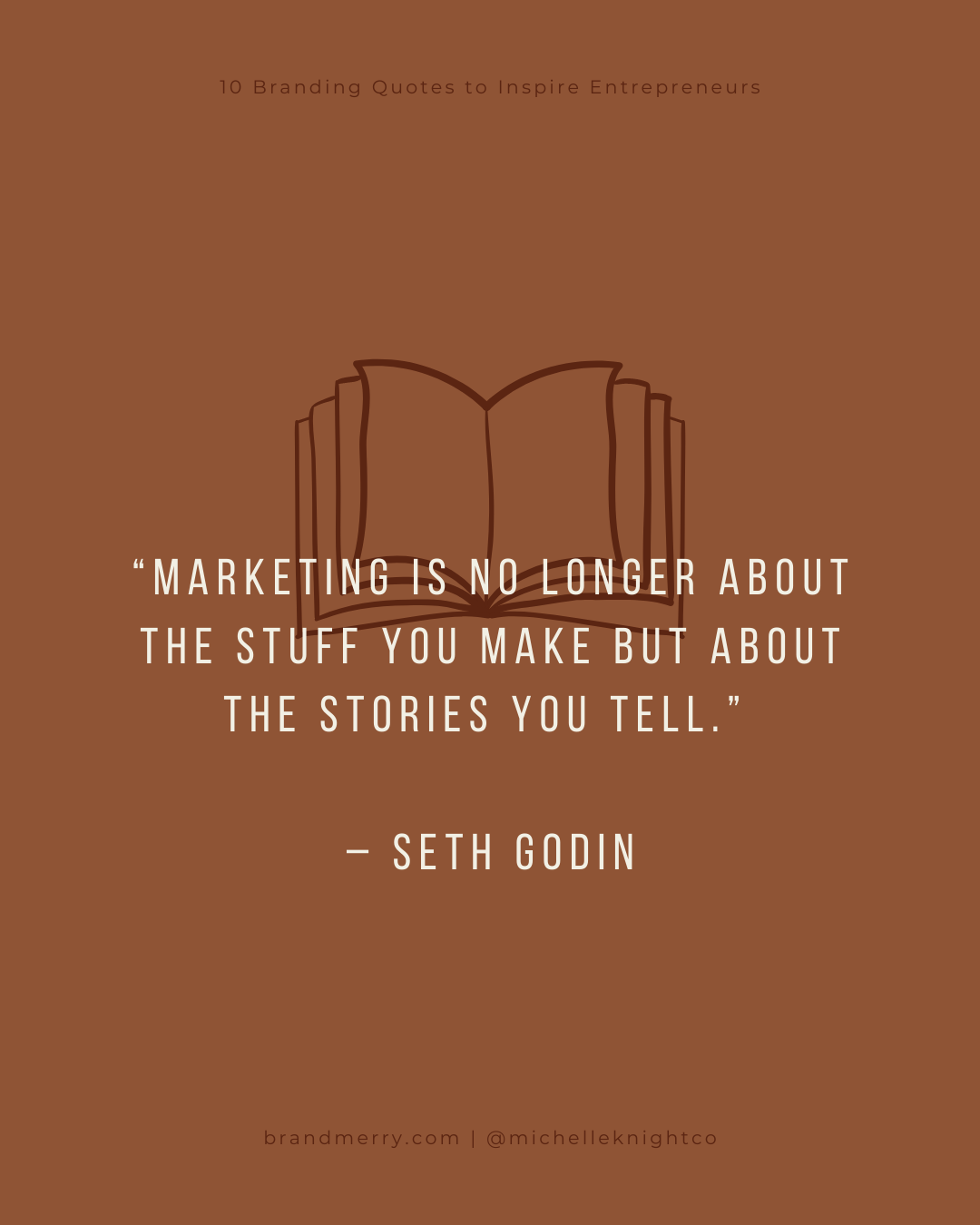
“If no one hates it, no one really loves it.” - Jessica Walsh
Why this quote is important: I often say a good brand should both attract and repel and the reason for this is that when you’re clear on your values, your niche is specific and your messaging is direct, there will be people who like it and others that don’t. This is great! Stop trying to please everyone with your brand and focus on your ideal customer only.

“Demand for your business is driven by the quality of your reputation. Live and breathe your values to maintain control of your brand reputation.” - Stacey Kehoe
Why this quote is important: I told identifying your brand values was key, but I think this quote also ties in the importance of transparency and an authentic brand. Your personal brand should be an extension of you - it doesn’t have to be all of you, this isn’t your diary, but it should be a living and breathing representation of who you are, your ideal customer and your values.

“Your personal brand is the experience you’re creating for your audience. Think of it as the beating heart of your business.” - Michelle Knight
Why this quote is important: Why, yes I did just quote myself and I’m not ashamed. I want to leave you with this vision of your brand. When we think of starting a business we often jump into all the logistics and systems, completely bypassing the very thing that makes it survive - your brand. Start to think of your brand as the heart of your business and watch as your ideal customers come seeking you out.

Don’t forget to sign up for my free training on the Build a Better Brand Method. It’s completely free and will support you in better understanding not only the purpose of a personal brand but also how to follow my 6-part framework to bring your brand to life.
P.S. Have you tuned in to The Beautiful Climb podcast? I release new episodes every other Friday on topics around productivity, motherhood, habits, goals and going after the life of your dreams! Check out past episodes and be sure to subscribe at thebeautifulclimb.com
- FREE GIFTS YOU'LL LOVE -
DISCOVER YOUR BRAND STORY IN UNDER 5 MINUTES
LEARN HOW TO WRITE AN ‘ABOUT ME’ PAGE THAT CONVERTS
MAP OUT 30 DAYS OF CONTENT IN UNDER AN HOUR
- READ THE LATEST POSTS -
MEET MICHELLE
Hey there, I'm Michelle Knight and I an online branding and marketing consultant for female entrepreneurs.
I believe in the power of storytelling and using that superpower to brand and market yourself online...oh and to set yourself free.
I'm obsessed with living a life of freedom, so much so, that my family and I now travel full-time while running my business from the road.
This blog serves as a home base for all things branding, marketing, content creation and more.

The Ultimate Personal Branding Guide for Coaches, Consultants and Entrepreneurs
The Ultimate Personal Branding Guide for Coaches, Consultants and Entrepreneurs
BY MICHELLE KNIGHT

Everything you need to know about personal branding as an entrepreneur.
Let's dive into why personal branding is essential 👇
THE IMPORTANCE OF BRANDING
Having a solid brand impacts the success of your marketing.
It allows you to craft messaging that pulls in your audience.
Having a solid brand allows you to know what to use for SEO to rank.
Having a solid brand tells you the type of copy and imagery to use on Facebook ads and Pinterest ads, so that they convert into sales.
Having a solid brand tells you what type of product or service you're going to put out into the world that's in alignment with what you want to provide and what your audience needs.
Having a solid brand is important, and it is the foundation of the things that you can achieve in your business.
Without a solid brand, your marketing will suffer.
SIGNS YOUR BRANDING ISN’T COMPLETE
Alright, now that we are all on the same page about the importance of branding as an entrepreneur, let’s dive into some of the signs that your brand might need some additional work. It’s important to pay attention to these signs and make adjustments so you can move forward with confidence in marketing your brand and business.
👉 SIGN #1: You’re Struggling to Make a Sale
Now, maybe it's your first sale or maybe you made a sale three months ago, but regardless of timing you're having trouble signing another client, or making another sale in your course.
The thing to keep in mind is that selling doesn't happen at the moment that someone's like, "I want to buy your product," it's happening long before.
It's happening the first time they come across your social media channel, your freebie, your Facebook ad, your website.
That's when the relationship and sale are starting and that is all reliant on branding.
That first feeling they get when they see your brand, the messaging that they're picking up on, that this is exactly what they need in their lives at this moment, how you're following up, your email campaign, the live streams you're doing, the podcasts; all of that is directly tied to branding.
The selling process has to start long before you actually send an email that says, "By the way, guys, selling this thing." Because if it doesn't, you're going to notice that you don't sell any of the “thing”. Because without that strong connection, nobody really knows what you're about, and there will most likely still be a lack of trust. If you don't email them ever or have clear, consistent content, they might not even know who the hell you are.
These are important pieces of branding.
So if you're struggling to make a sale, or let's just even say consistent sales, even consistent money, it's possible that you have a branding problem.
👉 SIGN #2: Your Messaging is All Over The Place
At least once a week, someone will message me and say, "Michelle, I'm looking for support. I want to work one-on-one with somebody. My biggest hurdle is that I feel like my messaging is all over the place."
If you feel like your messaging is all over the place, I can tell you with 100% certainty that that is a branding problem.
How you show up, how you share what you do in a way that clearly communicates to your audience that it's for them and how it will benefit them is part of your brand. So if you feel like your messaging is all over the place, it could be because of two different things.
One, it could be your social channels, and your website, and your emails all look very different. They all sound very different. There's not a clear linear message.
It could also be that anytime you're talking about your product or an offer, maybe you're in the middle of a launch, all your messaging is different. There's no clear, "This is the program. This is who it's for. And this is how it will benefit you," or, "This is the product. This is who it's for. This is how it will benefit you."
That is a sign that your messaging is all over the place.
And maybe you've already felt it, you aren't successful with your selling, because people aren't really sure what it is that you're doing and how it's going to support them. And that's huge.
👉 SIGN #3: Your Website Isn’t Converting
Your website is the experience that you get to control, and there's no algorithm fighting against you which is so nice.
But, once again if your website isn't converting viewers into subscribers or clients, it is a branding problem.
Because if people don't understand who you are and what you can help them with, they will peace out and they will do it very quickly.
I very rarely talk about the aesthetics as it relates to branding, but the reality is that with your website, those photos, those colors, those aesthetics, those fonts, that one-liner at the top, can make or break someone staying on your website or bouncing right off.
5 seconds is about all you have before someone says, "Is this for me? Is this not for me? Okay. Bye."
The photos and those pieces of your branding pull them in really, really quickly, and then it's all about your language and your messaging to keep them captivated and to convert them. So if you have a website, if you're getting traffic, and it's not converting, we have a branding problem.
These are three examples of possible holes in your branding, and the most popular one’s I see and hear from my clients and community.
How to Find Your Personal Brand 👇
What is a Personal Brand?
Your personal brand is the experience you create for your audience. It’s made up of your experiences, stories, skills, and personality.
Building your personal brand is important online, because whether you like it or not your personal brand is being written for you. The way social media works today is if you’re not in the driver's seat controlling your brand, you risk the wrong message getting out.
If you have a business, then personal branding allows you to create a deeper connection with your audience that builds trust and goes deeper than just the product or service you provide.
So how do you find your personal brand?
I’ve got 4 simple steps and important questions to ask yourself in the process.
1. Create a Personal Brand Identity Starting With You
If you want to create a personal brand identity it’s time to get, well, personal. The idea of a personal brand is that you and your story will be at the center of your brand.
So, before we get into strategy, ideal client work or messaging (which we will cover by the way) we need to take a look at your own authenticity and personality.
What makes you who you are? This includes the way you speak and write, the things you like to surround yourself with, what you value most and yes your favorite color. All of this is going to play a big role in building your personal brand.
When you can begin the process by looking inward rather than outward, you’ll better understand how to present yourself in the online space and that is SO important.
With how fast social media is changing and how many entrepreneurs are in your niche, it’s so important that your brand, the core of your business, is not only defined but is also different.
Now, before you freak out and say to me, “But, Michelle I’m no different, nothing exciting happened to me!”
I’d say, “Give me 60 minutes…” just kidding, but seriously, it often takes me just one coaching session to pull out the parts of you that are authentic, different and will set you apart from others in your industry.
And where I start with all of my clients is their story. Every single person has a story and that right there is what’s going to set you apart and build trust with your audience.
You can learn more about Brand Story in this post and take my Brand Story Quiz here.
2. Identify Your Personal Brand Audience and Future Clients
Alright, now that we’ve identified, or started to identify the core of your brand, there’s another crucial part.
I think we can agree that communication is a two-way street and that’s exactly what you’re setting out to do online when posting on social media, creating your website and writing emails. You can create that stuff all dang day, but if no one is receiving your message it kind of means nothing.
This is why identifying your audience is so important and should be done at the beginning of your business.
Identifying your audience consists of three parts:
Daydreaming about who you want to work with
Justifying your “dreams” with market research
Creating a client profile
The key step here, and what so many entrepreneurs skip, is the element of Market Research. Please promise me right now that you won’t skip this step.
Using free tools on social media, via Google, Facebook Groups and personal conversations you can begin to identify the key components of your audience and use that in your branding and marketing down the line.
3. Map Out Your Brand Offer and Framework
Let’s get one thing clear...I DO NOT MEAN YOUR PRODUCT.
So many people think that their product is part of their brand, but it’s not that’s all your business boo and without a brand, well you won’t have a successful business.
If you start with your product or service you’re going to miss the mark. You’ll have the logistics in place, but no clear pathway or transformation that you’re providing your client.
It’s important, during the branding process to take time to clearly state the transformation you provide and the overall framework for your product and services.
And, no, I don’t care if you sell soap or an online course, what are you providing your client beyond the individual product.
4. Create an Emotional Brand Experience for Your Audience
Want to stand out online?
Do you want your brand to do more than just get some followers and look pretty?
Then, you need emotional branding my friend. Emotional Branding is my specialty and something you don’t often find online but can be the difference between a brand that makes money and one that doesn’t.
The idea of Emotional Branding is that your audience will feel a deeper connection to your brand, above someone else's and therefore know, like and trust you...which as you guessed it, leads to business.
If you want to learn more about Emotional Branding specifically, you can check out this post.
Before you decide on your fonts, finalize your colors, create a logo or get your brand photos taken you want to identify the emotional core of your brand.
From here choose the aesthetics of your brand will be a breeze.
Brand Affinity 👇
WHAT IS BRAND AFFINITY?
Brand Affinity is when a consumer believes a particular brand shares the same values as them.
It’s deeper than a knowledge of the brand, brand awareness, and begins to build the connection between consumer and brand on a more personal and emotional level.
This connection is what allows you, as the brand, to not only stand out online but keep your audience coming back time and time again.
Remember purchase decisions come down to trust.
“If someone likes you they’ll listen to you, if they trust you they’ll do business with you!” - Zig Ziglar
Building this trust is necessary when building an online brand in 2020 and beyond because consumers are looking for brands that they can trust.
As more generations become part of movements and make changes in their personal lives they’re looking for brands that share those values and go even further to provide support for those values as well.
When you build brand affinity with your audience you increase the likelihood that they will purchase your service or product, you create a consumer base that sticks around for the long haul (hello community) and your audience is more likely to refer others to your brand.
I don’t know about you, but that sounds like a sweet deal.
5 WAYS TO INCREASE YOUR BRAND AFFINITY
I know you’re wondering, “Michelle, aside from storytelling how can I increase Brand Affinity with my community?”
Well, I’m so glad you asked!
I know storytelling can feel complex, I’ve included some resources below to support you with this, but I want you to be able to start TODAY. So, below you’ll find five simple ways to improve your Brand Affinity almost immediately.
1 | SHARE YOUR BRAND VALUES
Seems simple enough right? Well, not enough brands are identifying the values of their brand and therefore aren’t sharing them. How do you expect someone to experience Brand Affinity, shared values, if you yourself don’t know your brand values.
So, if you haven’t already identified yours now is the time to start.
I suggest thinking of the values you personally hold and how those connect to your brand.
What values do you want to share between you and your consumer, it will be a lot easier to build a business you love if you attract the right people.
For instance, some of my brand values are:
+ Authenticity
+ Transparency
+ Care and Attention to Detail
+ Reduce the overwhelm
+ The desire for our living a Freedom lifestyle
I showcase these through my marketing, every email, photo, etc is focused on attracting people who share the same values.
TAKE ACTION: Identify your core values and then share them.
The simplest thing to do is post them on your website, this can be done on your About Me page, but as we talked about earlier you’ll also want to showcase these through storytelling.
2| SHARE THE MISSION BEHIND YOUR BRAND
I started my career in non-profit work so forgive me as a gush over the power of a Brand Mission. As business owners we forget this, not enough business owners are taking the time to identify the mission or purpose behind their brand and this is a mistake.
63% of consumers state they want to buy from purpose-driven businesses.
And although money is amazing, I love it myself, it’s not the purpose. Your purpose and mission need to be deeper than that.
For instance, the mission behind my brand is…
“To empower women to uncover and own their story and share it with the world through their personal brand.”
This mission not only drives every decision in my business, but is also one of the main connectors for my audience.
TAKE ACTION: Identify your mission.
What is the purpose behind your business?
What legacy do you want to leave begin with your work?
Then share it! I love encouraging my clients to share their mission statement on their Home Page, but you can also include it on your About Me page.
3 | SHOW BRAND AFFINITY THROUGH PHOTOS
This is my favorite thing to do as a personal brand and it’s so important. We often don’t think about the effect of Instagram on building trust or the use of seeing multiple photos on a website as a way to build Brand Affinity, but it’s actually a very powerful practice.
Here’s why it’s so powerful. When you showcase multiple photos of yourself, different outfits, different locations, different expressions your audience feels as if they are seeing at different moments in time. It’s as if you’ve met and know each other for longer than you actually have.
Photography overall is one of my favorite investments as a brand. It’s not about spending a bunch of money or posing for all your photos, but it is about elevating your brand by showing different sides of your personality and if you’re not a photographer then hiring one can be one of the best investments in your business.
TAKE ACTION: Hire a photographer if you can and make sure you clearly articulate your brand values, ideal customer and the emotional connection you want to portray. More on prepping for a Brand Photoshoot here
But, even if you can’t invest in a photographer right now, you can use a tripod or a friend to take photos of you. Make sure you’re sharing different moments in time to achieve the Brand Affinity. Then share your photos on your website and of course on social media.
Take a look at my Instagram to get a feel for this!
4 | BUILD A COMMUNITY
There are a lot of different ways to build community outside of a private Facebook Group, even though everyone is telling you that you need one. The truth is you can build community on social media and through your email lists just as effectively.
When we think of community we think of a central location for everyone to hang out, but what you’re wanting to do is just declare your brand as the community.
For example, inside of my first email when you sign up for my email list I welcome new subscribers to the Brandmerry Community.
I’m always referring to the Brandmerry Community on my live streams, blogs and on social media. There isn’t a specific jacket we all wear, but we know. The women inside the community know I’m speaking to them and about them and that builds connection.
You could even go as far as declaring a name for your community.
This sense of unity makes someone feel as if they are part of something bigger. It’s not just about buying your product and peacing out it’s about belonging, which we as humans want.
TAKE ACTION: How can you use the tools at your fingertips to build a community? Will you give your audience a name? Determine some of the fun ways you can create a community that allows your audience to be part of something.
5 | EXCELLENT CUSTOMER EXPERIENCE
It’s no secret that as consumers we want to be cared for. We don’t want to work extra hard to get the products and services we desire and once we make the decision, i.e. commitment, we want it to be easy.
This is where your customer service comes to the next level.
We often think the customer service is the sale, and while that is important, what comes next is what builds further Brand Affinity.
For instance, when someone purchases one of my services or courses they receive instant confirmation that their purchase has been received. Then, they receive an email with all the information they need, including login, how to access the materials, the next steps and where to start.
I take the guesswork out of getting started and right away my audience feels taken care of and trust is increased.
TAKE ACTION: How can you improve your customer service? If you have any holes in your process, post-sale, fill those now!
Emotional Branding 👇
What is Emotional Branding?
Emotional Branding is the art of communicating with your audience on a deeper, more personal level. It amplifies this idea of building relationships, which is what marketing truly is.
The end goal when marketing your business (which is just the art of amplifying your brand and attracting the right people) is relationship building.
And how do you know what types of content to create to build those relationships, if you don’t fully understand your audience?
This is why an integral piece of emotional branding and relationship marketing is knowing your audience.
By understanding your audience you can make decisions that connect deeply with their struggles, challenges and obstacles they’re facing and the goals and desires they are working towards and use that in your marketing.
And one more note on relationship marketing.
As consumers, we are bombarded with messages every day and we know as consumers that we're going to resonate with the ones that make us feel something, that stir something inside of us, that motivate us and make us feel a sense of belonging. This is the art of great branding.
Understanding how you want your audience to feel impacts the aesthetics of your brand; your logo, your font, your colors, your copy, the language that you're using in your copy, in your content, the stories that you're choosing, the messaging that you're using when you're on a live video, your website and even your products and services.
Emotional branding impacts every single aspect of your business.
The Benefits of Emotional Branding
A study from Harvard found that 90% of purchase decisions are made subconsciously.
This proves that the reason we buy is based not on the logistics we know about a product, but rather the interactions we’ve had that lead us to that brand and product/service. It comes down to the know, like and trust factor of a brand and how we feel the brand will solve our problem.
And as I mentioned above, when it comes to selling we always focus our energy on the sales conversation or the moment someone says, "I would like to buy your product," but that's not actually the buying process. The buying process is happening long before they decide to purchase or they put their credit card down, it's happening in those interactions with your brand.
So if the reason we invest in someone or something comes down to how that person, that product, that business, that brand ultimately makes us feel, wouldn’t you want to make sure you’re connecting on this level with your potential client?
I bet you do!
And it doesn’t stop there with the purchase. In fact, an area that many small business owners neglect is thinking about how they are continuing the art of emotional branding throughout the customer journey.
Yes, we need to start having real conversations about the customer journey and customer lifetime value.
When we start our businesses, it’s all about making money and with good reason. However, this mindset can keep us playing small as we continue to grow our business. Once we get those initial clients in the door what happens? How do we keep them engaged?
This is where emotional branding comes in because emotional branding has been proven to increase customer lifetime value and retention. When you build a deep connection with your audience from the start and continue to deliver on your mission, values and promise, you’re creating a fan for life.
And this is how you build a sustainable business!
Choose Your Brand Colors 👇
1. Brand Color Tip #1: Look at Your Daily Inspiration
The idea of personal branding is that you are the center of your brand and use your own personality traits, authentic voice and stories to create a brand that resonates with your ideal audience. If you don’t already know my stance on personal branding, be sure to check out this article here.
So with that in mind, why don’t we start with the things you already love?
When starting to create the aesthetics of your brand it can be really easy to get lost in what other people are doing, other professionals and other brands. The result is a loss of personal brand identity and blending in with others in your industry.
Rather than first looking outside yourself for inspiration, I recommend taking a look at two areas in your life: your closet and your home.
We buy things that inspire us and often that is associated with the psychology of color (more on that later), so why not use this personal color inspiration as a tool to choose your branding colors?
Start by looking at your closet and making a list of the top five colors you see most prominent.
Then repeat the process, by walking around your home.
Do you see an overlap in the specific colors, tone of color or color palette you tend to gravitate towards? This is where you should start when thinking of your branding colors.
2. Brand Color Tip #2: Identify Your Brand Emotions (Emotional Branding)
Just like with all things branding, after you’ve connected with the purpose and story behind your brand (aka you), it’s time to think of your audience.
We never want to create a brand that only takes our taste or style into consideration and we never want to create a brand solely for others that doesn’t connect deeply to ourselves.
So, after you’ve identified the colors you enjoy most, it’s important to think of how you want your audience to feel.
This is referred to as Emotional Branding and is something I teach my clients in my signature programs. You can learn more about Emotional Branding above!
When thinking of your brand colors, you need to know your ideal client very well, the reason for this is if you don’t understand their pain and pleasure points you won’t be able to use the power of psychology to choose your colors.
For instance, if I know my ideal client is feeling overwhelmed, is highly stressed and struggles with time management, I won’t choose a color that tends to elicit a feeling of anger.
On the flip side, if I know my client is driving to feel pleasure in her home and her health and loves the eco-lifestyle, then I would choose a color like green, which gives a feeling or serenity and organic.
In order to choose the right colors based on psychology, you need to know your audience and use that information to decide how you want your audience to feel when coming in contact with your brand.
So, before moving on to step three, it’s important to identify 5-7 brand emotions to relay to your audience.
If you need support with understanding market research and why it’s important, be sure to catch my free masterclass on The Build a Better Brand Method. Sign up here.
3. Brand Color Tips #3: Choosing Your Brand Colors Based on Psychology
Ok, no the REALLY fun part and the part I seriously geek out on. This is why emotional branding is so important because everything that relates to the aesthetics of your brand: colors, fonts, logo design, website layout, brand photos, etc… can be built on the fundamentals of psychology.
I recommend choosing three brand colors as your main colors and explore complimentary colors to play around with on social media.
Must Haves for Brand Messaging 👇
WHAT IS BRAND MESSAGING
Brand messaging is how you communicate the purpose of your brand, the problem that it solves, what you do, the work that you do, and the products that you have in a magnetic way.
It's not only about attracting the right people, it's also leading them, and converting them to the offer. It's about bundling it all up in a clear, specific and concise way.
People are always telling me, "I want a better way to communicate what it is I do to my audience so that they want to do it."
And I'm like, "That is brand messaging." It's all about communication.
The mistake people make with their brand messaging is just focusing on what they do. They craft messages that say, "This is what I do. This is what I create. This is how many modules there are," and they don't focus on why those things are important.
Their focus is, “Well, this is how I'll help you, and this is what I'll do with x, y and z”, and not focused on why their audience cares about those things in the first place.
What your audience really wants to know is how what you say you're going to do will benefit them. Because when we're going into buying something, yes, we might be looking for specific things, but we want to know it's going to solve our problem and it's going to help us get to the end result that we want.
I know that might seem like a lot to include, you might be thinking, "How do I communicate all of that?" but it truly is quite simple.
WHERE TO USE BRAND MESSAGING
Brand messaging can be and should be designed for your brand as a whole. This is something that I teach inside of my programs and referred to as Core Brand Messages.
It's this idea that your brand as a whole solves a very specific problem for your ideal customer, and you need to understand why solving that problem is important to your ideal customer.
But then, you can also create different variations of that or even more specific messages for a particular offer, for a landing page, for a webinar, for a sales page, in an email, etc...
For instance, I have core brand messages for Brandmerry as a whole. But then, my program, Brandmerry Academy, which focuses specifically on marketing and teaching people how to market their business, has very specific messages on marketing. I don't talk about the basics of starting a business because we're focused on marketing.
I reserve those types of messages for my program Roadmap to Freedom.
Strong messaging is used everywhere and anywhere you want to sell something, and following this brand messaging framework will make your life way easier.
BRAND MESSAGING FRAMEWORK
Excellent messaging always comes back to knowing your audience. So, even though I’m going to share with you a framework for your messages, I want you to remember the language you’ll use will come from what you know about your ideal customer.
We can't craft messages that convert, sales pages that sell, email campaigns that email, we can't do any of that if we don't know how to communicate to our audience.
I think copywriting is such an art. And so many people are like, "Well, I'll just hire a copywriter. I'll just get to a place when I hire a copywriter." But you're never going to get there if you don't know how to do it now yourself.
There are people who are incredibly skilled at writing copy, and they freaking own that. They're just masters at it. But, everyone at the bare minimum needs to just understand how to communicate to their audience. And that's really what messaging is. And as you can see, so much of your messaging working is reliant on understanding who you're talking to and then letting them tell you what they want and the language that they use and plugging that into your copy.
The framework, once you have the market research, is actually quite simple.
The brand messaging framework includes what you do, the problem you solve and why it’s important.
PART ONE: WHAT YOU PROVIDE
You need to note that it’s not just one thing, otherwise you’d have one brand message. What you do needs to be broken down into pieces. Think about your framework, modules you offer, modalities, techniques or just the flow you lead your client through.
PART TWO: WHAT PROBLEM DOES IT SOLVE
Taking it back to the ideal client work, understanding the struggles/ pains of your ideal customer is huge. When you know what they want to avoid or what they are working towards you can use that to share how what you do will help them achieve that.
This is the second stage of messaging to say, “This is what I do so you can…”
PART THREE: ADDING THE REAL BENEFIT AND URGENCY
This is all about why your audience should care and why it’s important. This is the sweet spot of brand messaging and the difference between someone working with you and someone not working with you, someone buying your course and not buying your course, someone buying your product and not buying your product.
If they aren’t clear on how investing in this will serve them, they won’t do it!
4 Branding Tips 👇
Branding is hard, there I said it!
As a Branding and Business Coach for Female Entrepreneurs, I support women in branding and marketing themselves online and building the business of their dreams.
However, it took me months to find my personal brand after being stuck in a cycle of comparison and lost in connecting to my true story and personality.
I started my business with a single struggle - how to brand myself and my services online.
I spent eight months trying to create an online brand based on other’s expectations and it resulted in zero clients.
That was almost 4 years ago and since that time I’ve grown my community to thousands of women, celebrated over $400,000 cash in my business and figured out this whole personal branding thing, so much it’s what I now teach as the foundation of all my programs and as an online business coach.
And, if I’m being honest I think so many online coaches, especially business coaches get the whole branding thing wrong. It isn’t as simple as picking your colors and fonts and sure as heck doesn’t revolve solely around your service, product or offer.
However, it is one of the most important things you can do for your business!
You can learn more about The Build a Better Brand Method here.
Aside from the 3-part method I teach inside the free training, I wanted to share with you 4 great branding tips from someone who not branded herself online, but also teaches other women how to do the same.
Let’s get into it!
1. Tapping into Your Story
Yes, Storytelling is my signature tool to support female entrepreneurs and for good reason...storytelling is the key to branding.
The first thing you really need to do as a personal brand is to actually identify your story. You need to identify the reason behind your brand. You need to identify the mission behind your brand and tap into the different ways that your story, your personality brings that to life.
One of the things that separate a personal brand from a regular brand is the personality behind it and so you want to be able to input you into everything that you do in the online space and there's no better way to do that and set yourself apart from other people than by tapping into your story.
I highly recommend looking at your business, looking at the brand that you want to create, and then look back at your story.
There are various chapters to see which ones connect to where you are now. This is going to help you get started and actually sharing your story in the online space and start to build that trust, like and know factor with your audience.
Additional resources:
Where and When to Share Your Story. Click to read more.
How to Identify Your Brand Story. Click here to read.
2. Emotional Branding
If there is one secret weapon I learned earlier on in my biz as I was designing my business coaching programs, it's the importance and power of emotional branding.
We all know that feeling when we just click with a brand. We become obsessed with their content, products, IG stories, etc…
That's not because we need their product it's because we feel something when we're connected to them. This is emotional branding, and it's how I feel every time I think of Trader Joe's ♥️
Emotional Branding is so important no matter what you sell. Think of how you want your audience to feel when they see, hear, read or come in contact with your brand (remember it's not just aesthetics). How can you build trust with your audience by making them feel this connection?
P.S. this is also why we buy, because of an emotional connection, so you're doing yourself the service of not only attracting lifelong fans but also making sales.
Additional resources:
How to Build an Online Community Through Emotional Branding. Click to read more.
How to Attract Your Dream Clients Through Emotional Branding. Click to read more.
3. Clear Communication and Messaging
My third tip for you is around clear communication and messaging. You literally can not have an effective and revenue-generating brand without this piece.
How you communicate who you are, what you provide and in a way that resonates with your audience can make or break your business.
So I get this question a lot. “How much do I share?” “What parts of my story do I share?” And this is the communication component.
If you have a piece of your story that you think is really amazing, but you cannot connect that to your audience, it's not the right time to share that.
So some of the key things that I love to ask myself, is this valuable to my audience? And what kind of value do they get?
This allows me to make sure everything that I'm creating with my personal brand, every way that I'm communicating it through my marketing, my email and my social media is always going to resonate with my audience. This is the key.
Make sure your messaging is clearly communicating the benefit of working with you, of your service, of your product, with your audience so they can really see themselves in the outcome of your product.
Additional Resource:
How to Create Better Brand Messaging. Click to read more.
4. Create a Sensory Brand Experience
This one might be a combination of all three but it's worth repeating. Great brands are sensory, meaning they play on all the senses we as humans experience.
This is important because in the online space we often can't touch a product before we buy but we can get the same feeling through strong imagery and copy.
Focusing on creating a sensory experience invites your audience in and makes it real, tangible and unforgettable.
This is why I love storytelling so much because it gives you an opportunity to paint a picture for your audience.
The next time you're writing copy or choosing images think of how you can describe something so your reader feels as though they are right there in the room with you - this will not only increase awareness of your brand but also lead to more sales.
Actionable Step:
4 Steps to an Authentic and Revenue-Generating Personal Brand. Click to read here.
And don’t forget to sign up to watch my on-demand Build a Better Brand Method training! We dive deeper into my signature 6-part framework.
👉 Sign up for the training at brandmerry.com/brandmasterclass.
P.S. Have you tuned in to The Beautiful Climb podcast? I release new episodes every other Friday on topics around productivity, motherhood, habits, goals and going after the life of your dreams! Check out past episodes and be sure to subscribe at thebeautifulclimb.com
- FREE GIFTS YOU'LL LOVE -
DISCOVER YOUR BRAND STORY IN UNDER 5 MINUTES
LEARN HOW TO WRITE AN ‘ABOUT ME’ PAGE THAT CONVERTS
MAP OUT 30 DAYS OF CONTENT IN UNDER AN HOUR
- READ THE LATEST POSTS -
MEET MICHELLE
Hey there, I'm Michelle Knight and I an online branding and marketing consultant for female entrepreneurs.
I believe in the power of storytelling and using that superpower to brand and market yourself online...oh and to set yourself free.
I'm obsessed with living a life of freedom, so much so, that my family and I now travel full-time while running my business from the road.
This blog serves as a home base for all things branding, marketing, content creation and more.

How to Create the Perfect Welcome Onboarding for New Clients
Client onboarding is so important and one of the areas you can automate the most in your business. Creating a seamless welcome for new clients can not only help with the relationship from the start but also client retention. Learn my 8-part onboarding for new clients on the blog.
How to Create the Perfect Welcome Onboarding for New Clients
BY MICHELLE KNIGHT

Today, Brandmerry has group programs and courses, and a membership community called Brandmerry Academy, and I also still do private one-on-one coaching.
But private one-on-one coaching is how my entire business got started. It is all that I offered for really the first eight months in business because I really wanted to test out my strategies and my framework.
I essentially wanted to work with clients and get testimonials, which was a smart business move.
And, I wanted to make money quickly because I wanted to leave my nine to five. So one-on-one coaching/ consulting was really a really great way to do that.
Throughout the years, I have worked with hundreds of entrepreneurs who are also coaches, consultants, graphic designers or photographers and can say that anyone who is currently working one-on-one with clients will benefit from today's blog.
THE CLIENT ONBOARDING PROCESS
I pride myself on the onboarding process for all of my programs. In a few videos and blogs that we did last month, I talked about the onboarding process that I follow for my courses and my group programs.
But, today I wanted to share with you my one-on-one onboarding process because it is different and there are some additional things that you want to have in place from what you might do for an automated course.
Now, one of the products that I'm going to be sharing with you today that I love is called HoneyBook. If it sounds good to you and you want to give it a test run, you can actually get 50% off your first year using HoneyBook by going to brandmerry.com/honeybook.
I am an affiliate and if you decide to go with that discount, I will receive a little kickback, but I don’t recommend any product I don’t personally use in business.
Today, we’re focused on the eight steps to the client onboarding process, and then a little bonus that I really love about HoneyBook specifically.
CLIENT ONBOARDING STEP #1:
THE CLIENT APPLICATION
The first thing that I recommend is that you have some sort of application or form that your potential client completes.
Many of my clients are jumping on the phone with potential clients or having some sort of email correspondence back and forth before the actual investment, and I find that that's really great for a few reasons.
The main reason is that you get to know your ideal customer to see if they're actually a great fit for you and your brand and they get to ask some additional questions from you for further clarity. Because when it comes to one-on-one services, sometimes people have very specific things that they want and the product itself is designed to be kind of customizable.
Even for my photographer clients, they're customizing some of their packages based on the type of wedding that their client is planning on having, so that is really helpful to work those things out before payment.
The goal is to get your potential client to answer some important questions that will help you better “sell” and customize your services for them.
If you are a wedding photographer, you want to ask questions like, "What's the wedding date? What is the theme? How many guests? Do you have a location?"
If you're a graphic designer and someone is applying for your services, maybe you want to ask questions like, "Are you looking for a logo? Are you looking for a website? Are you looking for social media templates? Do you have a brand established or do you need support with that?"
By asking these types of questions, you can go into the conversation with the information that you need to close the contract a lot faster.
If we're going back and forth and back and forth or spending 20 minutes of our call asking these types of questions, then we can't really get to the important part, which is how you can ultimately support them by investing in your service. So asking these questions on the front-end is really helpful.
For my VIP Intensives that I offer monthly, I have an application. You have to apply for that spot and our correspondence is done via email, and while I no longer offer Discovery Calls for this offer, I did in the past and I used this form to discover more about my potential client before the call.
Your form or application can be done in a lot of different ways. We've created a form in HoneyBook, which we’ve embedded on my website so it looks really native to my website and my brand and then all of that information is stored in HoneyBook for that new potential client, which is fantastic as we move through the onboarding process.

CLIENT ONBOARDING STEP #2:
CLIENT SCHEDULING
The second step is scheduling.
Now, if someone is going to be scheduling a call with you after they filled out their form, you want them to do this right away and you want to send them directly to a scheduler. HoneyBook does have a scheduler native to their platform, but we also love Acuity as well.
We've been using Acuity for a really long time, so it's one of our favorites, but you can absolutely do this all in HoneyBook. Everything that I'm sharing with you can be done in Honeybook, which is really nice.
So whether you are having a scheduled call with them, or you're going to be doing email correspondence, just let them know prior to the application.
If offering them a Discovery Call, then take them directly to schedule a call with you with your respective platform. This is important because nobody wants a back-and-forth situation. If I email somebody and I'm interested in working with them, I don't want to go back and forth to find a time that's available. I want to just look at their calendar and pick a time that works with my schedule.
It’s important to take the time to set up your calendar with your availability so this process is seamless for your client and you don’t find yourself double-booked. You also want to set up your scheduler to send reminder emails for your scheduled call so you don’t have to manually send these out.
We do this for our sessions as well. I don’t have my clients email me saying, "Hey, do you have time this week?" No, they have the link and can go to my calendar and find a time that’s available. Like I said it takes that back and forth out, which is important because no one wants to waste their time on that stuff.
After the application (step one), you want to either send them directly to your scheduler or have something that pops up on the screen, a confirmation page that says, "Your application was received. You'll be hearing from myself or my team within 48 hours." And that's what we do over here at Brandmerry now.
CLIENT ONBOARDING STEP #3:
HAVE THE CALL OR EMAIL EXCHANGE
Step three is either having that discovery call or that email exchange, which you’re able to handle with so much confidence because you had them fill out the form already.
You have the information that you need to lead the conversation, to support them, to answer their questions so that you can ultimately close the timeline from inquiry to sale. That's really important because you don't want that process to be long and drawn out, as that can decrease the conversion rate for your sales calls.
We love to do our correspondence in HoneyBook. As I mentioned, someone is applying, their information is going directly into HoneyBook and now all of our communication can happen there as well.
I can see the emails in Gmail and can reply there if that’s easier, but I also have the Honeybook on my phone so it’s super simple. No matter what option you choose, responding directly in Honeybook or Gmail, all of the emails are logged in Honeybook so you never lose track of client information.
My team can log in and communicate as well, and that's really beautiful and seamless. We also love to add notes in there if there is a specific note we want the team to know about a potential client and where they are in the process we can track all of that there.
For calls, we usually hold those on Zoom, but you could also use Google Hangouts as well. For the calls, I like to keep them super simple. Remember you have all the information you need so these calls are to answer any questions your potential client might have, remind them of why they booked the call and how you can support them in reaching their desired outcome.
CLIENT ONBOARDING STEP #4:
THE PROPOSAL
Okay, now you've had the call.
You've had the email correspondence and we're ready to rock and roll, right?
Step four is typically the proposal section.
This might be the final email that says, "Okay, this is what you get when you enroll. You're going to get this much time with me. You're going to get this much support. It's this much money. Here is the link to sign up or here are the next steps."
You want to lay it out and say, “This is how we get this party started. This is how we rock and roll."
Another thing that you can do at this stage and another reason we like HoneyBook and many of my clients use it as well is that you can craft really beautiful brochures and proposals.
A lot of my photography and graphic design clients will have saved proposals where they have the packages outlined and then they'll go in and they'll customize that based on what they’ve learned about their potential client.
For example, they’ll add that particular person's wedding date, and if they know when they're going to have the engagement session, they'll put that there. They make it customized to the customer, and that's really amazing because it shows that attention to detail.
If you're a graphic designer, an interior designer, or a photographer and you’re creating custom packages, you can use this amazing tool to send a really beautiful custom brochure to your potential customer. And then within the brochure, they can actually click and it can be linked to the contract. So then they can go on to the next step.
If you’re not doing the brochure feature, you’ll just present the next steps for your new client and move to step five.
CLIENT ONBOARDING STEP #5:
SEND A CONTRACT
With high-level one-on-one clients, big packages that you're talking about anywhere from maybe $1,500 to $30,000, depending on how long the contract is or what it is, you want to make sure that you have a contract in place.
I personally recommend contracts for each private client but at the very least a clear Terms and Conditions.
HoneyBook has templates available for your contract, which is really nice. Although, I do recommend going through a legal service or a lawyer to get a contract drafted.
Just do your due diligence because it's important to stay protected. And it's a great way to make sure that you and your customer feel really, really good about the relationship that you're heading into and a way for you to both sign it and kick off this entire party.
You’ll want to send the contract at this stage, and as I mentioned, we use HoneyBook. The contract itself can go through HoneyBook and then you can customize the email that goes with it as well.
Inside of the email templates that we've created, it says, "Your contract is here. So excited to get started. After you sign your contract, your invoice will be delivered immediately." And we have all of those set up in a workflow.
In fact, pretty much everything that I've shared with you besides the proposal phase is all automated, which is very nice.
CLIENT ONBOARDING STEP #6:
SEND THE INVOICE
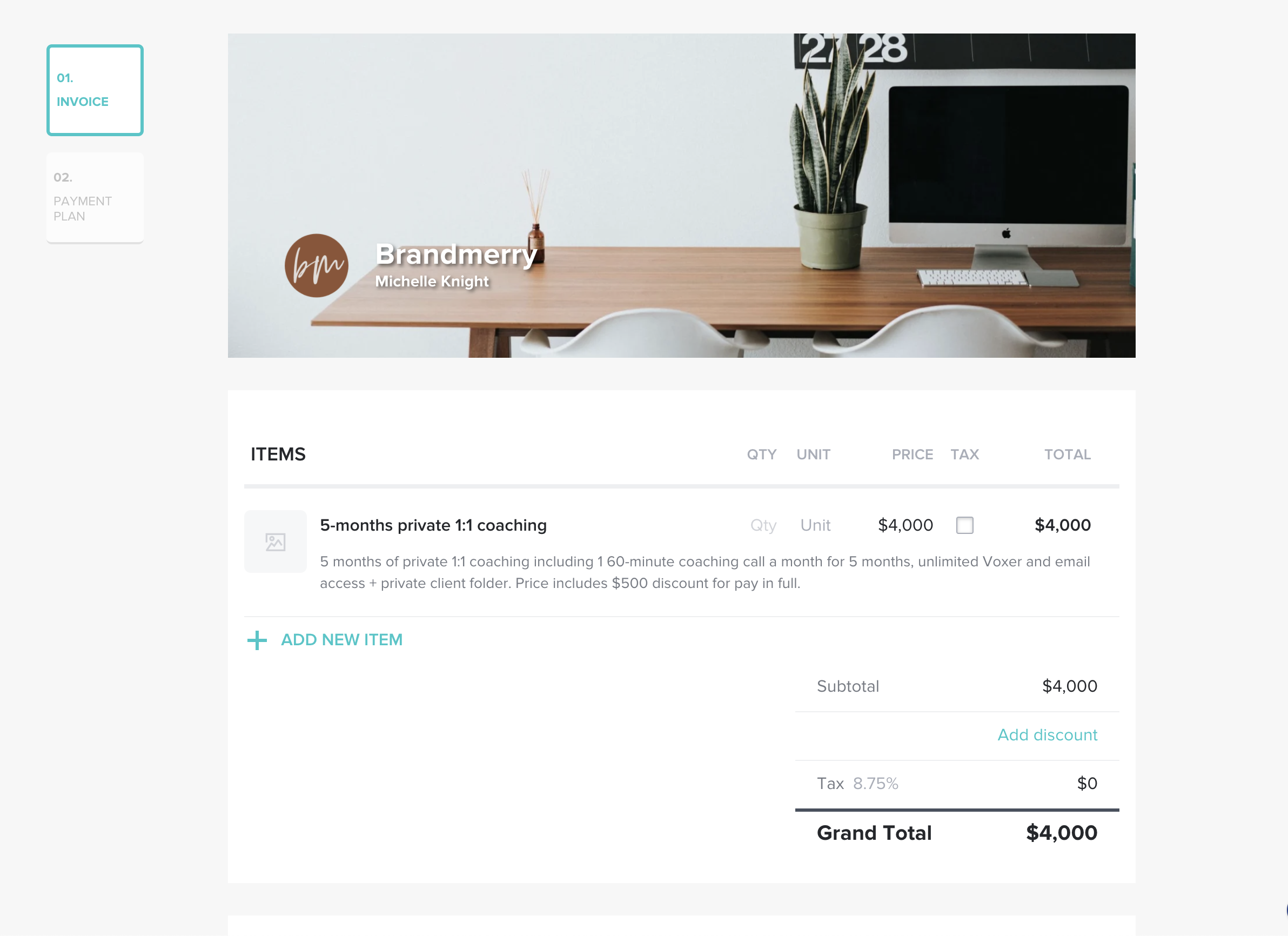
Then we move on to the invoice, which is number six. This is where they're ultimately going to pay for your services.
And again, you can set this template up ahead of time, go in, make any modifications to the numbers or payment plans that you want, and you can kick that out.
There are a lot of different ways to collect a payment, but one of the reasons that I love HoneyBook is that you can easily offer pay-in-full or payment plan options, 100% customized to your client.
You can customize the payment breakdown; maybe it's every month for six months, maybe they're doing more upfront and then a little less the remaining five months. Do they want to automatically do that? You can set that up as well.
I love having a template and then being able to go in and quickly adjust the payment schedule without a lot of fuss - It just makes the whole process so easy. And again, you can create all these templates and workflows so that it's just automatically happening on the backend with the platform.
Some of my clients also have customized workflows based on their different tiers. My graphic design clients might have just a logo package and then a logo and website, and then a logo website and retainer. They can customize these workflows, and after that initial proposal is accepted, they can just tag them in that workflow and then they're getting those customized emails, which is lovely.
Same with my photography clients. If they have an engagement, or a newborn, or a family, or a wedding, they can customize all of that inside of HoneyBook specifically.
CLIENT ONBOARDING STEP #7:
NEW CLIENT WELCOME EMAIL
So contract and invoice bring us to number seven, which is the welcome email. It’s the “Congratulations-we're-embarking-on-this-relationship-together email!”
I always tell my client this is where the important information lives. If anything is floating around in your new client's head or they're a little uncertain about something, this is where you want to take care of all of that.
So these emails tend to be a little bit longer because you want to cover everything and that’s why we prefer to save them as templates to use with each new client, and yes we do it in Honeybook.
Here at Brandmerry, we make sure to include the following:
Keep in mind this might be different for you based on your offering, but it’s a great template to follow.
WELCOME: Welcome the new client to the family
BONUSES: Remind them of any bonuses that they receive as part of your program. My clients get access to my signature course You! Branded so we include that information here and their log-in information.
SCHEDULING: We include a direct link to my scheduler so they can find a time that works for them and encourage them to save the link so they can schedule any future sessions if necessary.
CLIENT FOLDER: My private clients receive a private link for our shared documents, notes from their calls and recordings. We provide their link to the Google Drive folder in this email so they can begin adding materials if needed.
TIMELINE: Depending on when the scheduled first session or intensive is we also provide a brief timeline on what we want them to complete prior to their first sessions. For instance, my VIP Intensives book out months in advance, so we’ll say, “Before our session, these are the things that I want you to work on and put into our folder so that we're ready to rock and roll."
QUESTIONS: In addition, we make sure they have all the details they need on the level of support they receive when their support starts and who to email should they have questions about support, billing or anything else.
The goal of this email is to make sure they’ve got everything that they need and they're not emailing us and feeling confused or lost; they feel confident and supported straight away.

CLIENT ONBOARDING STEP #8:
CLIENT WORKFLOW AND TRACKING PROGRESS
When someone becomes a client, that whole onboarding process is so important, but then how are you tracking them?
Are you sending them surveys before their sessions, to get information to prepare?
Are you checking in with them? Are you asking them for feedback?
This hands down is one of the reasons that I love HoneyBook because it allows me to pay attention to when someone's contract is ending or when their session is coming up.
I can set up a workflow to automatically send out a form 24 hours before a session so they can complete and give me all the necessary information so we can make the most out of our time together. This workflow is based on where they are in my client progress tracker.
So while one through seven was before the session, or maybe even the date your package really kicked off, don't forget about tracking progress, staying in contact, and organizing that entire part so you don’t miss the opportunity for client feedback and possible continuation of a contract.
One of the last things I want to share with you about HoneyBook, one of the things that I love is that if you are a graphic designer and you need approvals, you can create client portals in the platform as well, which makes it super easy to keep everything clean and in one area for your client

CONCLUSION
Follow this 8-part onboarding process and I promise you’ll support your clients at the highest level and recognize how much can be automated with a platform like Honeybook.
Like your new email subscribers, your client onboarding of sending contracts, invoices and emails can be automated and creating those templates can save you quite a bit of time.
I hope that this was really helpful for you to understand all of the different processes of the client onboarding process.
If you want to try HoneyBook, you can go to Brandmerry.com/Honeybook to get 50% off your first year after your free trial and give it a spin.
Watch the full video here!
P.S. Have you tuned in to The Beautiful Climb podcast? I release new episodes every other Friday on topics around productivity, motherhood, habits, goals and going after the life of your dreams! Check out past episodes and be sure to subscribe at thebeautifulclimb.com
- FREE GIFTS YOU'LL LOVE -
DISCOVER YOUR BRAND STORY IN UNDER 5 MINUTES
LEARN HOW TO WRITE AN ‘ABOUT ME’ PAGE THAT CONVERTS
MAP OUT 30 DAYS OF CONTENT IN UNDER AN HOUR
- READ THE LATEST POSTS -
MEET MICHELLE
Hey there, I'm Michelle Knight and I an online branding and marketing consultant for female entrepreneurs.
I believe in the power of storytelling and using that superpower to brand and market yourself online...oh and to set yourself free.
I'm obsessed with living a life of freedom, so much so, that my family and I now travel full-time while running my business from the road.
This blog serves as a home base for all things branding, marketing, content creation and more.

Top Marketing Tools for Solopreneurs
When you’re a one-person show you want to make sure you’ve got the best tools working with you to scale your business and expand your reach. That’s why choosing the right marketing tools is so important and in today’s post, I’m sharing my personal favorites.
BY MICHELLE KNIGHT

Today, I want to share with you some of the top tools that we use over here at Brandmerry to improve our marketing. These are tools we're using every single day, as well as ones that we intertwined into our weekly workflow.
If you don't already know, I am a big, big fan of productivity.
I'm a big fan of simplifying and streamlining the process of marketing, and these tools that I'm sharing with you today are lifesavers.
The combination of these tools and weekly workflows save us so much time, when I say my existing workflow not only saved my sanity in business but also resulted in more revenue I’m not exaggerating.
In 2019, I got serious about my systems and the data and results were clear. Now, as part of my membership Brandmerry Academy, I teach entrepreneurs daily how to master their content and marketing workflow as well.
So let’s briefly talk about that process before delivering the tools.
DESIGNING YOUR MARKETING WORKFLOW
So essentially, over here at Brandmerry, we have a weekly marketing workflow. We've been fine-tuning this strategy for about two and a half years now.
What this means is that every week I'm creating content and every week I'm creating the same amount of content. Unless we're going through a launch or promotion, the content always stays the same.
For us that means a video is getting released, a blog post is going on the blog, social media content is going out there, and every other week we've got podcasts going out to my audience as well. So we always have this very, very clear idea of the things that we're repeating week after week.
This gives us a roadmap, complete with checklists, that make sure my team and I are going through the motions in executing these workflows.
Every week, I and the team know exactly what we need to do in order to get that content out there, and we're repeating this process week after week after week.
I’ll be breaking this entire process down in an upcoming episode, but I wanted to just share this concept with you if you have not initiated a marketing workflow for your business yet.
I’ll be referencing this concept throughout the blog, so now you know!
TOP TOOLS FOR MARKETING YOUR BUSINESS
canva
The very first tool that I want to share with you today is Canva. Now, you probably know about Canva, this is not some revelation of this amazing tool, but I find that a lot of people aren't using Canva to its fullest potential.
We use Canva for just about everything over here, even though I and multiple members of my team, including our marketing manager, have a background in graphic design. We know how to use Adobe, InDesign, Photoshop, and Illustrator, but we come back to Canva time and time again because it's so accessible.
It's something that we can work on together in a project, we can access it from anywhere that we need, and that makes it really, really awesome as a digital nomad who is working from anywhere that I can get internet access.
We primarily use Canva for our graphic design.
We use it for Pinterest images, for our social media content that you see going out, Insta stories that we have pre-designed.
We’re using it for workbooks that we create for our courses and for our freebies. Really anything that has some sort of a graphic design element to it, we are using Canva for the most part.
Now, you might be familiar with the platform, but where I find people aren’t using it to its greatest potential, and what will ultimately help you with your weekly content workflow, and that’s utilizing the templates.
When you're a solopreneur and you're not hiring a graphic designer, or maybe you don't even have a lot of graphic design background, you can use Canva to create templates to repurpose week after week.
They have designs ready for you that you can customize with your brand colors and your brand fonts, but you can also go in and create your own from scratch. We save these so anytime we need to update something, we just go into that template and update it.
Many of my clients who are getting started on Pinterest, because it's such an amazing platform for entrepreneurs, will create six to seven pin templates that they can just go into week after week, change out the colors, change out the title, and switch out the photo.
So it's only taking them 10 to 15 minutes every week to make sure that they have graphics for their blog.
If you have workbooks that you're updating every week or every quarter for a program, creating a template for that, and then just reusing it over and over again can save you a lot of time as well.
So I highly, highly recommend Canva. They have a free version and then they also have a paid version. We use the paid version because we can save the brand colors and the fonts and have a million different folders and all these different things for organization, which is super nice.
ubersuggest
The second tool I want to share with you today is called Ubersuggest. Now, this is one that's a little less known but it's one of our favorites.
If you don't already know, my program Brandmerry Academy teaches entrepreneurs how to market their business without relying on social media. The program puts a really big emphasis on evergreen content through blogging, YouTube, Pinterest, and Google.
All of those platforms rely heavily on keyword research.
Ubersuggest is a great way to do that research, as well as get those secondary keywords that you can use in your blog posts.
With this tool, you can get a good idea of how easy it's going to be to rank for that particular keyword or industry, you can look at competitors who have done something similar for inspiration. It's truly a whole plethora of information that's so important as a content creator.
We use Ubersuggest in a lot of different ways, but one of the things that we love to do is use it as a way to come up with our content strategy for the next 90 days. Every quarter (or slightly before) we type in some important keywords that we know we want to rank for and get some content ideas to put into our content calendar for the next 90 days.
Then we dive a little bit deeper within each one and use the information from Ubersuggest to craft our titles, our headers in the blog posts, what we're going to use on Pinterest and so on.
As with most options, there is a free version with limited searches and then you can also pay for it for a year for unlimited, which is very nice.
Again, as I’m sharing these tools I’m also stressing the importance of being strategic with your content creation. So many entrepreneurs are just creating content because they're like, "Oh, I think this might be nice," but there's data and there's research there on what people are searching for and you want to use that to your benefit.
Ubersuggest is just one of the tools that you could use, but it's one of our favorites over here.
convertkit
When it comes to email marketing, I have been a fan of Convertkit for a very long time and I still love them so much. I've been using Convertkit since I made the switch from MailChimp back in 2017.
When you are running a business, you need an email marketing platform because you need a way to gather your leads and put them into an email funnel.
You need a way to tag them and segment them.
You want a way to track what they're doing, what they're clicking on.
You want a way to send those weekly broadcasts, whether that's sending your blog post or a video, or just a nice little newsletter.
You want a way to email your community when you are launching and actively selling…
...and Convertkit is one of the best.
They have awesome deliverability which results in a higher than average open rate and click-through rate. One of the reasons is because they've stripped away a lot of the fluffy things that come with email marketing.
So, yeah the emails are pretty basic, although you can add some coding and photos, the less that you have the more it's going to improve your deliverability.
Convertkit is also super intuitive when creating sequences, funnels, and automations. Everything is able to be customized and you can send subscribers, based on interest to different funnels and track behavior for future promotions.
I say it a lot, but every entrepreneur needs an email list and needs an email platform, and Convertkit is one of, if not, the best.
social media scheduling
Speaking of Convertkit and scheduling emails, let's talk about scheduling some social media content. I want to share two tools with you here for Facebook, Instagram and Pinterest (remember when I said I loved it?)
LATER
Later is what we use to schedule Instagram and Facebook content. Now, you can schedule natively through Creative Studio on Facebook and we do use that to schedule weekly IGTV videos, as well as upcoming Facebook Lives, but for weekly posts Later is what we prefer.
The reason we love Later as a team is because of their note feature. Oh my gosh, it's like our favorite thing.
You can go into your monthly calendar and you can add notes to your calendar to preplan your content. So we can map out the entire month and say, "All right, this month, this is what we need on each of these days. This is the topic. This is the photo that we're looking for."
It’s really great because then I know what photos I need to plug in there, the team knows what other graphics we need, and we know what copy we need to add in there as well. Then we can add the tasks to ClickUp, which we use to manage tasks as a team.
In addition to the note feature, which we love for planning in advance, just being able to keep all of our photos in a nice organized folder to then schedule wherever it fits is amazing. I can add photos from my phone or desktop so we always have a reserve of photos for social media.
The ability to pre-schedule social media content via Later allows me to spend my time doing other things and not logging in, etc to Instagram and Facebook multiple times a day.
TAILWIND
Now, Tailwind is the scheduler we use for Pinterest. They truly are the best of the best when it comes to Pinterest scheduling and as marketers, they give you so many different features that are essential to marketing on Pinterest including awesome analytics, Tailwind communities, and Smart Loops.
I'm not going to do a whole post on Pinterest because it truly is a beast, and there is a very, very strategic way to take on Pinterest.
In fact, it's one of the things that I teach inside of Brandmerry Academy, so join the waitlist if you’re interested in learning more, but know that Pinterest isn't just about pinning your most recent blog posts one time and then crossing your fingers and hoping that someone finds it.
There's a clear strategy, and that requires consistent pinning and creating new, fresh content.
Because of this approach to fresh content you want a way to organize all of that and to pre-schedule it so that you're not going onto Pinterest every day for 10 minutes to put fresh content out there. We don't want to live on these platforms to grow our business otherwise we’ll never be able to serve paying clients, so utilizing these tools will help you get in front of your audience, while also protecting your time and energy.
Tailwind allows you to schedule your pins for an entire month and you can do fresh pins with your new blog posts that are coming out or whatever works for you in your business.
veed.io
All right, I've got another one for you, and this tool is called VEED.IO.
VEED is an amazing platform to repurpose your video content.
This blog is a great example.
You might have seen this video on Facebook as part of Mondays with Michelle, if you didn’t you can check out what I mean below.
Remember that workflow I was talking about in the beginning? Well, most of our content starts as a video. So we have this video, we upload it, we schedule it as a premiere on Facebook.
We also take this video and we release it on YouTube.
We also take this video and we release it as an IGTV. And for IGTV specifically, we want to adjust the formatting. With VEED you can adjust it so that it's a full vertical or I personally like to have the captions at the bottom and the title at the top, and we're able to do all of that in VEED.
VEED is a really awesome platform because you can upload the video from your computer, or you can pull directly via a link on YouTube. Then you can edit the video, you can crop it if you want to, you can cut out a section if it's not relevant to that specific platform, you can format the size, you can add the title, a transcript, all kinds of cool stuff.
Again, this is the whole idea of marketing and using a workflow, repurposing your content so you're not creating one video and putting it out in one place and hoping that people find it. You're putting it out everywhere that it can be discovered so you can get in front of your ideal customer.
If you go to my Instagram feed at michelleknightco, you'll see my videos that have been edited in VEED.
rev.com
The next thing that I want to share with you is actually for your transcripts. One of the things that we're doing with my videos is transcribing those videos into blog posts. Again, this is all part of the workflow that I'll share in a later post.
There are a lot of transcript services out there, but we really love Rev.com. They are a little bit more expensive, so it depends on your need, but we really want someone doing it for us because I don't want to spend a bunch of time having to cut out all of my ums and my ahs and we’ve found Rev to be the best.
We upload the video and typically have the transcript back within 24 hours.
We’re then able to edit that transcript and put it on the blog.
There are a lot of alternative options, they even have a cheaper option available if you just want an automated transcript for a video. But that's definitely something that you want to look into when you're creating video content or podcasting and you want to turn that into written content on your blog because it helps your content get discovered by more ideal customers and enhances SEO.
CONCLUSION
That was a lot of tools, but I hope it helps you understand just how possible it is to invest in a few great tools as a solopreneur so you can optimize your time more efficiently.
I know it's really hard to find the right tools for your business, especially when it comes to marketing. There are a million options out there, so hopefully, this takes some of the mystery out of it, gives you an awesome place to start.
If you missed the other two posts from this series you can read about my top tools for Operations and Productivity here.
If you want to get a headstart on your workflow, I have a free repurposing guide for you. You can go to brandmerry.com/repurpose and snag your free repurposing guide.
And in the next few weeks, we're going to be talking more about content creation and creating your own custom workflows, so make sure you’re checking back weekly on Thursdays for new blogs!
Watch the full video below!
P.S. Have you tuned in to The Beautiful Climb podcast? I release new episodes every other Friday on topics around productivity, motherhood, habits, goals and going after the life of your dreams! Check out past episodes and be sure to subscribe at thebeautifulclimb.com
- FREE GIFTS YOU'LL LOVE -
DISCOVER YOUR BRAND STORY IN UNDER 5 MINUTES
LEARN HOW TO WRITE AN ‘ABOUT ME’ PAGE THAT CONVERTS
MAP OUT 30 DAYS OF CONTENT IN UNDER AN HOUR
- READ THE LATEST POSTS -
MEET MICHELLE
Hey there, I'm Michelle Knight and I an online branding and marketing consultant for female entrepreneurs.
I believe in the power of storytelling and using that superpower to brand and market yourself online...oh and to set yourself free.
I'm obsessed with living a life of freedom, so much so, that my family and I now travel full-time while running my business from the road.
This blog serves as a home base for all things branding, marketing, content creation and more.