

Brandmerry Blog Archives

How to Create a 6-Figure Course Offer
There comes a point in business when having a course makes a lot of sense. Maybe it’s more revenue? More impact? Or that you want to get more of your time back! Today, I’m sharing how to create a 6-figure course offer step by step!

How to Create a 6-Figure Course Offer
BY MICHELLE KNIGHT
This post contains affiliate links which means if you make a purchase through a link, I may receive a commission at no extra cost to you!

I had to go through a lot of limiting beliefs about putting my work out there and believing that I could ultimately create a course that would deliver the same amount of value as working with me one-on-one.
After I went through all of the work on those limiting beliefs and served my clients at the highest level, I realized that one of the best things that I could do for my business was create this course.
The truth is having a course allows you to impact more people and that's always been the driving force for me and my brand. I'm very mission-driven, and I want to help as many entrepreneurs as possible understand the branding process and truly understand themselves more, which is my signature part of the branding process.
The only way to do that without trading my time and my energy for money was to create a course. I also realized that a course complimented my life pretty perfectly.
I love to travel with my family and I value my time as the highest value, and having a course allowed me to scale my business by creating recurring revenue that I knew and could pretty much count on every single month.
A COURSE IS POSSIBLE FOR EVERY BUSINESS
A course is a great idea for every type of business. I know people who have courses on dog-walking. So you could create a course around anything.
Some of my clients have courses around knitting, courses around mindset. No matter what you're doing in your business, there is an opportunity for you to create a course at some point in your journey.
Do I think everybody should just start creating a course right out of the gate? No, not necessarily, and we're going to talk about that today.
Now, the course that we're talking about today is my You! Branded course, which teaches you how to build a personal brand centered around your story so that you can attract your true fans and create a revenue-generating business.
I created this course in 2019 after following these five steps I'm going to share with you today.
After creating I continued to test the product and my marketing and continued to scale to a 6-figure cash offer in my business which has helped hundreds of entrepreneurs brand themselves online.
Step One: Master Your Framework
Your framework is really important.
To be honest, I did this in my business pretty early on and I've used it to be the driving force for all of my programs and courses since then. I developed it while working with private 1:1 clients.
It’s so important in business so it’s something I’ve included in my program You! Branded because I believe that your framework is part of the branding process.
So many people brand an offer rather than branding the business as a whole.
When you brand an offer out of the gate, then you have trouble with scalability, so what I want you to focus on is branding you, the entrepreneur, and then getting super clear on your framework.
Think of the ways that you support your clients.
Yes, even if you don’t have any paying clients yet you can map out the first version of your framework based on the problem your ideal customer is experiencing.
Everybody has a framework. I promise you that.
I started my business, offering coaching as a one-on-one service, and many of my clients start that way as well. In fact, I think it's one of the best ways to vet a course idea: Start working with people one-on-one, get feedback, map out your framework, figure it out, and then turn it into a course.
Do you have to do that? No, you don't, but many of my clients choose to go that route because it allows them to make money while they get their foundation and their footing started in their business, and then they're able to turn that into a course.
Regardless of if you choose to do a private service or not, understand your framework and what it provides your ideal customer is key.
The cool part about having your framework is that each of these different pillars, that make up the framework, can be broken down into individual courses, products, programs and offers or you could create a course that encompasses your entire framework.
An example of this is inside my program, Roadmap to Freedom I teach a large part of my framework, which includes:
Brand Foundations
Community Growth
Marketing (aka Attraction)
Selling with Authenticity
The only pillar left is Systems to Scale, which is focused more on my 1:1 clients. But, these 5 steps are my framework.
Inside of You! Branded I simply focused on providing one of the pillars and that’s my Brand Foundations.
This main pillar is then broken down into separate modules that support my client, which include:
Your Story and Niche
Your Ideal Customer
Your Messaging
Your Core Offer
Your Authentic Voice
Your Emotional Brand (Aesthetics)
As you can see, you can break everything down even further, but what this allows you to do is make sure that your courses always connect back to your brand framework and therefore create a client ascension model which improves client retention.
So, step one is to figure out your Brand Framework and then break that down, if needed, into your specific course.
Step Two: Build a Targeted Audience
The second thing that you want to do is build a targeted audience.
One of the things that I was doing for years was building an audience around the concept of personal branding, so when I launched my course, people were ready to buy because they were here for that purpose.
So if you've been building a business around this core idea from the beginning, you already have a community of people who are going to be interested in your course.
But if you haven't, and this is maybe a new idea, you can absolutely start building your community now and no it doesn’t have to take years to launch your course, but you’re going to need to W-O-R-K or pay money #truth
In fact, I recommend you start building your email list in your community long before the course is even ready so that when the course is ready, you can launch it and you have people to actually sell it to.
This looks like building your email list using the advanced marketing strategies that we teach over here at Brandmerry, on the Brandmerry blog and at Brandmerry Academy, on how to build your email list using SEO, Pinterest, YouTube and more.
Your goal is to bring in targeted people, the right ideal customer for your course.
That might look like a lead magnet specific to the course that you are ultimately going to be offering. In my case, I have a lead magnet called Your Personal Brand Roadmap that's all about your personal brand and what you need to do to create it.
That leads very effortlessly to my program and brings in people who are interested in personal branding.
When thinking of a way to build your targeted audience, think of something you can always offer like a video training replay, pdf download, checklist, audio download, or evergreen masterclass.
You’re going to want to run this continuously to make sure you have new subscribers daily in your business and use organic or paid strategies to drive traffic to your landing page for your free offer.
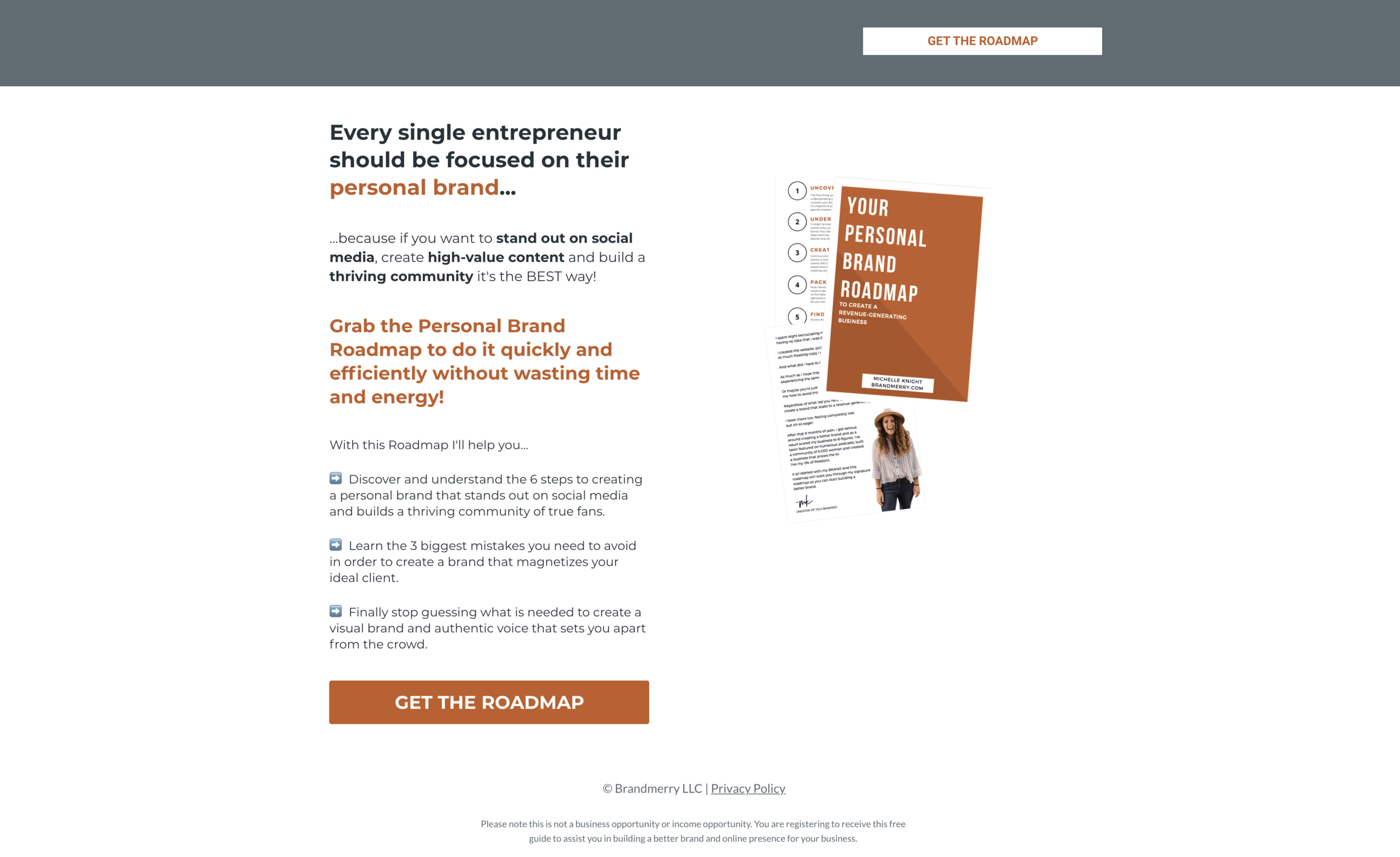
Remember, the goal is to have an audience to sell your course to, so give yourself plenty of time here.
Step Three: Create a Waitlist
Number three is to create a waitlist for your course and then tease your offer like crazy.
If you know anything about me, you know that I love showing up regularly for my audience. That includes blogging, video content, email, Instagram, social media, all the things, and I have a very streamlined repurposing plan that lets me stretch my content out on multiple platforms.
But when I was gearing up for my course, or any launch for that matter, I always talk about the course and that the doors will be opening way before it actually happens.
For instance, on episodes of my weekly show Mondays with Michelle, I would say, "I have a new course coming out called You! Branded, and you can join the waitlist here.”
I want to make sure to talk about it constantly so that my audience is ready to go when the doors open and I could answer any questions and handle any objections before the doors actually open. This is also a great time to talk about topics that specifically relate to your course, here are some examples:
No matter what model you choose, whether it’s evergreening out of the gate (which I did not do) or live launching (which I did) you want to make sure you lead your audience to the sale with quality content.
For a live launch, I recommend spending the first 30 days minimum teasing your offer and promoting the waitlist.
I tell my clients that the selling doesn't actually happen when the doors open through when the doors close, it's happening 30, 60, 90 days leading up to that.
So one of the best things that I did to launch my course the first time built this anticipation for a new course offer that I had. I had a substantial waitlist, and then I was able to have conversations with those waitlisters, getting them excited and ready to sign up for the program.
Step Four: Live Launch Your Course
That leads us to number four, which is where I live launched the program.
So I personally didn't go out of the gate and straight to evergreen (meaning someone could join the course at any time through a Facebook ad, class or funnel). I know a lot of people who love to teach that and that might work well for you, but I personally want to test things before doing that.
I want to test my messaging.
I want to test graphics.
I want to get feedback from people who’ve bought and those that didn’t.
So live launching is my favorite thing to do, to be in it, to hear from people and to be able to test everything then use that data to spend money and evergreen later on.
One of the things that I did when I launched You! Branded, was I launched it for a lower price because it was the first time that I was putting it out into the world. I launched it to my email list that I had been growing through my marketing, through my content, and I got a substantial amount of people to sign up. It ended up being about a $10k launch.
During the launch, I stressed that this was the first time this course was being handed to anyone and that feedback was essential. So I would survey them frequently and say, "How is it going? What's going on?"
I would ask in emails, I had assessments, we asked for testimonials, and then that allowed me to really pack my course with testimonials and proof when I was ready to ultimately evergreen the program.
I recommend live launching and getting those testimonials out the gate. Although some people refer to it as “beta” I don’t because I feel like “beta” is kind of like a cop-out.
It has an “I’m-just-kind-of-launching energy to it and I believe in just going for it. If you’re going to do it, just do it! Offer a discounted price if you want, but get people excited and get those testimonials, get that social proof, and use that for when you're going to launch and possibly evergreen the course later on in your journey.
Now, when you live launch, a couple of things that I want to just touch on: You absolutely can offer support. Some of the programs that I've put out into the world for the first time, I also offered support, a Facebook group or weekly calls or something like that.
But when I launched You! Branded, I really just said, "Hey, here's the program, here's the course. There's a Facebook group. You can ask me questions if you need to," because I knew that I was going to do that with the evergreen course as well.
I wasn't planning on doing calls or anything like that, so I wanted to really test that model with that first live launch, prove it works, prove people could get results, and then use that to my advantage.
And if you want to know some of my top tips for building your course, which includes selling it through a launch and then building it, check it out here.
Number Five: Evergreen the Course
That really leads us to step five, which is evergreening the course. Once you have gone through this process laid out for you above, you have testimonials and social proof the next step and quickest way to a six-figure course that's recurring is through this evergreen model.
That basically means that someone can sign up through an email funnel, through a masterclass, through a challenge, through a video series, and it's 100% automated.
Now, there still need to be deadlines or ways to add urgency even though it is evergreen.
For instance, if you watch my masterclass, you'll get an opportunity to join You! Branded, but you're only given that opportunity for a short amount of time. We have technology and cool systems in place that actually honor that. You can't access the sales page after your deadline has expired.
This model works really well because we're consistently bringing in new leads through my marketing efforts to the masterclass.
You're getting an opportunity to buy You! Branded through my email funnel, so we're getting daily and weekly sales for this product.
That truly is how businesses build these sustainable evergreen models.
A couple of things you need to know about when you plan for this stage.
TIP #1: KAJABI
You want to make sure that your course is set up for distribution.
Y'all know I'm a big fan of Kajabi over here, and if you go to brandmerry.com/kajabi, you can actually try Kajabi out right now and get a sweet bonus from me all about live launching.
If you join Kajabi through my link at brandmerry.com/kajabi, you’re not only getting the amazing all-in-one platform to market, sell and deliver your product, you’re also getting a sweet bonus from me to help you launch your program (see Step Four)!
Kajabi is a great platform to put all your course materials in, including: your videos, your audios, your workbooks, your notes, all the things. Build out a membership portal so that when people join, they have access to everything they need.


Remember, people are joining at any time with evergreen, that's the goal, so you want to make sure that they have access to everything that they need when they join.
With Kajabi, you're able to drip that content if you choose to do so and it's just streamlined and absolutely beautiful for your customer.
TIP #2: AUTOMATE YOUR ONBOARDING
Since people are able to sign up at any time, you want to make sure that the onboarding process is automated. You don’t need to be adding people manually at 3 am so they have their login information.
Again, we use Kajabi for this because we love the option of keeping it all in one spot.
From the second that someone buys the course, to receiving the confirmation page, to getting a confirmation email, to getting their login link, to filling out their assessment when they're done with the course, all of that is set up in Kajabi.
We even have emails that go out after someone completes each module, that say "Oh, my gosh, you're doing amazing. Keep going," and I really love that because even though it is an evergreen program, even though it's automated and you're not getting live support from me, it feels like that, that I'm supporting you every step of the way.


Again, Kajabi is a great platform to do that, but you want to make sure that your client onboarding is automated.
TIP #3: SELL IT
Then the goal is to figure out how you’ll sell it on evergreen.
Are you going to sell it on a masterclass, through an email funnel, a video series, a challenge?
What does this look like for you?
Remember, no matter what you choose you want it to be recurring, so you want to make sure that it’s not something you have to do live all of the time in order to make sales.
You absolutely can live launch it a few times a year. I will open the doors to You! Branded a couple of times a year, and that feels amazing, but we have this recurring evergreen revenue coming in the back. It’s important to have that in order to scale your business - consistent revenue.
Then scaling your offer is about testing! As you get the feedback you can adjust your program and your marketing strategy to make it even better. Looking at your data is key to make those adjustments as well.
Be open to knowing you don’t know what you don’t know!
Test
Test
Test
And make adjustments!
I really can't stress that enough.
So many people just jump in, start throwing money at their course without knowing their numbers. Make sure that everything is functioning inside of your funnel before you start scaling it.
Then get super clear on how much money you can give every single month, looking at your numbers and saying, "All right, if I spend a dollar, I make $4 off of this course, so I'm going to continue to scale that." That's what you really want to look at.
Those are some of the things that we teach inside of Brandmerry Academy because we love data. So looking at your number and scaling and adjusting your budget or efforts is truly the key.
You will create an evergreen product and it will be successful, but it does come down to your numbers.
When you follow these five steps, you're setting yourself up for success so that you have all of the pieces in place and then you can continue to grow and scale and build and build and build and build using things like Facebook ads, Pinterest ads, and organic measures like we teach inside of the academy.
CONCLUSION
I want you to know that creating a course is 100% possible for you.
I highly recommend it when it is the right time in your business and again, I recommend testing your materials, making sure they are proven, that they work, that you've got testimonials out of the gate, and then just continue to scale from there.
That's truly, I think, how everything in business works: test it, scale it, test it, scale it.
If you're ready to take action now and start building your course inside of Kajabi, make sure you go to brandmerry.com/kajabi and get signed up.
Remember when you join through my link you’re not only getting a free trial period but also a complete Launching Guide to help you host challenges, webinars and plan your launching strategy!
Get signed up at brandmerry.com/kajabi.

Watch the full video below!
P.S. Have you tuned in to The Beautiful Climb podcast? I release new episodes every other Friday on topics around productivity, motherhood, habits, goals and going after the life of your dreams! Check out past episodes and be sure to subscribe at thebeautifulclimb.com
- FREE GIFTS YOU'LL LOVE -



DISCOVER YOUR BRAND STORY IN UNDER 5 MINUTES
LEARN HOW TO WRITE AN ‘ABOUT ME’ PAGE THAT CONVERTS
MAP OUT 30 DAYS OF CONTENT IN UNDER AN HOUR
- READ THE LATEST POSTS -






MEET MICHELLE
Hey there, I'm Michelle Knight and I an online branding and marketing consultant for female entrepreneurs.
I believe in the power of storytelling and using that superpower to brand and market yourself online...oh and to set yourself free.
I'm obsessed with living a life of freedom, so much so, that my family and I now travel full-time while running my business from the road.
This blog serves as a home base for all things branding, marketing, content creation and more.

My Top 4 Tips for New Course Creators
Thinking about building an online course? There is a lot of information online, trust me when I was starting out I was overwhelmed with all the options. And while there are still a lot of options I want to share my top 4 tips for new course creators to try and help with the overwhelm.
My Top 4 Tips for New Course Creators
BY MICHELLE KNIGHT
This post contains affiliate links which means if you make a purchase through a link, I may receive a commission at no extra cost to you!

If you are an entrepreneur or you're thinking about becoming an entrepreneur, you have probably recognized that there is a lot of money in creating courses. And aside from the money aspect of it, which is why a lot of people gravitate towards it, the focus that I really want to put your energy towards is the impact that you can have.
If you are doing one-on-one services or consulting, you have a limited amount of people that you can work with at a time. And that's one of the reasons that I fell madly in love with creating courses.
It allows me to serve more people and to support more people without sacrificing my precious time, which you probably know is a huge value over here at Brandmerry and just for me as a human being as well.
So I thought it would be kind of fun to do a blog that is all about my top tips for new course creators.
Now, even if you're not new, maybe you already have a course, listen in because the information I'm going to share is going to save you tons of time, money, and energy in the long run. I really want to share this with you because as you know, streamlining and simplifying the process of running a business is so, so important and dear to me.
So these four tips are really designed to remove the overwhelm that you might be feeling on what is required to build out your course.
TIP #1: STREAMLINE YOUR PROCESS WITH AN ALL-IN-ONE PLATFORM
The first tip that I have for you is to make sure that you are not trying to piece it all together.
When you start out and look, I did it too, you want to bootstrap. I totally understand. I was the exact same way. And to be honest, I needed to.
But, when you're creating a course and you have intentions of evergreening that course, meaning you want to be able to sell this at any time and somebody can sign up at any time and it's not reliant on you sending an email or processing a payment or something like that, it is going to save you a lot of time and energy to have it all in one location.
In my business, I use a platform called Kajabi. Maybe you've heard me talk about it before, but Kajabi is an all-in-one platform for course creators.

What this allowed me to do was create the sales page, checkout page, confirmation page, process the payments, send the emails, send weekly check-ins and automated emails, deliver the materials, drip it, releasing it live, etc...all in one area.
When I first started my business and I was selling a group program and a few small courses, I was just piecing it all together and it became really messy and very confusing. If one thing didn't work, then I had to figure out what wasn't working and why it wasn't working and fix it.
At the end of the day, I realized I was actually spending more money.
By piecing together a bunch of different options that varied in price, I was actually spending almost the same amount of money that I would spend to just invest in a platform like Kajabi.
Not to mention, by switching to Kajabi, I also ended up saving myself a lot of time trying to build everything on different platforms. So I really recommend that everybody tries to find a platform that allows them to do all of those things.
Now is every platform perfect? No, of course not. It never works out like that. And everybody has different desires.
But I know for myself, when I was ultimately choosing Kajabi in the beginning, I wanted to have a way to stay in contact with my clients as well as to really streamline the onboarding process.
Don't try to piece it all together. You're going to recognize that someone is going to have to go to a sales page and then the checkout page, and then you need to email them their login information, and then you need to email them important information, and then they need to log in and then you have to house all the materials right?
There are a lot of moving parts. And the more that you can streamline that, have that all in one platform, the better it is going to be for you in the long run.
So, I recommend Kajabi to so many of my clients, and actually have a free trial for you. You can go to Brandmerry.com/kajabi to get started on the platform. In addition, I’m giving away a bonus when you ultimately commit to Kajabi which includes an entire mini-course on Launching.
Tip #2: TAKE CARE OF YOUR CUSTOMER WITH ONBOARDING
That whole process leads me to tip number two, taking care of your customer.
I don't know about you, but I've signed up for courses before and I’m so excited and then I don't get an email or I don't get the information that I wanted, or I don't get taken to a confirmation page.
Then I'm really confused about where I'm supposed to start and what I'm supposed to do. So one of my top tips for my clients is that you need to take care of your customers.
Think about if you were going through that process. Think about if you saw a course was for sale and you built up the courage and strength, you pulled out your credit card and you put your credit card number in there, and then suddenly you felt completely lost.
How would you feel? It wouldn't feel very good and it's going to put a sour taste in your mouth.
One of the best things that you can do truly for your business and for the longevity of your clients sticking around and referring their friends, is to take care of them from the very beginning and make sure that they feel super supported.
So when you are designing your course, so many people focus on just the course, and we're going to talk about that. But I also want you to think about that onboarding process because it is so important.
I would argue that making sure that your onboarding process is clear and has a step-by-step process, will save you money because you're going to have fewer people asking for a refund, feeling confused, ending up in your inbox, or just not knowing what to do overall.
So when it comes to the onboarding process, here's a very simple step-by-step that I recommend.
STEP ONE: THE CHECKOUT PAGE
Let's assume they go to your checkout page or a sales page. They're on your sales page learning more about your program. They click a button that takes them to the checkout page, whether you have a pay-in-full or a payment plan. One of the things that I love to include on a checkout page is a video.
Now I host the entire thing inside of Kajabi as I've mentioned before, so I can upload a video saying, "Hi, I'm so glad that you're here. Here's what happens next."

I'm taking away some of those fears that my ideal customer and potential client is experiencing like, "If I put my credit card number and what happens? Where do I go? What happens next?"
So I create a video that's me on camera sharing the step-by-step of signing up. I also love to recap on the checkout page exactly what they get and share some testimonials as well.
STEP TWO: CONFIRMATION PAGE
So they go to the checkout page, put in their card information, agree to your terms and policies, then what happens?
You take them to a confirmation page. Please don't skip this step. It's very important.
After they’ve signed up it's important to put their fears at ease. Trust me they are thinking, "Oh my gosh, I just put my credit card number and now what happens?"
This is why I love to create confirmation pages for my courses that are typically just me on video. I think that's such a great way to build trust and build a relationship with your audience by saying, "Congratulations, you're in. You did it. Here's what happens next."
I also like to type out any information that they might be getting in their inbox, let them know their login information is on its way, let them know that they're going to get an email with this, this, this and this.
I'm really just focused on guiding them through the process, holding their hand and making them feel really supported every single step of the way.
STEP THREE: DELIVER THEIR EMAILS
The next step is to deliver all the info they need to get started.
I love to deliver one email that contains their login information and another email that has more of the logistical pieces.
Where do they log in?
Do you have a community or a Facebook group where you're supporting them?
Are there calls that they need to put into their calendar?
How do they ask questions? What does that look like?
You can outline all of that inside of the email.
And, of course, I like to take it a step further, and you can totally steal this from me if you want, and actually say, "This is the first thing I want you to do. And the second and the third and the fourth," so that it's very clear and we can remove some of that overwhelm.
STEP FOUR: LOG IN
Then comes the final step of the onboarding process, and that's getting them to log in to where your course is.
When they log into your course, I love to have a welcome video there as well. In fact, inside of my programs, we have a start here section, which gives a walkthrough of the membership site.

It has a checklist if necessary and it tells them where they can get support and answers some more questions, encourages them to get started and tells them exactly where to start to get the best results.
It's really about holding your client's hand through the entire process, making sure that they feel supported and you've removed the overwhelm.
So my second tip is to put your time and your energy into creating a really streamlined onboarding process. And again, if you're using an all-in-one platform like Kajabi, you can do all.
TIP #3: KEEP IT SIMPLE
Don't try to be fancy.
When it comes to building out your course, I talk to so many entrepreneurs every single day.
They're like, "Well, I really want to launch a course but I want to wait because I need a backdrop. And I want to be able to hire a graphic designer for my workbooks. And I want to have a nice camera," and so on.
I’ve got to be honest - that is just keeping you from putting your content out there. And by delaying putting your content out there, you're actually delaying sales and the overall growth of your program.
I highly recommend that you are not fancy when you put your course out there the first time.
Many of my first courses didn't even have video, they were just workbooks, and I just created the workbooks in Pages on my Mac computer.
You do not have to have a fancy graphic designer helping you with your workbooks in the beginning. Go into Canva, choose a template and change it with your colors and some photos and truly make it your own.
When it comes to filming, so many people get hung up on the fact that they have to work with a professional videographer, or they have to have perfect lighting or a perfect backdrop.
That is absolutely not required, I still don’t do that in my course and it has served over 300 people. Remember, it's about delivering value. That is what people pay for. You can use your Quicktime or Loom on your computer to record, or just on your phone.
One of our favorite tools to use in course creation is Loom. Loom is an online program that you can use to record videos, store them in the cloud, and organize them. They're just a great place to do a screen share, the camera only, whatever.
Honestly, if we're talking like bare-bones, you need something to record on, which could be a computer, a phone, or a camera if you have it.
You need some sort of light, which could be your ceiling light. You could even position yourself in front of a window or purchase a cheap ring light and tripod online and make a workbook in Canva and that's it.
One of the things that I see holding course creators back is that they wait to put their materials out there because they want them to be perfect or professional. But the biggest thing that I've learned as a course creator is that you will modify and change as more and more people work through your program.
The best way to create a course that over-delivers, is super valuable, and is profitable for your business, is constantly making small adjustments. So if you're waiting to put the course out there until it's perfect, then you're not going to be able to make those adjustments and move forward with your progress.
The best thing that you can do is get your content organized, put it out there and then ask for feedback and make those adjustments as you go.
I keep mentioning Kajabi obviously because that's the platform that we use over here at Brandmerry, but inside Kajabi, I can upload my workbooks effortlessly.
I can upload my videos natively without having to use Youtube or Vimeo. If I want, I can upload an audio file.
You can choose to deliver your content in so many different forms making it really easy for your audience to access those materials on their desktop or on their mobile phone because you can download an app to use with the membership portal as well.
Keep it simple. Don't try and be super fancy with it because you're going to change and adjust as you go. That is the art of creating an amazing digital product.
TIP #4: GET PAID TO CREATE YOUR COURSE
We are coming in hot with tip number four and this is one of my favorite things to teach.
One of the coolest things that you can do is get paid to create your course. I mean when someone told me this when I first started my business I was sold within like five seconds.
Now I'm not talking about a beta program. Some people really love that and if that works for you, that's amazing, but I’ve found using the term “beta” gives you a little permission to not do a full launch or get paid.
I'm talking about actual cash in hand to then create the course.
Let me give you an example of this. One of the first courses that I created was called Brand New Adventure. I now have a branding course called You! Branded. You! Branded came from putting Brand New Adventure out there, getting paid for it, adjusting it over the course of a year, and then really packaging it into what I ultimately wanted to create, and adjusting the name and some of the marketing.
But when I first sold Brand New Adventure all I had was an outline for my modules, the onboarding process was done so I could accept payment and email my clients and I had a sales page, and that was it.
I sold Brand New Adventure, in fact, it was a $7,000 launch, my biggest at the time, and every week over five weeks, I would create the new module. I would drip a new module and video training on Monday and then I would support students inside the Facebook Group. I got paid to create the course and the program.
So if you've got an audience, even if it's a small audience, you can sell the course or the program before it's even created.
Similar to a membership site. If you want to host a membership site. We're talking about courses here, but platforms like Kajabi work for membership sites as well.
Brandmerry Academy, my membership community that teaches marketing, is hosted on Kajabi as well.

When I first sold that program, I didn't have all of the monthly trainings created. I created them as I went throughout the year with my Founding Members giving feedback on what they needed most.
This is a really smart business move because a lot of entrepreneurs will spend months and months and months creating a course, creating a program and then attempting to sell it and finding out that people don't actually want it.
You get to test your marketing, you get to test your messaging, and then you get to actually create it for someone specifically, get feedback, adjust it, and then evergreen it down the line if that's something that you choose to do. So it's such a fun strategy, get paid to create.
CONCLUSION
Those are my four tips for course creators and I highly, highly recommend you take them and you run with them. I wish someone would have told me these four things in the very beginning.
It would have saved me a lot of time and energy.
Speaking of saving time and energy, I clearly talked about Kajabi a lot. I don't recommend anything that I don't use and I don't believe in, and they truly are, in my opinion, one of the leaders in course creation because of the amount of time and energy and tech headaches that they will save you through the streamlined process.
If you’re interested in giving Kajabi a try, you can go to Brandmerry.com/kajabi and test it out.
When you wrap up your trial and become a paying member of the platform you’ll get a special bonus from me. This is only available to community members who use my custom link above.
Inside of this bonus is an entire training on hosting and selling on webinars authentically.
Might I add, not like sleazy, but like truly authentic, valuable webinars that convert. Hosting challenges, if you want to host a live video challenge to sell your course or sell your program as well as an entire training that I call Launchpad, which is all the step-by-steps of launching your course.
Kajabi will support you in creating your course, there are a ton of materials out there, but then you've got to know how to market it and launch it.
So sign up at Brandmerry.com/kajabi and sign up through that link, then you will be gifted my entire bonus bundle to support you in marketing and selling your brand new course after your trial.
Check out Brandmerry.com/kajabi for more info.
Watch the full video below!
P.S. Have you tuned in to The Beautiful Climb podcast? I release new episodes every other Friday on topics around productivity, motherhood, habits, goals and going after the life of your dreams! Check out past episodes and be sure to subscribe at thebeautifulclimb.com
- FREE GIFTS YOU'LL LOVE -
DISCOVER YOUR BRAND STORY IN UNDER 5 MINUTES
LEARN HOW TO WRITE AN ‘ABOUT ME’ PAGE THAT CONVERTS
MAP OUT 30 DAYS OF CONTENT IN UNDER AN HOUR
- READ THE LATEST POSTS -
MEET MICHELLE
Hey there, I'm Michelle Knight and I an online branding and marketing consultant for female entrepreneurs.
I believe in the power of storytelling and using that superpower to brand and market yourself online...oh and to set yourself free.
I'm obsessed with living a life of freedom, so much so, that my family and I now travel full-time while running my business from the road.
This blog serves as a home base for all things branding, marketing, content creation and more.

5 Must-Have Business Tools for Operations
I get it, choosing the business tools for your business is like trying to find a needle in a haystack. There are so many options it can sometimes feel easier to not use anything. Today, I’m sharing my favorite tools for Operations to hopefully make your life a little easier.
5 Must-Have Business Tools for Operations
BY MICHELLE KNIGHT
This post contains affiliate links which means if you make a purchase through a link, I may receive a commission at no extra cost to you!

One of the top questions that I get asked daily in my business is, "What did I use to do that? What do I use to run this? How do I do that?"
Everybody wants to know what tools I'm using, and I get it because there are a lot of options out there.
Today, I wanted to share those tools with you, but I wanted to share them with you in a way that is a little bit more streamlined, because we've all seen the blog posts that have 35 Business Tools, and we're like, "I don't even know what to do with all this information."
So, we're going to kick off a series that is going to share some of my top tools in business, but we're going to break it up into specific categories.
Today, I want to share with you five of the tools that I use in my business for operations. Think tools used for the day-to-day, working with my customers, handling payments, tasks inside of my business.
And before we get into it you should know I’ve tried so many tools in my business, like way too many to count. So, I’m hoping my need for in-depth research helps you streamline your process a bit and saves you valuable time.
So let's get into it.
MUST-HAVE BUSINESS TOOL #1: Kajabi
Now, tool number one should not come as a surprise to many of you if you have read some of my previous blogs.
The top tool I recommend tends to be Kajabi. You might know that I have a membership site called Brandmerry Academy. I also have a course that I've been selling for almost two years now called You! Branded. I also have group programs, special bonuses and deliver free content to my community and all of it is housed inside of Kajabi.
I love Kajabi because it truly is an all-in-one platform that was designed for course creators, but as you can tell, allows for a lot of different things.
Kajabi can have your website and your blog, to handle your checkout pages, your sales pages, to upload your course content, to email your subscribers, to email your clients, to have landing pages. There are so many options inside of Kajabi.
Over here at Brandmerry, we specifically use it for paying clients.
For my program Brandmerry Academy, or You! Branded, my clients will check out on Kajabi, they'll get access to the membership site in Kajabi, they will get emails from me and updates from me all inside of Kajabi.
It makes my life easier as an all-in-one platform to onboard and update my existing clients from one simple platform.
In the next few posts, I’m going to share more about how I use Kajabi specifically to host my courses and scale my revenue.
If you want to try Kajabi and give it a spin, you can go to brandmerry.com/kajabi for a 14-day trial and to check it out, see if you like it for yourself.
One of the goals as a business owner is to have recurring clients, and so many of my clients will go from You! Branded into the Academy and then maybe work with me inside of Roadmap to Freedom.
So they get to keep all of their awesome materials in one location, and it makes it a valuable and organized membership portal for Brandmerry clients, which I love.
So tool #1 is Kajabi and it’s what we use over here for housing all of our membership and paid content, and communicating with our paying clients.
MUST-HAVE BUSINESS TOLL #2: HoneyBook
The second tool that I love to use in my business is called HoneyBook.
While Kajabi is what I love to use for my clients inside of my courses, membership and group programs, I love to use HoneyBook to use with my private clients.
There are a lot of different ways that you can use HoneyBook in business. Many of my clients are photographers and/ or graphic designers and love HoneyBook because when they’re working with a 1:1 client and there is a lot of back and forth.
First, you’ve got the contract, then invoices, email communication, maybe proposals, proofs, etc and you want a way to keep that in one place for the client.
This is what HoneyBook provides.
At Brandmerry we use HoneyBook to create automated workflows and templates to streamline the entire onboarding process for my high-level one-on-one clients.
These clients start with applying for a one-on-one coaching spot, which is a form that we embed from Honeybook.
Then we have email correspondence back and forth to answer any questions about the timeline, support and pricing. All of this is housed in HoneyBook and can be easily read and responded to there, but also connects directly to my Gmail as well.
Then the potential client moves to paying the invoice, receiving and signing their contract and making sure additional onboarding emails for their folder, scheduling their calls, etc are all handled within HoneyBook.
We saved all those emails as templates inside of HoneyBook, which helps us automate so much of that process and also saves us tons of time. I also love how it tracks where someone might be inside of the onboarding process so we can check in with anyone who might not have responded or whose contract is up for renewal.
Also, many of my clients love the segmenting options HoneyBook provides.
For instance, let’s say you are a photographer and you have an inquiry form on your website. Someone can check different boxes, based on what they're interested in (i.e. wedding, engagement, newborn, etc…), and then go into different workflows with templated emails.
If you want to test drive HoneyBook you can use my link for a special discount and trial, depending on the package you choose.
MUST-HAVE BUSINESS TOOL #3: Squarespace
One of the top questions I get is “Where is your website, Michelle?”
And you might have just guessed it but my website is on Squarespace.
So as I mentioned before, you can have your website on Kajabi, but in the beginning, I wasn’t so savvy and tried to piece everything together.
So my website's been on Squarespace since day one and I wouldn't trade it for anything. I absolutely love Squarespace because it allows me to customize and design things without having all of the tech knowledge.
Over the years I’ve taught myself how to code and make modifications because I had a little bit of that past knowledge in my toolbox, but many of my clients don't have that, and they're not really keen on designing everything themselves, so Squarespace makes it super easy.
In addition to the ease of designing your website in Squarespace, I’m also a big fan of their Analytics and SEO (Search Engine Optimization).
Inside Squarespace, you have all of your analytics so that you can see your numbers. You can see what pages people are viewing, you can see where people are coming from, and you are set up for strong SEO on the platform as well.
You might know that I teach Search Engine Optimization inside of the Academy, and that's because I have used SEO to rank my website on page one for multiple keywords, if not the first spot on page one.
That's all done in Squarespace.
Many people think you need WordPress to do it and that’s just not true.
It's super easy to make sure that your page title and your page description, your keywords, and your alt text is all set up to support you in doing just that.
Squarespace is one of my favorite websites to recommend to my clients, so if you're just starting out and you're not necessarily ready to host courses and things like that, and you don't want to invest in Kajabi out of the gate, then Squarespace is a great option to start out.
Or if you're like me and you just want to pay for the best of the best, you just keep both of them because it's just easier that way.
I think one of my favorite things that I learned about Squarespace early on is that I didn't have to pay somebody to make updates to my website. I could do it myself. And there's something really empowering about doing that as a business owner, especially when you're starting out.
MUST-HAVE BUSINESS TOOL #4: Acuity Scheduling
There is a lot of scheduling that happens over here at Brandmerry.
We've got client scheduling, bonus sessions, all kinds of different things that need to work with my personal schedule, so having a central scheduling platform is amazing.
At Brandmerry, we use Acuity Scheduling, and one of the reasons that I love Acuity is because it allows me to set up tons of automation on the backend.
You guys are probably picking up on this, but I love a good automation.
It’s important to have automations in place to stay in contact with people who have booked with you and make sure that your time slot is on their calendar and they've got the information that they need for your call. So I love that Acuity allows me to set email templates to send important links for our Zoom room, to link a form that I want them to fill out before their session, or even send post-session automations as well.
I can send it all through Acuity to make sure my clients have everything they need.
Inside Acuity, you also can set your availability. So if someone goes to schedule a call, they aren't accidentally going to book on a day that I'm hanging out with my kiddo or I'm running errands or just want to take the day off.
Having a scheduler set up is essential if you want to have clear time boundaries in your business.
And some additional perks of Acuity are that you can collect payments and have submission forms and questionnaires.
So, for scheduling over here, we love Acuity.
MUST-HAVE BUSINESS TOOL #5: Zoom
That leads us to tool number five.
I feel like everyone, and their mom, and their grandma, knows this platform now because of 2020…
...and that's Zoom.
I've been using Zoom since the very beginning of my business, back in 2016 and have used it for my coaching calls, workshops, webinars, recording podcasts and more.
While I have a feeling you might already be using this platform, if you’re not and you’re having conversations with people, coaching calls, hosting webinars and want to record the thing then Zoom is a great choice.
CONCLUSION
So there you have it.
Those are the five tools that I love to use in my business that help with Operations. Go ahead and try some of them out, many of the links above offer discounts or free trials because they are affiliate links.
Hopefully, this helps you make some decisions and get started with streamlining and automating the operations side of your business.
Stay tuned for future posts on the series around productivity and marketing tools.
Watch the full video below!
P.S. Have you tuned in to The Beautiful Climb podcast? I release new episodes every other Friday on topics around productivity, motherhood, habits, goals and going after the life of your dreams! Check out past episodes and be sure to subscribe at thebeautifulclimb.com
- FREE GIFTS YOU'LL LOVE -
DISCOVER YOUR BRAND STORY IN UNDER 5 MINUTES
LEARN HOW TO WRITE AN ‘ABOUT ME’ PAGE THAT CONVERTS
MAP OUT 30 DAYS OF CONTENT IN UNDER AN HOUR
- READ THE LATEST POSTS -
MEET MICHELLE
Hey there, I'm Michelle Knight and I an online branding and marketing consultant for female entrepreneurs.
I believe in the power of storytelling and using that superpower to brand and market yourself online...oh and to set yourself free.
I'm obsessed with living a life of freedom, so much so, that my family and I now travel full-time while running my business from the road.
This blog serves as a home base for all things branding, marketing, content creation and more.

The #1 Myth Entrepreneurs, Coaches, Consultants and Small Business Owners Believe Around Brand Storytelling in Business
Entrepreneurs tend to make a lot of mistakes when it comes to brand storytelling and one of those mistakes comes from this very popular myth. Read the blog to find out so you don’t do it too!
The #1 Myth Entrepreneurs, Coaches, Consultants and Small Business Owners Believe Around Brand Storytelling in Business
BY MICHELLE KNIGHT
This post contains affiliate links which means if you make a purchase through a link, I may receive a commission at no extra cost to you!

As a personal branding consultant and a marketing strategist, I focus a great deal on not only who you are as an entrepreneur and the brand experience that you're creating, but also how you are attracting quality leads.
One of the methods, and my favorite method by far, that I have become very known for is all around brand storytelling.
Incorporating the art of storytelling in your content, on your sales pages, in your email marketing, in your videos, every single thing that you do, as a way to build that connection and trust.
But when it comes to brand storytelling there is one major myth floating around the internet and it’s hurting a lot of entrepreneurs, content creators, coaches, consultants and more.
It pains me so much when I see it, when it’s truly a simple fix. I watch as business owners write social media posts, write emails, promote their offers and their services and experience low conversions, despite the fact that storytelling is incredibly powerful.
So, let’s set the record straight and dive into the #1 myth around brand storytelling in business.
Brand Storytelling Myth
It is important that you understand that there is a difference between just telling stories and building a business.
At the end of the day, you're asking people to invest their money into a product or a service that you sell.
We're not just telling stories to tell stories.
I often call this the friend zone, right? You don't want to fall into the friend zone where someone's like, "Cool story, bro. That's amazing."
You want to position yourself as the guide or the authority. So understanding that there is a difference plays a role in correcting the myth or belief.
The truth is many people believe that brand storytelling is about them, their brand, but it's not.
It's really about your audience.
I know some of you are like, "But it's my story, Michelle. But this is what I'm telling and this is my journey."
And I'm over here like, "Yes, amazing. I love that for you. I love this story for you. I am excited that you have this story. I am so excited that you want to share it with the world. Please freaking do that."

But every story that you share has got to connect with your audience or you're going to miss the mark.
You're going to have people saying, "Wow, I love your story. That's amazing."
Rather than taking action on your offer.
You’ll have people not following through and clicking through to the product or the service that you're promoting.
And ultimately just being interested in what you have to say rather than seeing the value in investing in your products and your services.
How to Tell Better Brand Stories in Business
The myth that I see happening manifests itself in business owners writing their stories for themselves, but it’s not for you, it’s for your audience and it needs to be about them!
So what do we do?
How do we avoid buying into this myth and making this very, very big mistake?
I've shared in some previous blogs that one of the first things that you need to do in your branding and marketing work is understand your ideal customer.
You've got to know who they are, because how can you know what stories to share with them if you don't actually understand who they are?
Understanding who they are at their core and essentially their story makes you a better marketer.
You want to understand your ideal customer's journey.
Where have they been?
Where are they now and what are they struggling with?
Where do they ultimately want to be and what needs to happen for them to get there?
Then you position your product, your service, and your stories to help them and connect with them along the way.
Brand Storytelling Example
We all know about the importance of the ‘About Me’ page, right? It’s often the first thing entrepreneurs write for their website and spend hours and hours on.
And while, many educators will tell you that you shouldn’t talk about yourself in your ‘About Me’ page, I go against the grain and say, “Yes, you should talk about yourself!” But, as we’ve been mentioning it can’t be all about you.
The reality is that people are clicking on that page because they want to connect with you and they want to get to know you.
So even on this miraculous page which is all about you and your journey, you want to make sure that you're highlighting those pieces that connect with your ideal customer.
HERE ARE SOME EXAMPLES:
You want to highlight the things your ideal customer is looking for in a brand. This is a great opportunity to share your brand values.
Highlight a part of your story that can connect with your ideal customer. Highlight parts of your story that connect with where your ideal customer is now and where they want to be.
You also have an opportunity to invite your audience in. Whether or not your stories mirror each other, you can draw up similarities by simply asking a question. For example, you can say, “Have you ever felt like this?”
And, then a golden opportunity near the end of the page is to turn it around back to them.
You want to say things like, "And this is where I am today and I help blah, blah, blah, blah, blah, to create their amazing brand. How would it feel for you to go from struggling to understand your brand, to feeling confident in your brand and sharing it with the world? How would it feel for you to..."
You're making it about them, not just about you!
WHY BRAND STORYTELLING IS IMPORTANT
Storytelling is important and sharing those very authentic stories about your life are key because they allow you to be a human being to your audience.
They build trust and they build connection, but you'll miss the mark every single time if you just make it about you.
If you just come at it from the angle of let me share this cool thing that happened to me today rather than saying let me share this thing and how it ultimately is valuable to you, you’ll miss the connection.
So aside from understanding your ideal customer and their story, you’ve got to find those connection pieces.
You also want to make sure before every single story that you share, you understand and you identify the value that it provides your ideal customer. If you do that, I promise you will avoid this mishap that so many brands make.
Make a commitment right now when it comes to brand storytelling.
Say, “I am not going to just tell stories to tell stories. I'm going to tell stories to move my business along, to guide people through the branding process, to connect with them, and ultimately lead them to the sale because it's very, very important."
And you’ll be golden.
Watch the full video below!
P.S. Have you tuned in to The Beautiful Climb podcast? I release new episodes every other Friday on topics around productivity, motherhood, habits, goals and going after the life of your dreams! Check out past episodes and be sure to subscribe at thebeautifulclimb.com
- FREE GIFTS YOU'LL LOVE -
DISCOVER YOUR BRAND STORY IN UNDER 5 MINUTES
LEARN HOW TO WRITE AN ‘ABOUT ME’ PAGE THAT CONVERTS
MAP OUT 30 DAYS OF CONTENT IN UNDER AN HOUR
- READ THE LATEST POSTS -
MEET MICHELLE
Hey there, I'm Michelle Knight and I an online branding and marketing consultant for female entrepreneurs.
I believe in the power of storytelling and using that superpower to brand and market yourself online...oh and to set yourself free.
I'm obsessed with living a life of freedom, so much so, that my family and I now travel full-time while running my business from the road.
This blog serves as a home base for all things branding, marketing, content creation and more.

5 Must-Read Books for 2021
If you’re like me you’ve made it a goal to read a bit more in 2021. I know finding the next book is something of a daunting task, so I’m sharing some of my favorites reads from 2020 and previous to give you a solid place to start.
5 Must-Read Books for 2021
BY MICHELLE KNIGHT

I feel like every year I make it a goal to read a little bit more.
Truth be told, slowing down is not easy for me, so picking up a book nightly sometimes feels like a chore. However, years ago I discovered that educational books and motivating books are my jam (who’s surprised truly?)!
I can easily lose myself in a book that helps me live a more aligned and intentional life.
So you’ll see a trend here in my top reads for 2021 and I hope they motivate you if you find that reading romance novels, murder mystery and fantasy just aren’t your jam. BTW no shame there sometimes I wish I could dive into them, but alas after more than 33 years on this earth I know what I like.
Are you similar? Then this list is for you!
5 MUST-READ BOOKS FOR 2021
These are some of my favorite books I’ve read over the past few years, but one I’m looking forward to most in 2021 (more on that later). Happy Reading!
1. ATOMIC HABITS BY JAMES CLEAR
I’m a BIG fan of James Clear and his work and teaching on habits. In fact, this book changed my life and I’m not exaggerating. I shared more about my journey with habits and how this book shaped my 2020 and beyond on this podcast episode of The Beautiful Climb Podcast.
James has an amazing way of presenting the data and stories around building habits and how the work of habits sets you up for success. I’ve pretty much recommended this book to everyone I know and my clients, it’s that good!
If you haven’t read it and you’re a human, it’s time to order it!
2. RICH AS F*CK: MORE MONEY THAN YOU KNOW WHAT TO DO WITH BY AMANDA FRANCIS
As an entrepreneur, I’ve been following Amanda Francis’ work for quite some time. Although, I understand there are a lot of mentors and leaders around money mindset, I’ve found her work and way of teaching just resonates most with me. I’ve invested in her programs and found this book to provide the same exceptional value (although not a substitute for her courses).
I read this book in just 14 days, which might be a record for me. It shares her story and her teachings around money mindset in a non-bull shit way while being super motivating.
It’s a must-read for anyone in 2021 if this is the year you get your money story focused on abundance rather than lack.
I’ve had quite the journey with money as a woman, and talk about it in detail on this podcast episode.
3. I’M STILL HERE: BLACK DIGNITY IN A WORLD MADE FOR WHITENESS BY AUSTIN CHANNING BROWN
Like many of you, the events of the Black Lives Matter movement in 2020 brought a lot of my upbringing and pre-programmed beliefs to the surface. While I’ve always tried to be an advocate for black lives and persons of color, I recognized that I was also lacking so much education on what it really meant to be an ally.
I found Austin Channing Brown’s work as I researched more ways to try and understand more about the Black Lives Matter movement and what it’s like as a black person in America and while I’ll never truly understand as a white woman, I found this book to be beautiful, heartbreaking and eye opening all at the same time.
I truly believe we don’t know what we don’t know, but when we know we have to do better. This book is an excellent example of great storytelling in general, but through Brown’s stories, you also develop a deeper understanding of what’s truly happening in our country.
Once again I recommend this book to everyone and love all the information Brown provides on social media and beyond.
4. UNTAMED BY GLENNON DOYLE
If there’s ever been a book that made me gasp, cry, shake my head vigorously and stop every 5 minutes to read a line to my husband it is Untamed by Glennon Doyle.
Seriously, THIS BOOK! It might be one of my favorite non-fiction books to date because of the impact it has had on me as a woman and mother. It’s a beautiful and honest reminder of what living a life of alignment and freedom really means and how it’s different for each of us.
This book almost gave me a level of permission I had been seeking. To strip away old generation stories around what makes a woman a woman and how to be a “good” person. If you’re a womxn it’s time for you to get your hands on this book.
5. WE SHOULD ALL BE MILLIONAIRES BY RACHEL RODGERS
Ok, so technically at the time of writing this blog post this book hasn’t been released yet, but that won’t stop me!
I’m most looking forward to the first book by Rachel Rodgers in 2021 for so many reasons. Not only is Rachel a mentor of mine through her membership community, but one of my favorite discoveries to come out of 2020. Her book, mission and work is so inspiring and needed because like her I also believe we should all be millionaires.
There is no doubt in my mind that this book will be one of those life-changing reads that we come back to time and time again. If you’re looking to feel empowered around making more money in business, this book is going to be a must for you as it is for me.
P.S. Have you tuned in to The Beautiful Climb podcast? I release new episodes every other Friday on topics around productivity, motherhood, habits, goals and going after the life of your dreams! Check out past episodes and be sure to subscribe at thebeautifulclimb.com
- FREE GIFTS YOU'LL LOVE -
DISCOVER YOUR BRAND STORY IN UNDER 5 MINUTES
LEARN HOW TO WRITE AN ‘ABOUT ME’ PAGE THAT CONVERTS
MAP OUT 30 DAYS OF CONTENT IN UNDER AN HOUR
- READ THE LATEST POSTS -
MEET MICHELLE
Hey there, I'm Michelle Knight and I an online branding and marketing consultant for female entrepreneurs.
I believe in the power of storytelling and using that superpower to brand and market yourself online...oh and to set yourself free.
I'm obsessed with living a life of freedom, so much so, that my family and I now travel full-time while running my business from the road.
This blog serves as a home base for all things branding, marketing, content creation and more.